[Davos Forum] Trump Says “Only the U.S. Can Defend Greenland,” Atlantic Alliance Shows Signs of Fracture Amid Broadside Against Europe
Oliver Griffin is a policy and tech reporter at The Economy, focusing on the intersection of artificial intelligence, government regulation, and macroeconomic strategy. Based in Dublin, Oliver has reported extensively on European Union policy shifts and their ripple effects across global markets. Prior to joining The Economy, he covered technology policy for an international think tank, producing research cited by major institutions, including the OECD and IMF. Oliver studied political economy at Trinity College Dublin and later completed a master’s in data journalism at Columbia University. His reporting blends field interviews with rigorous statistical analysis, offering readers a nuanced understanding of how policy decisions shape industries and everyday lives. Beyond his newsroom work, Oliver contributes op-eds on ethics in AI and has been a guest commentator on BBC World and CNBC Europe.
Authored On
Modified
Trump “Greenland Must Be Annexed to Deter Russia and China, Safeguard Global Security”
Criticism Also Targets UK Decision to Return Chagos Archipelago to Mauritius, a Strategic Chokepoint
Russia: “No Interest in Greenland, Europe Blocking Trump’s Achievements”
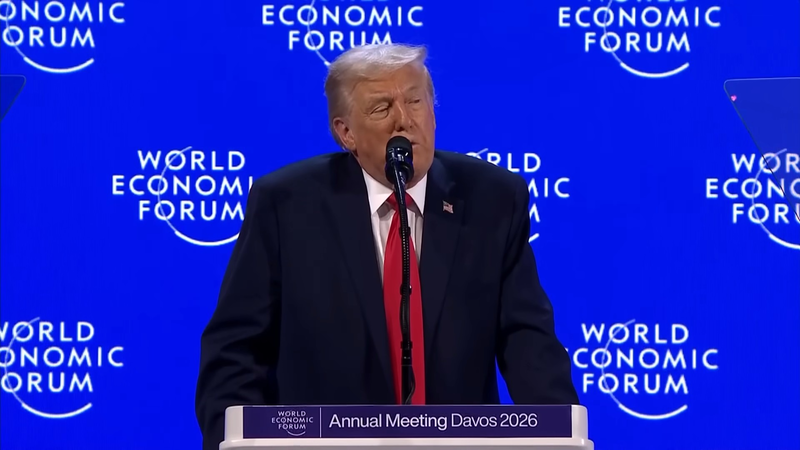
U.S. President Donald Trump has once again underscored the necessity of annexing Greenland, declaring that “only the United States can protect Greenland.” He argued that the objective is not access to rare earth resources but the containment of Russia and China and the reinforcement of international security. In contrast, Trump launched an unvarnished attack on European allies opposing the move, accusing them of lacking both the capacity and the will to uphold security responsibilities. Against this backdrop, Russia and China are closely monitoring the situation, viewing emerging fractures within the Atlantic alliance as a potential strategic opening.
“The United States Defended Greenland in World War II”
On Jan. 21 (local time), speaking at a special session of the World Economic Forum (WEF) Annual Meeting in Davos, Trump stated that “all North Atlantic Treaty Organization (NATO) allies are obligated to defend their own territory, and the only country capable of properly defending Greenland is the United States.” He went on to invoke America’s role during World War II, asserting, “If it were not for the United States, you would all be speaking German or Japanese today,” and adding that “when Denmark was unable to defend Greenland, the United States stepped in to protect it.” He criticized Denmark for what he called a lack of gratitude, remarking that “returning Greenland to Denmark after the war was a foolish decision.”
Addressing the rationale for annexation, Trump said, “Greenland occupies a strategically critical position between Russia and China,” emphasizing that the move is “about international security, not rare earths buried hundreds of feet underground.” He added, “There is only one thing we want from Denmark: to hand over this land so that we can deter dangerous potential adversaries.” Describing Greenland as “essentially a block of ice,” Trump argued that it represents “a very small price compared to what the United States can provide.” He further announced plans to build “the greatest golden dome ever” in Greenland, claiming that “its very existence would help defend Canada.” The “golden dome” refers to the advanced, multi-layered missile defense system proposed by Trump.
Trump also spared no criticism of Europe and NATO. “The United States has protected Europe from Russia and supported it for years, yet received nothing in return,” he said, asserting that “the U.S. bears nearly 100 percent of NATO’s costs.” Addressing European opposition to U.S. control of Greenland, Trump said Europe “is not heading in the right direction,” adding that “if Europe followed the United States, it could improve citizens’ lives and achieve an economic miracle.” He called for immediate negotiations, stating that “ownership of Greenland is necessary to defend it,” while clarifying that he had no intention of using military force, saying, “There is no need to use it, and I do not want to use it.”
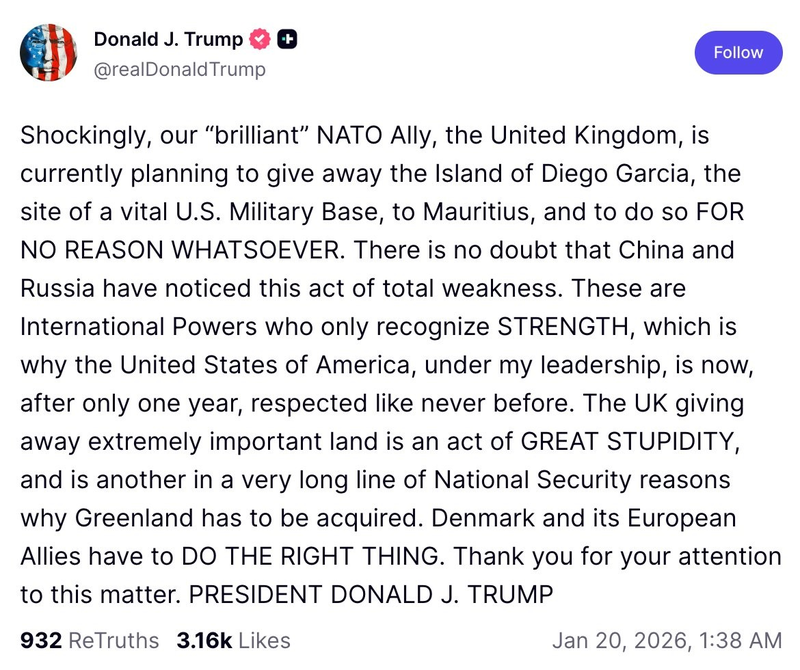
Trump Rejects International Law, Slams Chagos Archipelago Transfer
On the eve of his address, Trump intensified pressure on Europe by posting critical messages aimed at leaders opposing the Greenland annexation. On Jan. 20, he shared on his social media platform Truth Social messages sent by French President Emmanuel Macron and NATO Secretary General Mark Rutte. In the messages, Macron referred to Trump as a “friend” and invited him to a G7 dinner in Paris on Jan. 22, while Rutte praised Trump, saying he would “widely publicize your achievements in Syria, Gaza, and Ukraine.” The disclosures were widely interpreted as an attempt to highlight what Trump portrayed as Europe’s conciliatory, pro-American posture despite outward resistance on the Greenland issue.
The United Kingdom was not spared. Trump criticized Britain’s decision to return the Chagos Archipelago to Mauritius, writing, “Shockingly, a NATO ally, the United Kingdom, is planning to hand over Diego Garcia in the Chagos Archipelago—where a U.S. military base is located—to Mauritius.” He called the move “extremely foolish” and cited it as “one of the many reasons Greenland must be annexed.” The Chagos Archipelago, located in the central Indian Ocean, came under British control in 1814 following the Treaty of Paris after the Napoleonic Wars. Britain separated the islands from Mauritius in 1965 and retained control even after Mauritius gained independence in 1968.
In 1971, the U.K. and the U.S. built a military base on Diego Garcia to counter Soviet influence. CNN has described the base as one of America’s most important and secretive overseas assets, a core hub for bomber operations across Asia and a key staging ground supporting two invasions of Iraq. Mauritius has long claimed sovereignty over the islands and pursued litigation in international courts. In 2019, the International Court of Justice (ICJ), the United Nations’ highest court, ruled that the U.K. must promptly return the Chagos Archipelago to Mauritius. While the ruling was not legally binding, it was followed by a UN General Assembly resolution and sustained international pressure, including statements of support from the African Union.
In May last year, the British government agreed to transfer sovereignty over the Chagos Archipelago to Mauritius while retaining control of the Diego Garcia military base for at least 99 years. Under the agreement, the U.K. will pay Mauritius approximately $128 million annually in lease payments for the base. At the time of negotiations, the British government secured Trump’s support during a White House meeting, and the U.S. State Department stated that Washington “welcomed” the agreement between the U.K. and Mauritius.
CNN characterized Trump’s abrupt reversal as “a clash of worldviews between the leaders of the United States and the United Kingdom,” noting that while Prime Minister Keir Starmer argues the transfer is a legal obligation, Trump has consistently rejected the relevance of international law and does not recognize such constraints. The BBC reported that “the divergence between the two countries may not end here,” suggesting that Britain’s approval of a new Chinese embassy construction could further inflame Trump’s ire.
Greenland Emerges as Polar Front Line in Expanding U.S.-China Rivalry
Meanwhile, Russia has responded with relative composure as it watches tensions rise between long-standing allies. On Jan. 20, Russian Foreign Minister Sergey Lavrov, speaking at a press conference in Moscow reviewing Russia’s diplomatic record for 2025, remarked, “In principle, Greenland was not originally part of Denmark,” calling it “the result of colonial conquest.” He explained that Greenland had first been a Norwegian colony, then a Danish colony, and that it was only in the mid-20th century that an agreement designated it as part of Denmark rather than a colony.
Responding to Trump’s claims that Russia and China pose a threat necessitating Greenland’s annexation, Lavrov said, “Russia has nothing to do with any plan to occupy Greenland,” adding that “the United States surely knows there are no such plans by Russia or China.” He noted that “Western economists and political scientists also refute such claims,” and added that “many Russians did not even know what Greenland was before this issue arose.” He nonetheless described Greenland as “a serious geopolitical matter” and said Russia is “closely watching developments.”
Russia’s official government newspaper Rossiyskaya Gazeta described a hypothetical annexation of Greenland by Trump as “a historic breakthrough comparable to Lincoln’s abolition of slavery,” while criticizing opposition from Denmark, the U.K., and France as “stubbornness that blocks America’s greatness.” As the Kremlin’s official mouthpiece, the paper’s tone suggests that Russia views not Greenland itself but the rift within the U.S.-Europe alliance and NATO as the true strategic prize.
China is also monitoring the situation closely. Wang Yiwei, director of the Institute of International Affairs at Renmin University of China, said, “The U.S. attempt to annex Greenland is a strategy aimed at containing China and Russia,” adding that “while Russia is a historical rival, the long-term target is China.” He argued that U.S. control of Greenland would enable deployment of missile defense systems, undersea fiber-optic cables, and nuclear submarines, and predicted that “the arena of future U.S.-China competition could expand to space and the polar regions.” From China’s perspective, which is pursuing Arctic shipping routes to facilitate trade with Europe, U.S. dominance over Greenland could function like a Panama Canal-style chokepoint, constraining access to critical maritime corridors.
Oliver Griffin is a policy and tech reporter at The Economy, focusing on the intersection of artificial intelligence, government regulation, and macroeconomic strategy. Based in Dublin, Oliver has reported extensively on European Union policy shifts and their ripple effects across global markets. Prior to joining The Economy, he covered technology policy for an international think tank, producing research cited by major institutions, including the OECD and IMF. Oliver studied political economy at Trinity College Dublin and later completed a master’s in data journalism at Columbia University. His reporting blends field interviews with rigorous statistical analysis, offering readers a nuanced understanding of how policy decisions shape industries and everyday lives. Beyond his newsroom work, Oliver contributes op-eds on ethics in AI and has been a guest commentator on BBC World and CNBC Europe.
Similar Post
















