[Greenland Dispute] Trump Seeks Permanent Access to Greenland, Calculus Centered on Military Secrets and Arctic Shipping Routes

Authored On
Modified
Plan for long-term control of Greenland under the banner of the Golden Dome missile defense system
Cold War–era military legacy highlights need to manage classified information buried beneath the ice
Intensifying competition with China and Russia over Arctic routes and resources reaffirms Greenland’s strategic value
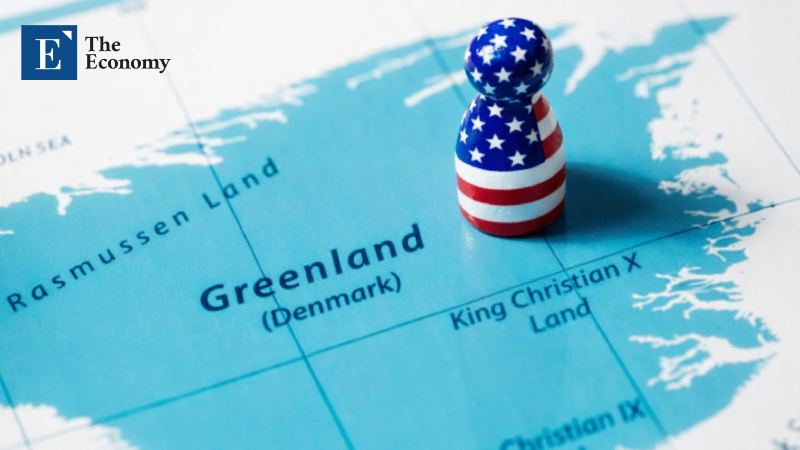
U.S. President Donald Trump has declared that he intends to secure “total access” to Greenland—without time limits and without paying any compensation—placing the next-generation missile defense initiative known as the “Golden Dome” at the forefront of his strategy. He framed the move as a national security imperative aimed at countering threats from China and Russia. Given the extensive military activities the United States has conducted in Greenland since World War II, analysts see an underlying motive to reassert control over access to sensitive military data and strategic assets still embedded in the ice sheet and seabed. Combined with Greenland’s geopolitical importance as a key Arctic shipping hub and its renewed strategic relevance amid climate change, Washington increasingly appears to view the territory as a place it must “reclaim.”
Trump “We Will Have All Military Access Without Paying Anything”
On the 22nd (local time), President Trump said in an interview with Fox Business that the United States was negotiating details with Europe to secure “total access” to Greenland “without paying anything,” adding that there would be “no time limits—whether 99 years or 10 years.” The remarks were widely interpreted as signaling that U.S. access rights to Greenland would be permanent. When asked what compensation Washington would provide in return, Trump replied, “Nothing,” adding, “We will have all the military access we want and place whatever we need there.”
Trump has long argued that Greenland is essential for responding to external threats from China and Russia. Reiterating that stance, he said, “If hostile forces launch attacks, they will come over Greenland,” stressing that the issue is “directly tied to international security.” He added that the United States would not need to pay for anything beyond constructing the Golden Dome missile defense system, describing it as “100 times the scale of Israel’s Iron Dome and entirely built in the United States.” Trump also noted that former President Ronald Reagan had envisioned a similar concept, but lacked the necessary technology at the time.
The United States has made repeated efforts over decades to leverage Greenland as a strategic stronghold. In 1941, after Denmark was occupied by Nazi Germany, Washington concluded a defense agreement with Denmark and Greenland, securing rights to build airstrips. This laid the groundwork for expanding U.S. military footholds across the island. Between 1951 and 1953, the U.S. constructed Thule Air Base on Greenland’s northwestern coast, using it to monitor Soviet nuclear threats and as a bomber operations hub. At its peak, some 10,000 U.S. troops were stationed there; today the facility operates as Pituffik Space Base.
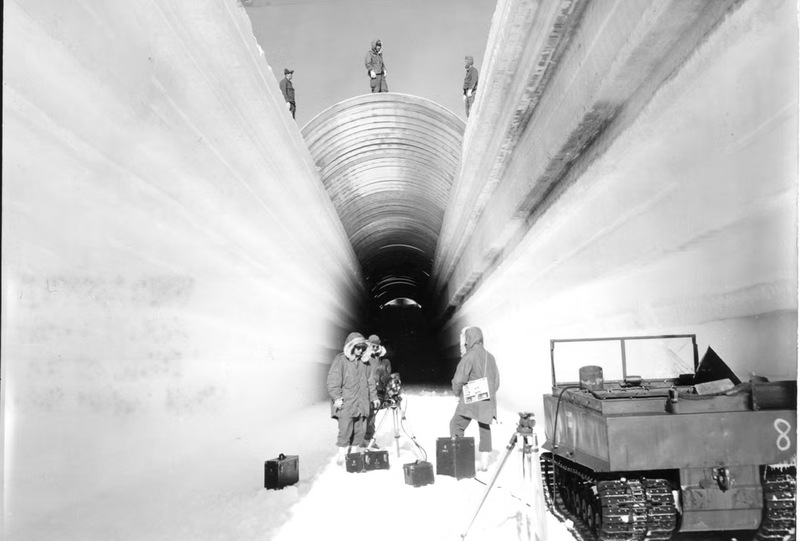
The United States also pursued the construction of secret bases beneath the ice. In 1959, Camp Century was publicly introduced as a scientific research station, but its true purpose was to advance “Project Iceworm,” a plan to connect 3,000 kilometers of tunnels under the Greenland ice sheet and deploy up to 600 nuclear missiles aimed at deterring the Soviet Union. Although construction proceeded covertly in extreme conditions, the project soon encountered insurmountable obstacles as shifting ice deformed tunnel structures and heightened the risk of collapse. The United States ultimately withdrew from Camp Century in 1967 and formally abandoned the missile deployment plan.
Camp Century Beneath the Ice May Reemerge as Warming Accelerates
Given its longstanding reputation as a strategic linchpin, U.S. interest in acquiring or annexing Greenland is not new. President Andrew Johnson floated the idea in 1867, and President Harry Truman made a similar proposal in 1946, both of which were rejected. Trump himself expressed interest during his first term in 2019. At the time, Danish Prime Minister Mette Frederiksen dismissed the proposal, stating that “Greenland is not for sale and does not belong to Denmark.” In response, Trump canceled a planned visit to Denmark, writing on Twitter (now X) that Frederiksen appeared uninterested in a Greenland deal.
Washington’s push to strengthen access to Greenland is closely tied to its past military activities there, many of which left behind sensitive remnants. One prominent example is the 1968 crash of a U.S. Air Force B-52 strategic bomber in northwestern Greenland. Of the four hydrogen bombs onboard, one was never recovered. Despite extensive search operations, the weapon is believed to remain somewhere beneath the ice or seabed, with its precise location still unknown. The incident caused radioactive contamination in the surrounding area and sparked prolonged controversy within Danish and Greenlandic society.
More recently, climate warming has raised the possibility that Camp Century could resurface as thinning ice exposes long-buried structures. Some observers warn that abandoned military installations beneath the ice could become a “Pandora’s box.” Camp Century functioned as a fully equipped underground base, complete with a library, gymnasium, dining hall, and post office, housing roughly 200 personnel and powered by a small nuclear reactor. Researchers at York University in Canada have warned that melting ice could release contaminants left behind at the site. According to their analysis, the contaminated area spans approximately 550,000 square meters—equivalent to 77 soccer fields—and after 2090, ice melt is projected to exceed snowfall, accelerating glacier retreat.
Rare Earth Reserves Estimated at 1.5 Million Tons, but Harsh Conditions Limit Extraction
Global warming has further elevated Greenland’s geopolitical value by opening Arctic shipping routes as sea ice recedes. Transporting cargo from Busan to Rotterdam via the Arctic route can shorten the journey by about 7,000 kilometers and reduce transit time by roughly 10 days compared with routes through the Malacca Strait and the Suez Canal. As ice coverage has diminished, Arctic maritime traffic has surged. Cargo volumes transported along Russia’s Arctic coastline reached a record 37.9 million tons in 2024. China, in particular, has sought to integrate Arctic routes into its Belt and Road Initiative, intensifying efforts to expand its influence in the region.
Greenland’s vast natural resources further underpin U.S. interest. According to the U.S. Geological Survey, the island is estimated to hold roughly 13% of the world’s undiscovered oil reserves and 30% of its natural gas reserves. It is also rich in non-ferrous metals such as gold, lead, zinc, and uranium, as well as rare earth elements essential for semiconductors, smartphones, and other advanced technologies. Greenland’s rare earth reserves are estimated at approximately 1.5 million tons, ranking eighth globally. Analysts see the Trump administration’s renewed focus on Greenland as closely tied to these resources, particularly amid China’s tightening controls on rare earth exports.
Even so, experts broadly agree that actual extraction would remain extremely challenging, even under U.S. control. Most major mineral deposits lie near the edge of the Arctic Circle, beneath an ice sheet roughly 1.6 kilometers thick and in regions that endure prolonged darkness and extreme conditions. These factors drive up costs and undermine commercial viability. CNN noted that “Denmark’s ownership of Greenland is not the main obstacle to U.S. resource development,” arguing that “the real barrier is the harsh Arctic environment.”
Some contend that climate change could gradually improve mining conditions, but CNN remains skeptical. While melting ice has opened limited sea routes, it has also destabilized terrain, complicating drilling operations and increasing landslide risks. Economic feasibility remains contested. Canadian mining company Amaroq has argued that improved conditions could enable extraction of gold, copper, and germanium, and is reportedly in direct investment talks with U.S. counterparts. Others counter that the technical difficulty and enormous upfront capital requirements make large-scale commercialization unlikely.
Similar Post