Latin America Becomes a Battleground in the Global Mineral Race, as U.S.–China Supply Chain Rivalry Intensifies

As one of the youngest members of the team, Tyler Hansbrough is a rising star in financial journalism. His fresh perspective and analytical approach bring a modern edge to business reporting. Whether he’s covering stock market trends or dissecting corporate earnings, his sharp insights resonate with the new generation of investors.
Authored On
Modified
Latin America Emerges as a Strategic Hub for Critical Minerals, Drawing a Surge in Global Mining Investment
China Moves Aggressively, While the U.S. and EU Step Up Supply Chain Cooperation
Global Competition for Resources Intensifies, with U.S.–China Rivalry in South America Set to Deepen
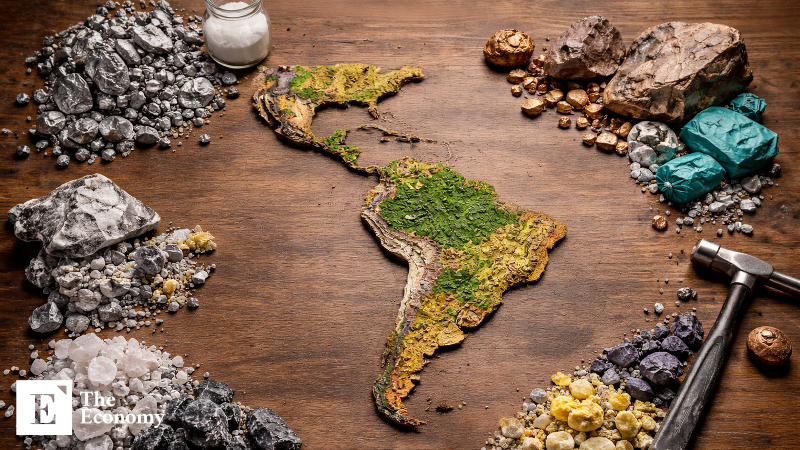
Latin America is drawing in global mining investment at a rapid pace. As the global push toward clean energy and the explosive growth of the electric vehicle market drive a sharp rise in demand for critical minerals, South America—home to vast mineral reserves—has emerged as a strategic hub. In response, major powers including China and the United States are locked in intensifying competition to secure resources across the region.
Mining Investment Flows Into Latin America
According to the “Future Minerals Barometer 2025” report released on the 24th (local time) by McKinsey & Company and the Future Minerals Forum (FMF), as much as 74% ($22.2 billion) of global mining-sector M&A investment totaling $30 billion in the first three quarters of 2025 was concentrated in Latin America. Mining investors are increasingly turning their attention to the region, opting for Latin America over Africa or Central Asia, where geopolitical risks are higher.
Latin America holds vast reserves of a wide range of critical minerals, including lithium. The so-called “Lithium Triangle” spanning Argentina, Chile, and Bolivia accounts for roughly 68% of global lithium reserves and produces 46% of the world’s copper. Brazil ranks second globally in graphite reserves and is also rich in key battery minerals such as nickel, manganese, and lithium. Mexico, which boasts the world’s tenth-largest lithium reserves, is a major supplier of zinc, molybdenum, graphite, silver, sulfur, arsenic, cadmium, antimony, lead, and barite. Colombia produces large quantities of gold, silver, platinum, mercury, coal, oil, bauxite, nickel, molybdenum, and uranium.
These countries are accelerating efforts to build regional supply chains for critical minerals. Last month, Inter-American Development Bank (IDB) President Ilan Goldfajn, who oversees development finance for Central and South America, told the Financial Times that Latin American countries are moving away from exporting minerals to Asia in raw form and instead pursuing domestic smelting and processing. He noted that this approach aligns with the strategy of the Donald Trump administration, which is seeking to secure mineral supply sources closer to home.
Strategies by Major Powers to Secure Resources
Countries around the world are taking note of Latin America’s potential. China, in particular, invested more than $16 billion in South American lithium projects between 2018 and 2024, and the scale of that push has become especially pronounced in recent years. Data from the American Enterprise Institute’s (AEI) China Global Investment Tracker show that since 2020, China’s foreign direct investment (FDI) in Latin America has surged by roughly fourfold.
In August last year, Ganfeng Lithium, China’s largest lithium producer, signed a deal to integrate Lithium Argentina, headquartered in Switzerland, with three salt-flat projects in Argentina. The sites include the Pozuelos, Pastos Grandes, and Sal de la Puna salt flats in Salta Province. The two sides plan to produce 150,000 tons of lithium carbonate annually by extracting it from brine. The companies already operate the Cauchari-Olaroz mine in Jujuy Province in northwestern Argentina with a local mining firm, and the renewed partnership reflects a fresh push to secure additional output.
Western countries are also accelerating efforts to build cooperation with Latin America. The EU has teamed up with the IDB to launch a roughly $140 million initiative to develop critical-mineral value chains. The core goal is to help Latin American countries move beyond simply mining ore and exporting it to Asia and elsewhere, and instead build their own refining and processing capabilities. The United States, meanwhile, is pursuing a partnership with Brazil to reduce its dependence on China for rare earths. According to the Financial Times, officials from both countries have already held preliminary talks, and the Brazilian government is also showing an active stance in negotiations over critical minerals.
U.S.–China Political Tensions Rise Over South America
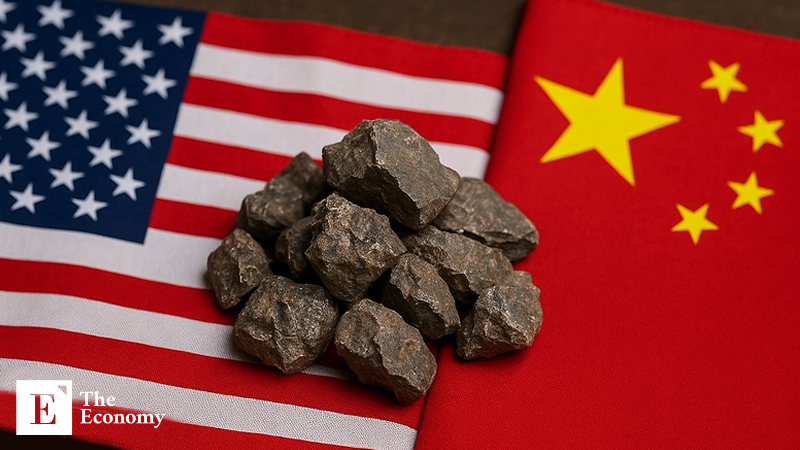
Experts warn that intensifying competition for resources could further deepen political confrontation between the United States and China over Latin America. Over the past several years, U.S. influence in the region has waned, while China’s footprint has expanded significantly. In this context, John Borden, a professor at Oregon State University, wrote in a May article last year for the Italy-based nonprofit Other News that “South America is diversifying its trade away from a protectionist United States, a shift that began through mutually beneficial trade relations with China,” adding that “the region is steadily moving away from a U.S.-centered order toward multipolarity.”
Against this backdrop, the Donald Trump administration last month unveiled a new National Security Strategy (NSS) with a strong isolationist tilt that places priority on the Americas. The document states that restoring U.S. “strategic primacy and influence” across the Western Hemisphere—including North, Central, and South America—is a top objective. The move is widely seen as a reinterpretation of the 19th-century Monroe Doctrine and a clear signal of Washington’s determination to block the entry of rival powers from outside the region. First articulated by former President James Monroe in 1823, the doctrine declared the Americas a U.S. sphere of influence and warned European powers against intervening in Latin America.
China responded swiftly to Washington’s posture by advancing its vision of building a “community with a shared future” with Latin America. In a recent policy paper on Latin America and the Caribbean—its first in nine years—Beijing stated that “China breathes together and shares a common destiny with the Global South, including Latin America,” stressing that China–Latin America relations “are not aimed at or constrained by any third party.” The message amounted to a direct pushback against U.S. pressure under its isolationist approach.
The Center for Strategic and International Studies (CSIS) interprets China’s policy vision as signaling an ambition to position itself as an alternative power to the United States in Latin America. According to CSIS, China’s ultimate goal is to become the dominant force in the region, surpassing U.S. influence. In practice, Beijing has steadily expanded its political clout by financing infrastructure projects across Latin America, most notably through the Belt and Road Initiative, which aims to link trade routes across land and sea to Europe. As of 2017, no Latin American country had joined the initiative; today, 24 countries in the region are participants.
As one of the youngest members of the team, Tyler Hansbrough is a rising star in financial journalism. His fresh perspective and analytical approach bring a modern edge to business reporting. Whether he’s covering stock market trends or dissecting corporate earnings, his sharp insights resonate with the new generation of investors.
Similar Post
















