China Sets Export Records Despite U.S. Tariff Walls, Global Trade Chooses Survival Over Efficiency

Anne-Marie Nicholson is a fearless reporter covering international markets and global economic shifts. With a background in international relations, she provides a nuanced perspective on trade policies, foreign investments, and macroeconomic developments. Quick-witted and always on the move, she delivers hard-hitting stories that connect the dots in an ever-changing global economy.
Authored On
Modified
Reduced Reliance on the U.S. Through Market Diversification
Regulatory Evasion via Third-Country Routes, Strengthened Global South Alignment
Global Trade Prioritizes Stability Over Efficiency
Structural Reconfiguration of Supply Chains Amid U.S.–China Tensions
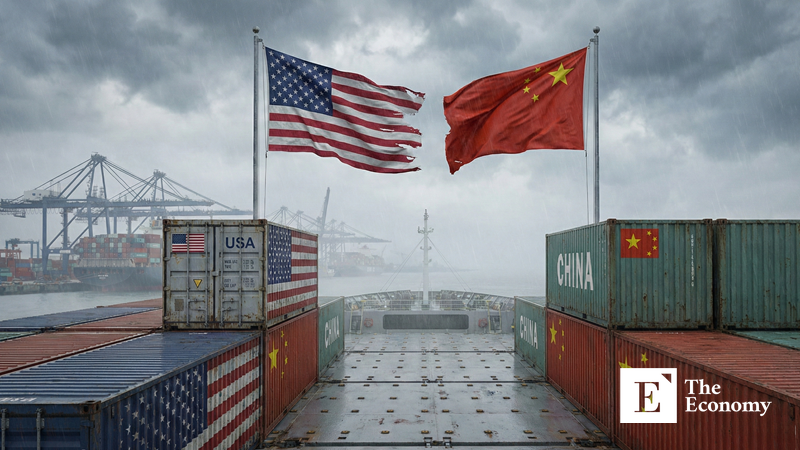
Despite Washington’s steep tariff barriers, China’s march toward new export records shows no sign of slowing. Leveraging third-country transit routes and tariff-free access to developing markets, Beijing has deftly navigated around U.S. protectionist constraints. In response, global corporations are abandoning efficiency-driven just-in-time (JIT) production models in favor of just-in-case (JIC) strategies that prioritize resilience and continuity, even at higher cost.
China Breaks Through Tariff Barriers to Set Export Records, Redrawing Supply Chains Without the U.S.
According to major international media outlets including Reuters on the 25th (local time), data released by China’s General Administration of Customs show that the country’s exports, imports, and trade surplus all reached record highs last year. Annual exports totaled approximately $3.78 trillion, while imports stood at about $2.59 trillion, bringing total trade volume to roughly $6.37 trillion, up 3.8% year-on-year. The trade surplus surged to an all-time high of around $1.23 trillion, underpinning the headline performance.
Wang Jun, Vice Minister of the General Administration of Customs, said that “amid rapid shifts in the global environment and mounting risks to the international trade order, China’s economy has withstood pressure and achieved new progress in innovation and openness.” The figures underscore the durability of China’s manufacturing competitiveness despite Washington’s aggressive tariffs and attempts to exclude China from key supply chains. The resulting expansion in net exports is widely seen as a critical support pillar that helped annual GDP growth, which had slowed in the first three quarters, converge toward the official target of around 5%.
Beneath the headline numbers, however, a profound transformation in China’s export geography is taking shape. Exports to the United States fell by roughly 20% year-on-year as tariff pressures took hold, but emerging markets rapidly filled the gap. Trade with the Association of Southeast Asian Nations rose by 8%, while shipments to Latin America increased 6.5% and exports to Africa surged 18.4%, signaling that market diversification aimed at reducing U.S. dependence is gaining traction. Trade with countries participating in the Belt and Road Initiative reached approximately $3.30 trillion, accounting for 51.9% of China’s total trade volume. Rather than suppressing overall export volumes, U.S. tariff barriers appear to have accelerated a shift away from a U.S.-centric model toward a multipolar export structure.
Alongside market diversification, China is accelerating qualitative upgrading of its export mix and reconfiguring logistics infrastructure. Exports of high-tech products rose 13.2% year-on-year to about $0.73 trillion, led by high value-added items such as wind power equipment, which jumped 48.7%, and lithium-ion batteries, up 26.2%. Logistics routes are also being reshaped. China is moving to secure independent shipping corridors that bypass the U.S., including new direct routes to South America. In April last year, Guangzhou Port, the largest maritime hub in southern China, launched a direct shipping line to Peru’s Chancay Port, cutting transit times to around 30 days and reducing logistics costs by roughly 20%. This reflects not merely tactical rerouting but a fundamental redesign of trade and logistics networks to structurally reduce U.S. exposure.
U.S. High Tariffs vs. China’s Zero-Tariff Strategy, Acceleration of Third-Country Routing
Behind China’s record export volumes lies a structural reconfiguration of export routes driven by its response to U.S. tariffs. While market diversification has fueled headline growth, the U.S. is increasingly experiencing the impact in the form of third-country transshipment. The South China Morning Post reported on the 24th that although tariff shocks peaked in 2025, corporate adaptation through rerouting and transshipment is expected to ease uncertainty somewhat in 2026. Although China’s exports to the U.S. fell by about 20% last year following a sharp rise in effective tariff rates, analysts caution against interpreting this as full decoupling. The Brookings Institution has highlighted the rerouting of supply chains through Mexico and Vietnam, while Goldman Sachs estimates that trade worth tens of billions of dollars is now flowing through third countries. The parallel rise in China’s exports to Mexico and Mexico’s exports to the U.S. suggests that such routes are becoming permanent trade channels rather than temporary workarounds.
The sourcing realities of U.S. retailers further entrench this dependence on indirect routes. Companies such as Walmart and Amazon still source 40–60% of general merchandise from China, with dependence reaching 70% for toys and 60% for lithium batteries. While some retailers, including KÜHL and Target, have shifted assembly operations to India or Vietnam, industry insiders note that core materials and key components remain overwhelmingly Chinese, underscoring the structural limits of full supply-chain separation. The Financial Times has reported that Chinese goods transshipped through Vietnam and Malaysia have become entrenched logistics pathways despite tighter U.S. enforcement. Even if tariffs were eventually rolled back, a return to pre-tariff direct export structures appears unlikely, implying a lasting increase in global trade costs.
As the U.S. raises tariff walls, China is responding with the opposite approach: an expansive zero-tariff strategy. Citing data from the Economist Intelligence Unit, the SCMP reported that the U.S. effective tariff rate climbed to 11.2% in 2025, the highest since 1943, while China’s average effective tariff rate fell to about 1.3%. Beijing has granted zero-tariff access on all imports from 43 least-developed countries with which it maintains diplomatic relations, including numerous African nations, reinforcing ties with the Global South. This approach not only diversifies export destinations and secures resource access but also projects an image of openness that Beijing is leveraging strategically. Chen Zhiwu, Chair Professor of Finance at the University of Hong Kong, argues that China’s low- and zero-tariff policies contrast sharply with U.S. protectionism, strengthening China’s diplomatic positioning.

Survival Over Efficiency, Fragmentation and Self-Preservation in Global Trade
As new trade routes combining transshipment and zero-tariff access become structurally embedded, companies are fundamentally rethinking supply-chain design. The interaction of U.S. tariff escalation and China’s countermeasures has created a dense web of variables—tariffs, rules of origin, subsidies—that is pushing corporate strategy away from efficiency optimization toward survival. Industry analyses indicate that cost-driven supply chains once optimized for labor arbitrage and logistics efficiency are being replaced by policy-adaptive designs that prioritize tariff avoidance and regulatory compliance. Supply-chain management has evolved from a price-optimization exercise into a sophisticated portfolio strategy that simultaneously navigates trade rules and geopolitical risk.
These macro-level shifts are reshaping firm-level operations, particularly inventory management. Analysts note that the efficiency-focused JIT model that dominated global manufacturing for decades is giving way to JIC approaches, with companies holding larger inventories as insurance against disruption. This trend is especially pronounced in pharmaceuticals and biotechnology, where firms are preemptively stockpiling critical inputs ahead of potential tariff hikes. European companies, facing uncertainty over operations in China and tightening export controls, are likewise diversifying sources for irreplaceable components to mitigate risk.
At the macro level, these micro-level adjustments are contributing to fragmentation of global trade and slower growth. The International Monetary Fund and the World Trade Organization have repeatedly warned that rising trade barriers are accelerating economic bloc formation. Global supply chains are increasingly splitting into a U.S.-centered Western bloc, a China-centered Eastern bloc, and a third group pursuing independent paths, structurally driving up trade costs. For China, export diversification has become a matter of survival; for Western firms, supply-chain risk dispersion is now paramount. The global economy appears to have closed the chapter on an era defined by cost minimization and efficiency, entering instead a phase in which stability is secured only by accepting higher costs in a world of fragmented, self-preserving trade.
Anne-Marie Nicholson is a fearless reporter covering international markets and global economic shifts. With a background in international relations, she provides a nuanced perspective on trade policies, foreign investments, and macroeconomic developments. Quick-witted and always on the move, she delivers hard-hitting stories that connect the dots in an ever-changing global economy.
Similar Post