From Educational Game Character to Far-Right Meme, the Path of Britain’s ‘Amelia’ Going Viral

Authored On
Modified
From public campaign character to political meme
Immigration and public safety fuel a “collective outburst” in Britain
Rising support for nationalist parties across Europe
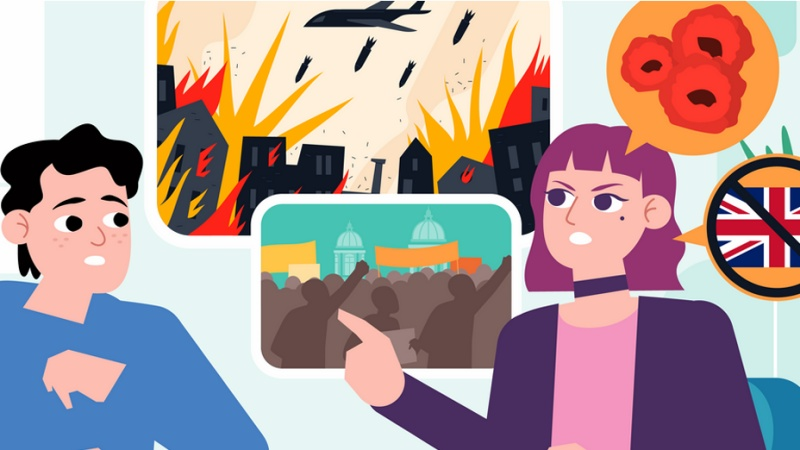
A character named “Amelia,” originally created for a government-backed counter-extremism educational game in the United Kingdom, has been repurposed into an online meme promoting anti-government and anti-immigration messages, spreading rapidly across digital platforms. Memes—online cultural formats in which images, short videos, or phrases are repeatedly modified and reproduced to convey specific messages or sentiments—now frequently depict Amelia as an image voicing loyalty to Britain while expressing suspicion toward immigrants.
Stoking anti-immigration and anti-Islam sentiment
According to the The Guardian on the 26th (local time), memes featuring “Amelia,” an AI-generated female character, have been spreading rapidly across online communities and social media in the UK and other Western countries. Depicted with short purple hair, Amelia is shown walking the streets of London while proclaiming affection for her country or warning about the perceived dangers posed by armed Islamist groups and migrants from the developing world. On X (formerly Twitter), some posts portray scenes in which she is reprimanded by a man in Islamic attire for eating pork sausages, repeatedly invoking overt anti-immigration and anti-Islam narratives.
Rather than foregrounding explicit political slogans, these memes adopt the form of character-based consumption, broadening their reach. Their spread has been facilitated by the flexibility inherent in AI-generated content, which allows images, dialogue, and backgrounds to be altered at low cost and with ease. National flags or tourist landmarks recur without being bound to a fixed storyline. The Guardian noted that Amelia memes are “increasingly appearing in the feeds of ordinary users rather than remaining confined to overtly political accounts,” adding that while the political message remains intact, its fusion with entertainment has increased exposure without resistance.
The character’s origin is paradoxical. Amelia was initially designed as a central figure in “Pathways,” a counter-extremism and media literacy game funded by the UK Home Office. Aimed at teenagers aged 13 to 18, the game is set in a university environment and presents players with choices such as whether to engage with potentially extremist content or participate in small political rallies protesting what is described as the erosion of “British values.” Some scenarios are structured to trigger follow-up measures under the government’s counterterrorism programs. Within the game, Amelia functions as a warning signal intended to discourage alignment with extremist views.
That role was quickly inverted as the character intersected with platform dynamics. According to analysis by Periton Intelligence, an online monitoring and intelligence firm, a post uploaded by an anonymous X account on the 9th served as the inflection point, drawing more than 1.4 million views. Posts referencing Amelia, which had averaged around 500 per day, surged to roughly 10,000 as international users joined in around the 15th, with 11,137 new posts recorded on X alone on the 21st. Cryptocurrency tokens even emerged in the process. While the game’s developer criticized the trend as the “monetization of hate,” the transformation of a public education campaign character into a political symbol within the meme economy has continued unabated.
Anger and distrust toward the left reach a breaking point
The spread of the Amelia meme is widely read as the migration of conservative and right-wing anxieties—linking immigration to deteriorating public safety—into online culture. Recurrent scenes pair declarations of love for Britain with direct references to immigration and Islam, condensing claims that migration undermines everyday security and weakens national identity. Though packaged as character-based content, the direction of the message aligns with narratives long cultivated within right-wing discourse.
Anti-immigration sentiment in the UK has also manifested in offline political action. In September last year, large-scale demonstrations erupted in central London following anti-immigration rallies, with police estimating that attendance at an event organized by far-right groups could reach as many as 110,000 participants. Counter-demonstrations under the banner “March Against Fascism” drew more than 5,000 people. At the time, the UK was preparing to implement a “One in, One out” agreement with France, under which irregular migrants crossing the English Channel in small boats would be returned to France in exchange for allowing an equal number of asylum seekers to enter the UK.
Protesters framed the policy as emblematic of unchecked migration, waving white flags bearing England’s red cross and Union Jacks while chanting slogans such as “Take our Britain back” and “Stop the boats.” The demonstrations were led by far-right activist Tommy Robinson, whose supporters clashed violently with police. About 1,000 officers were deployed, and nine protesters were arrested on site. Anti-immigration rhetoric continued thereafter, with repeated references to public safety incidents used to inflame opinion.
International coordination and platform influence were also evident. Far-right politicians from France, Germany, and Denmark appeared on rally stages to express solidarity, with a representative from Germany’s Alternative for Germany (AfD) declaring, “Your fight is our fight.” In the online sphere, X owner Elon Musk criticized Britain’s immigration policies, saying the country was “collapsing because of such policies” and that accepting migrants inevitably leads to national decline. His remarks served as a catalyst linking offline protests with online discourse.
Seen in this context, the Amelia meme functions as a surface symbol of deeper social tensions. While it does not itself organize rallies or change policy, analysts view it as a chosen medium through which anger and distrust toward political institutions are translated into the language of popular culture. Institutional debates over government policy, judicial decisions, and international agreements are compressed into character images and short videos that gain speed through shareability, signaling that anti-immigration discourse in the UK has expanded beyond politics into the cultural sphere.
Voters gravitate toward “hardline public order” pledges
Heightened concern over immigration and public safety has translated into tangible political support. In a survey conducted late last year by polling firm Focaldata, Reform UK recorded a 25% approval rating, surpassing the Labour Party at 24% and the Conservative Party at 21%—the first time it had topped a single poll. The figure marks a steep rise from the party’s 14.3% share of the vote in the previous general election. Focaldata projected that Reform UK could capture around 60 seats from Labour in the next election, potentially securing up to 76 seats, noting that its emphasis on hardline public safety pledges has been drawing support particularly from male and working-class voters.
Some observers attribute the surge in part to external interventions, pointing to Musk’s public criticism of Prime Minister Keir Starmer and suggestions of interference in domestic affairs as factors that amplified the profile of Reform UK leader Nigel Farage. Within the UK, however, the prevailing view is that the trend poses a greater threat to the traditional center-right Conservative Party than to the governing Labour Party, as disaffected voters may bypass established conservatism in favor of more radical alternatives.
Comparable dynamics are visible across Europe. Germany’s AfD secured 20.8% of the vote in federal elections last February to become the second-largest party, and polls conducted in December showed its support rising to 26%, ahead of the CDU–CSU alliance at 24%. In France, the National Rally (RN) continues to lead with support exceeding 30%, while in Italy, Giorgia Meloni’s Brothers of Italy (FdI) won 26% of the vote in the 2022 general election and formed a government. Across these countries, rising refugee inflows, economic slowdown, inflation, and distrust of established parties have converged to elevate political forces offering uncompromising solutions as perceived alternatives.
Similar Post