“A Foreign Exchange Market Moving to Trump’s Script” — Dollar Slides to Four-Year Low, Eroding Its Trust Premium

Authored On
Modified
Trump policy uncertainty and rate-cut expectations accelerate dollar weakness
U.S.–Japan intervention speculation rattles the “policy trust premium”
Trump openly embraces a weaker dollar to boost U.S. exports
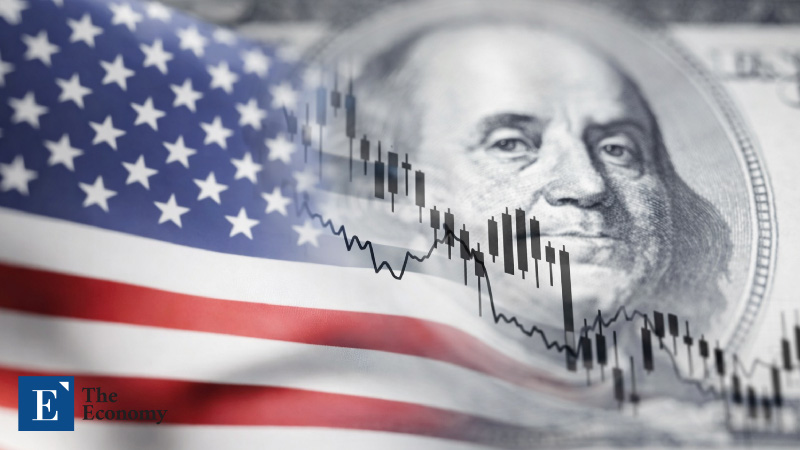
The U.S. dollar has plunged to its lowest level in four years against major currencies. Remarks by President Donald Trump signaling tolerance for a weaker dollar, mounting speculation over coordinated intervention by U.S. and Japanese authorities in foreign exchange markets, and heightened trader caution ahead of this week’s interest-rate decision have combined to drag down the dollar’s value. The weakening trend aligns with the Trump administration’s long-articulated strategic orientation, underpinned by a policy calculus aimed at easing the federal government’s massive interest burden on its debt.
Greenland dispute, Federal Reserve uncertainty, and U.S.–Japan intervention speculation weigh
On the 27th (local time), the dollar index—measuring the greenback against a basket of six major currencies—fell to around 95.55 in New York trading, marking its lowest level since February 2022. The three-day decline was the steepest since early April last year, when U.S. stocks, bonds, and the dollar sold off sharply after President Trump abruptly unveiled sweeping tariffs on what he dubbed “Liberation Day.”
The dollar has faced sustained downward pressure since the start of the year. Tensions between the United States and Europe over Greenland, along with the Trump administration’s pressure on the Federal Reserve, have continued to sap demand for the currency. Additional headwinds include fears of a U.S. government shutdown tied to unrest in Minnesota, questions over central bank independence, uncertainty surrounding the appointment of a successor to Federal Reserve Chair Jerome Powell, and pending Supreme Court rulings on the administration’s tariff policies—all of which have dulled the dollar’s appeal.
Speculation over coordinated U.S.–Japan intervention has further accelerated the decline. On the 23rd, the Federal Reserve Bank of New York contacted major foreign exchange trading desks in coordination with the U.S. Treasury, a move widely interpreted as a “rate check,” typically a precursor to direct market intervention. Following the outreach, the yen surged sharply, briefly rebounding by nearly 3%, to around $0.0065 per yen. Although the Japanese currency remains roughly 13% weaker against the dollar over the past year, markets interpreted the move as a signal that U.S. authorities are unwilling to tolerate further yen depreciation. Lefteris Farmakis, an FX strategist at Barclays, said, “Intervention speculation is amplifying the downward momentum by signaling that the administration may tolerate a weaker dollar to bolster export competitiveness.”
Trump “Let the dollar find a fair level”
Above all, President Trump’s own remarks have been the dominant driver behind the dollar’s fall to a four-year low. Speaking at an event in Iowa on the morning of the 27th, Trump dismissed concerns about the dollar’s recent decline, saying, “No, I think it’s good.” He added, “Look at the dollar. Look at the business we’re doing. The dollar is doing very well,” before stating that he wants to “let the dollar find its own level—that’s fair,” signaling no intention to defend the currency artificially. Following his comments, the dollar recorded its largest single-day drop of the year, with the Bloomberg Dollar Spot Index sliding as much as 1.2% intraday.
Since Trump’s inauguration, abrupt shifts in trade and foreign policy, rhetoric undermining the Federal Reserve’s independence, and expanded fiscal spending have driven the dollar down more than 9% on a year-to-date basis, its worst annual performance since 2017. The greenback has continued to weaken markedly against major currencies, including the euro, the pound, and the Swiss franc. Seema Shah, global strategist at Principal Asset Management, noted, “It’s hard to view this simply as a ‘Sell America’ trade,” but added that “factors unfavorable to the dollar are converging in one direction faster than expected.”
The monetary policy backdrop has also turned unfavorable. Markets expect the Federal Reserve to cut rates at least twice this year, while the European Central Bank and the Bank of England are signaling rate pauses and even leaving the door open to further tightening. This dynamic redirects global capital toward relatively higher-yielding regions, diminishing the attractiveness of holding dollars. Narrowing interest-rate differentials are exerting structural pressure by weakening incentives to maintain dollar-denominated assets.
Compounding the pressure is uncertainty surrounding Federal Reserve leadership. With Chair Powell’s term set to expire in May, online betting markets have recently priced a roughly 50% probability that Rick Rieder, Chief Investment Officer of Global Fixed Income at BlackRock, could become the next Fed chair. Rieder is widely viewed as favoring a relatively accommodative policy stance aligned with Trump’s preferences. Chris Turner, Global Head of Markets at ING, said, “Uncertainty around the Fed appointment itself is acting as another catalyst for dollar weakness.”
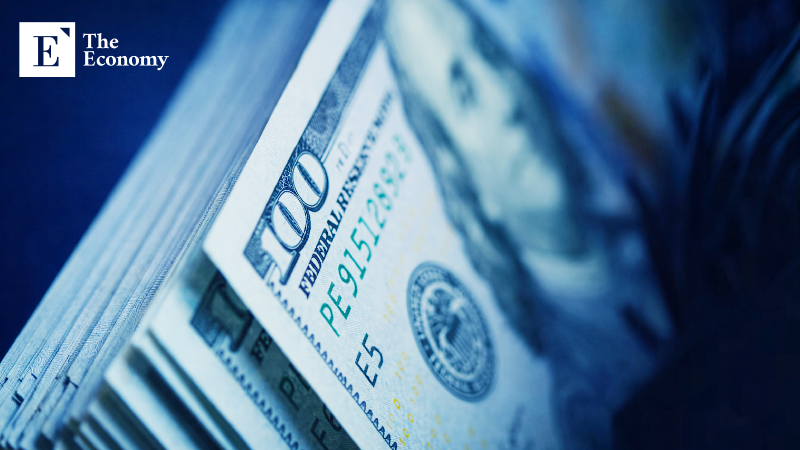
Weaker dollar as a lever for manufacturing revival and debt relief
The dollar’s slide reflects a stance Trump has consistently maintained since taking office: alleviating dollar strength to revive U.S. manufacturing while preserving the nation’s status as the issuer of the world’s reserve currency. Trump’s preference for a weaker dollar is closely tied to the federal debt burden. As of early this year, U.S. federal government debt exceeds $38.5 trillion. What matters, however, is not the nominal figure but the real repayment burden. When the dollar depreciates, the real value of the debt declines; a 10% drop in the dollar reduces the effective burden of servicing a given amount of debt. This debt-deflation effect, achieved through currency depreciation, functions as a monetary lever particularly potent during periods of high interest rates and inflation.
Trump is convinced that restoring U.S. manufacturing requires simultaneous reduction of fiscal deficits and a weaker dollar. He and his economic advisers have long argued that persistent dollar strength accelerated the hollowing-out of U.S. industry. In their view, the dollar became overvalued as the United States expanded liquidity to sustain its reserve-currency role, flooding the domestic market with foreign goods. By allowing the dollar to depreciate, the administration aims to enhance export competitiveness, boost overseas sales, and narrow the trade deficit—an argument rooted in the belief that America’s twin deficits are a byproduct of structural dollar overvaluation.
The risk lies in the backlash from engineering sustained dollar weakness. The dollar’s reserve-currency status depends on robust global demand for dollar assets and U.S. Treasuries. Prolonged depreciation risks triggering the Triffin Dilemma, in which persistent current-account deficits undermine confidence in the reserve currency itself. A sustained erosion of value could accelerate global investors’ retreat from dollar assets, weakening the foundational trust that underpins the dollar’s hegemonic role.
Warnings are mounting that Trump’s dollar strategy could tip the economy toward a hard landing rather than a soft one. Geopolitical uncertainty is approaching overload. Trump’s push to annex Greenland and the resulting confrontations with NATO and the European Union have injected unprecedented uncertainty into markets. He has also threatened to impose a 100% tariff on Canada should it conclude a trade agreement with China. Last week’s surge in the 10-year U.S. Treasury yield toward 4.3% is increasingly viewed not as a reflection of economic data, but as a market response to fears over Washington’s confrontational stance toward allies.
Domestic fractures are deepening as well. In Minneapolis, the deaths of two U.S. citizens at the hands of federal agents within a three-week span have raised the risk of nationwide protests. The opposition Democratic Party has floated blocking budget legislation and even triggering a government shutdown in response. Together, these dynamics are casting doubt on the stability of the U.S. system itself—the ultimate pillar supporting dollar dominance.
Similar Post