OpenAI, Epicenter of the ‘AI Upheaval,’ Also Scales Back Hiring as AI Rewrites the Productivity Equation

Oliver Griffin is a policy and tech reporter at The Economy, focusing on the intersection of artificial intelligence, government regulation, and macroeconomic strategy. Based in Dublin, Oliver has reported extensively on European Union policy shifts and their ripple effects across global markets. Prior to joining The Economy, he covered technology policy for an international think tank, producing research cited by major institutions, including the OECD and IMF. Oliver studied political economy at Trinity College Dublin and later completed a master’s in data journalism at Columbia University. His reporting blends field interviews with rigorous statistical analysis, offering readers a nuanced understanding of how policy decisions shape industries and everyday lives. Beyond his newsroom work, Oliver contributes op-eds on ethics in AI and has been a guest commentator on BBC World and CNBC Europe.
Authored On
Modified
From ‘Hiring Freezes’ to Workforce Reallocation and Downsizing
AI Diffusion Curtails Entry-Level Recruitment
“Far More Output With Far Fewer People”
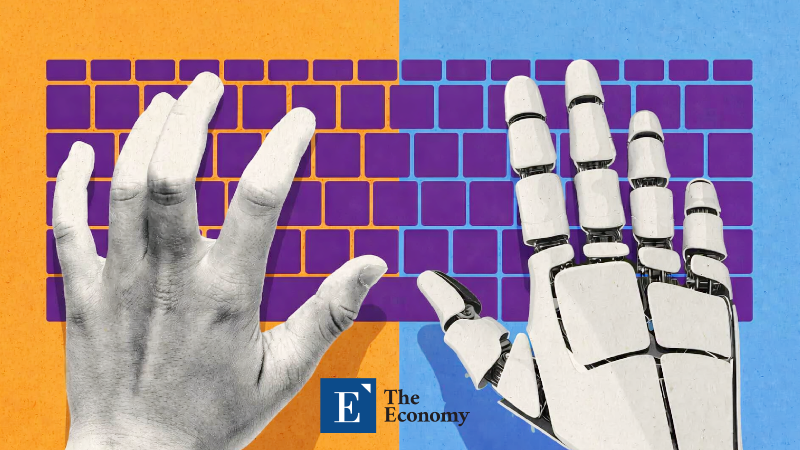
Artificial intelligence is reshaping the corporate productivity calculus and overhauling workforce management across industries. As AI tools dramatically lift output per employee, companies are prioritizing organizational and system efficiency over headcount expansion, accelerating restructuring efforts. The simultaneous slowdown in entry-level hiring and reductions in existing staff underscores how AI is now directly influencing decisions on workforce size.
OpenAI Signals Hiring Slowdown
On the 26th (local time), OpenAI Chief Executive Officer Sam Altman addressed questions about recent changes in hiring and interviews during a live-streamed town hall meeting, saying, “For the first time, we plan to dramatically slow our rate of growth.” While emphasizing that developer hiring would continue, Altman added that the company would be able to “get vastly more done with far fewer people,” signaling that the hiring pullback reflects advances in AI capabilities.
Altman noted that OpenAI is maintaining its current interview format for now but intends to shift toward assessments that directly test practical skills. “What would have taken two weeks to complete a year ago, I want to see candidates accomplish on the spot in 10 to 20 minutes,” he said.
He stressed that the decision to slow hiring was deliberate, saying he wanted to avoid “overly aggressive hiring followed by extremely uncomfortable conversations when we suddenly realize AI can do a large share of the work.” Looking ahead to future employment models, Altman suggested companies would gravitate toward either employing a small number of humans alongside many AI colleagues or operating almost entirely with AI, adding that he “sincerely hopes it will be the former.”
AI Occupying Entry-Level Roles
Altman’s remarks come amid mounting concern over AI’s impact on the broader labor market. According to data from the U.S. Bureau of Labor Statistics, the unemployment rate as of last November reached its highest level since 2021, while job openings fell by roughly 37% from their 2022 peak. U.S. business outlet Business Insider reported that the ratio of jobs to jobseekers, once about two positions per applicant, dropped to roughly one-to-one in the second half of last year. Long-term unemployment now accounts for nearly a quarter of the total, indicating that hiring weakness is spreading across the labor market.
Companies, in practice, are pairing AI adoption with cuts to new hiring under the banner of “efficiency.” A prominent example is IBM. In media interviews, IBM CEO Arvind Krishna said that within five years, around 30% of tasks in support and back-office functions such as customer service and human resources could be replaced by AI and automation, prompting a temporary halt to hiring in those roles. This equates to roughly 7,800 positions out of a 26,000-strong non-customer-facing workforce, illustrating that AI is beginning to function as an invisible barrier to hiring itself, not merely a tool for augmenting human labor.
Fintech firm Klarna offers an even clearer case. The company said its AI chatbot handled 2.3 million customer inquiries in a single month, matching the workload of 700 full-time agents. Klarna reported that customer satisfaction remained comparable to that delivered by human staff, while average resolution time fell from 11 minutes to under two minutes and repeat inquiries dropped sharply. The example suggests that automation in call centers and customer service roles has advanced to the point where the same work can be done with far fewer employees.

AI-Driven Layoffs Exceed 50,000 Last Year Alone
Layoffs are also accelerating. According to U.S. consultancy Challenger, Gray & Christmas, American companies announced 1.17 million job cuts last year, up 54% from 760,000 the year before. Of those, 54,694 were attributed specifically to AI. Since AI was first cited as a reason for layoffs in 2023, a total of 71,683 jobs have been cut for that reason, with 76.3% occurring last year alone—evidence that AI-driven job losses are gathering pace.
An MIT research team’s “Iceberg Indicator” estimates that jobs currently replaceable by AI account for about 2.2% of the labor market, but researchers caution this represents only the tip of the iceberg. So far, AI exposure has been concentrated among roles such as computer engineers and data scientists. Looking ahead, the team projects AI’s impact will spread across administrative, financial, and professional services, affecting 11.7% of the U.S. labor market, equivalent to wages totaling 1.2 trillion USD.
Findings from Microsoft align with this outlook. In a paper titled “Working with AI” released last July, Microsoft identified 40 occupations most susceptible to AI substitution. Interpreters and translators ranked first, followed by historians and writers. Service sales representatives placed fourth, CNC tool programmers fifth, and broadcast announcers and radio DJs sixth. The study suggests that not only repetitive tasks and data analysis but also roles requiring creativity, communication, and strategic thinking are increasingly vulnerable to automation.
The content industry has already felt the impact. Video generation tools such as OpenAI’s Sora and Google’s Veo enable users to create advertising content simply by entering descriptions, allowing ads to be produced faster, with fewer people and at lower cost. AI also poses a direct threat to lower-skilled occupations including administrative assistants, clerical workers, and machine operators. A report released last November by the UK’s National Foundation for Educational Research projected that between one million and three million jobs in administrative, secretarial, customer service, and machine operation roles could disappear by 2035. While AI-driven disruption is currently concentrated in white-collar work, analysts expect its reach to expand across the entire labor market as AI converges with robotics.
Oliver Griffin is a policy and tech reporter at The Economy, focusing on the intersection of artificial intelligence, government regulation, and macroeconomic strategy. Based in Dublin, Oliver has reported extensively on European Union policy shifts and their ripple effects across global markets. Prior to joining The Economy, he covered technology policy for an international think tank, producing research cited by major institutions, including the OECD and IMF. Oliver studied political economy at Trinity College Dublin and later completed a master’s in data journalism at Columbia University. His reporting blends field interviews with rigorous statistical analysis, offering readers a nuanced understanding of how policy decisions shape industries and everyday lives. Beyond his newsroom work, Oliver contributes op-eds on ethics in AI and has been a guest commentator on BBC World and CNBC Europe.
Similar Post