Germany’s gas storage falls to 42%, procurement narrows despite “energy security” rhetoric

Niamh O’Sullivan is an Irish editor at The Economy, covering global policy and institutional reform. She studied sociology and European studies at Trinity College Dublin, and brings experience in translating academic and policy content for wider audiences. Her editorial work supports multilingual accessibility and contextual reporting.
Authored On
Modified
Weather-independent risk of repetition grows
Industrial backlash fuels policy–market friction
Manufacturing and broader economic uncertainty spreads
Germany’s natural gas storage levels have fallen below the levels seen during past supply disruption crises. After effectively cutting off imports of Russian gas, Germany reshaped its procurement structure to rely heavily on U.S. liquefied natural gas (LNG). Record cold weather then drove up heating demand, rapidly depleting reserves. As the gap between the policy goal of strengthening energy security and the actual procurement structure becomes more apparent, energy supply anxiety across German society is intensifying.
Criticism over “side effects of easing storage obligations”
According to Germany’s daily Augsburger Allgemeine on the 28th (local time), gas storage levels in Germany recently fell to 42%, more than 20 percentage points below the average level recorded between 2017 and 2021. Quoting Tim Keller, head of the German Association of Gas and Hydrogen Industries, the paper noted that “current storage levels are more severe than during the 2022 energy crisis, when gas supply disruptions peaked,” adding that “the government’s easing of storage obligations has triggered an energy security emergency.”
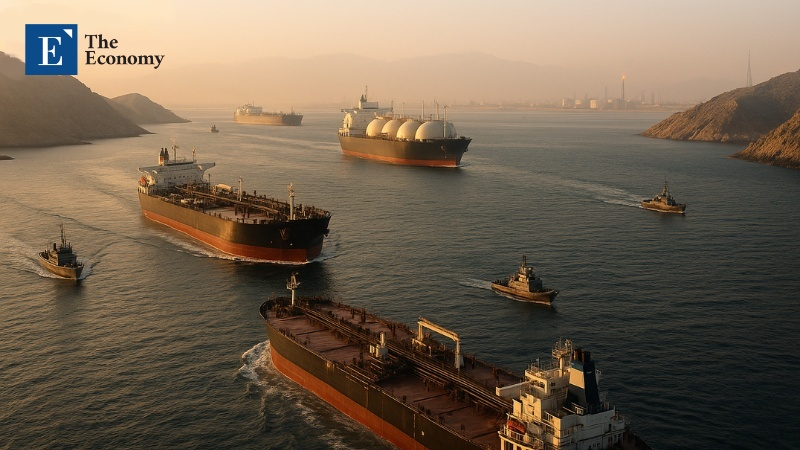
Germany rapidly restructured its procurement system starting in 2022, when the war in Ukraine began, effectively cutting off Russian pipeline gas imports. In the process, U.S. LNG emerged as the primary alternative, with its share expanding sharply. According to the German Environmental Aid Association (DUH), Germany imported approximately 101 terawatt-hours (TWh) of U.S. LNG last year, accounting for 96% of total LNG consumption. This represented an increase of more than 60% year on year, with import costs rising from $1.9 billion to $3.2 billion.
This U.S.-concentrated procurement structure exposed its vulnerabilities as storage levels declined. Before the cutoff of Russian gas, continuous pipeline supply operated alongside large-scale storage. By contrast, U.S. LNG imports transported by sea are directly exposed to volume fluctuations in the global energy market. When winter demand rises and U.S. LNG deliveries fall short of expectations, the ability to defend storage levels weakens rapidly. In fact, Germany entered the heating season last November with storage at around 75%, compared with 98% at the same time the previous year—a gap of 23 percentage points.
This is where the disconnect between the stated goal of “strengthening energy security” and reality becomes evident. While Germany succeeded in reducing dependence on Russia, it replaced that gap not with diversification but with reliance on a single country, altering the nature of supply risk rather than eliminating it. DUH warned that “LNG has moved beyond a temporary emergency solution and has become Berlin’s new energy pillar,” adding that “Germany is now almost absolutely dependent on an increasingly unpredictable United States.” This suggests that similar crises could recur at any time if the current procurement structure remains unchanged.
Questions raised over infrastructure support policy
As a result, domestic backlash in Germany continues to intensify. A representative case involves private LNG terminal operator Deutsche ReGas. On the 16th, Deutsche ReGas filed a lawsuit challenging the European Commission’s approval of $5.95 billion in state subsidies for the federal government’s floating storage and regasification unit (FSRU) terminals, arguing that large-scale, government-led financial support distorts market competition and ultimately undermines supply stability.
The company cited the nature and performance of its own infrastructure. Deutsche ReGas stated that it built and operates the “Deutsche Ostsee Energy Terminal” in Mukran and an existing LNG terminal in Lubmin using only private capital, without state subsidies. It added that during the heating season from late the year before last through early last year, these terminals supplied the largest volumes of LNG within Germany, serving roughly 15% of household and commercial gas demand. The company warned that providing large-scale support only to state-run operators would depress utilization at private terminals and increase uncertainty around investment recovery.
Another axis of friction between policy and the market lies in the fact that deepening dependence on U.S. LNG directly translates into diplomatic and trade variables. The New York Times, citing the Bruegel think tank, reported that while U.S. LNG accounted for only about 5% of total EU LNG imports in 2019, the share has now expanded to more than a quarter. The paper noted that this shift indicates energy procurement is no longer just a market transaction but is increasingly intertwined with foreign policy and security considerations. As Europe’s dependence on U.S. energy has grown, so too has the influence of the Trump administration.
Anne-Sophie Corbeau, a Paris-based researcher at Columbia University’s Global Energy Policy Center, similarly observed that “people are beginning to realize how excessively dependent we are on U.S. LNG,” adding that “Europe effectively has very few alternatives.” While some caution that using LNG exports as a diplomatic tool could backfire on the U.S. energy industry itself, concern within Europe that procurement changes could constrain both policy autonomy and market function shows little sign of abating.
Energy transition inefficiencies worsen the situation
The first sector to feel the impact of energy instability was German manufacturing. Already mired in a prolonged economic downturn, the sector now faces additional pressures from high energy costs and supply uncertainty. Germany recorded GDP growth of -0.9% in 2023 and -0.5% in 2024, followed by near stagnation with growth of just 0.2% last year. During this period, industry consistently cited high energy prices and the cost of the energy transition as key drivers of the slowdown. Supply instability raises production uncertainty, ultimately eroding competitiveness.
The burden is especially pronounced in energy-intensive industries such as chemicals, steel, and automotive manufacturing, where high electricity and gas usage makes costs highly sensitive to price fluctuations. In a recent report, the Korea Energy Economics Institute noted that during the outbreak of the Russia–Ukraine war in 2022, LNG prices surged by as much as tenfold in Europe and eightfold in Asia, attributing the shock to inefficiencies in the energy transition. It argued that a gas-centered power structure formed during the push to phase out nuclear and coal power directly translated into higher costs and reduced production stability for manufacturing.
These pressures have spread beyond Germany to Europe as a whole. As the Russia–Ukraine war approaches its fourth year and disruptions to gas and oil supplies persist, some countries have reverted to coal. According to the International Energy Agency (IEA), global coal consumption rose 1.5% year on year in the first half of last year, with the EU driving the increase. Poland’s decision to restart coal-fired power plants to address power shortages is a notable example. Germany also restarted coal plants after cutting Russian gas imports, while countries in the Balkans—including North Macedonia, Serbia, and Bosnia and Herzegovina—either expanded coal power or delayed plant closures.
At the same time, Europe has begun searching for long-term alternatives to reduce reliance on U.S. LNG. At the North Sea Summit on the 26th, ten countries—including the United Kingdom, Belgium, Denmark, France, and Germany—agreed to jointly develop 100 gigawatts (GW) of offshore wind capacity in shared economic zones. The challenge is that existing offshore wind capacity across Europe totals only about 37 GW, meaning it will take considerable time before planned expansions have a meaningful impact on power markets. In the interim, manufacturing remains locked into a structure dependent on LNG and gas-fired power.
Niamh O’Sullivan is an Irish editor at The Economy, covering global policy and institutional reform. She studied sociology and European studies at Trinity College Dublin, and brings experience in translating academic and policy content for wider audiences. Her editorial work supports multilingual accessibility and contextual reporting.
Similar Post