Debt-Fueled Growth in Developing Economies: Record Capital Outflows in 50 Years—A Global Economic Tripwire?

Stefan Schneider brings a dynamic energy to The Economy’s tech desk. With a background in data science, he covers AI, blockchain, and emerging technologies with a skeptical yet open mind. His investigative pieces expose the reality behind tech hype, making him a must-read for business leaders navigating the digital landscape.
Authored On
Modified
Debt service exceeds new capital inflows
Record principal and interest burdens amid “reverse capital flows”
Trade share at 44%, with vast spillovers for the global economy
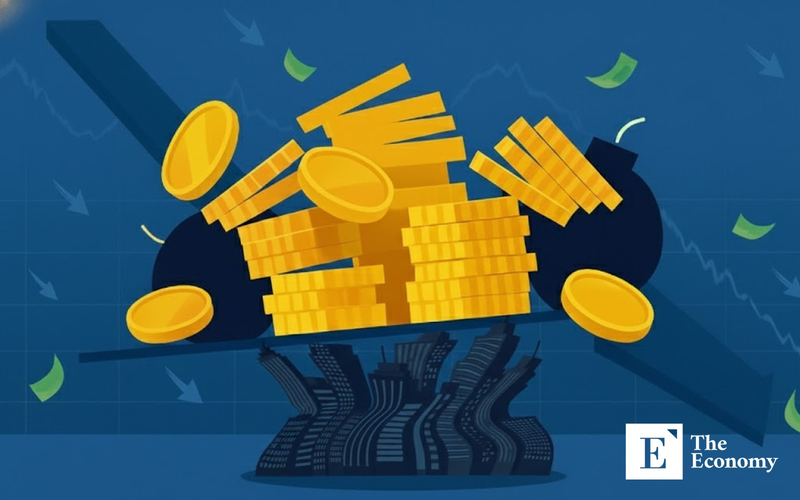
As global public debt rises rapidly across low- and middle-income countries, it is increasingly acting as a risk factor that erodes the world economy’s underlying resilience. Given that a substantial share of global growth and consumption depends on these economies, expanding debt-servicing burdens are expected to have outsized spillover effects on the broader global business cycle. The global financial system is also tightly interconnected with developing economies, raising the likelihood that fiscal stress—such as defaults—could spill across borders into financial markets and the real economy at large.
Deteriorating external debt quality, signs of strain in the real economy
According to the World Bank’s International Debt Report released, over the three years from 2022 to 2024, developing economies paid $741 billion more in principal and interest to foreign creditors than they received in new borrowing. This marks the largest net capital outflow in 50 years since such statistics began in the 1970s. Developing economies typically raise funds abroad to invest in roads, power, education, and industry, but capital that should have supported growth instead flowed to advanced-economy financial institutions—including Wall Street asset managers, London hedge funds, and Beijing policy banks—effectively eliminating any trickle-down benefits.
Historically, global finance saw capital move from low-return advanced economies to higher-growth developing ones, creating a complementary structure in which advanced economies earned interest income while developing economies grew through investment. However, global high interest rates and a strong dollar have broken this mechanism, triggering a full-fledged “reverse transfer of wealth” from poorer to richer countries. Indeed, according to the Institute of International Finance (IIF), total external debt of low- and middle-income countries stood at about $9 trillion last year—little changed in absolute size—but the burden of servicing that debt surged to a record high.
With external debt already accumulated, real interest rates rising to around 10% have further amplified the burden of high-cost borrowing. The World Bank assessed that “as the quality of external debt deteriorates, developing economies have narrowly avoided default through restructuring, but the shock of debt distress is rapidly spreading to the real economy and livelihoods.” In 22 high-risk countries where external debt exceeds 200% of exports, 56% of the population cannot afford even a minimum daily meal. Among them, 18 are International Development Association (IDA) countries, where two-thirds of the population fails to secure basic food needs.
Limits of a public-debt-dependent growth model
Experts are increasingly focused on the risk that expanding debt in developing economies could act as a global economic trigger. These countries are now deeply embedded in the global economy. According to the United Nations Conference on Trade and Development (UNCTAD), the share of global merchandise trade involving developing economies doubled from 22% in 1964 to 44% today, reflecting a shift in the center of consumption and production as advanced economies entered low-growth phases. Even so, non-tariff barriers in advanced economies—such as quotas and import licensing tied to safety and sanitary standards—have prevented developing economies from fully capturing the benefits of rising trade volumes.
A core problem is that growth in developing economies relies more on public debt than on organically expanding incomes. Their share of total global public debt rose from 10% in 2010 to 30% in 2023, with the pace of increase roughly twice that of advanced economies. Because developing economies now underpin global demand, a debt crisis among them would inevitably spread across borders through global supply chains. Financial-market spillovers are another concern: as debt-servicing pressures intensify in some countries, investor sentiment toward developing economies as a whole could sour, accelerating capital outflows. Accordingly, international organizations such as UNCTAD increasingly classify developing-economy debt as a systemic global risk.
The growth and debt structures of emerging markets formed via China also warrant attention. Over the past decade, trade in developing economies expanded alongside China’s rapid growth. As China became a core production base and one of the largest trading partners in global supply chains, infrastructure investment and exports across emerging markets rose, spreading a debt-dependent growth model. Through initiatives such as the Belt and Road Initiative (BRI), China became deeply involved in infrastructure investment in developing economies, often with Chinese financial institutions providing funding and Chinese firms participating in projects. Laos and Pakistan—where debt to China surged amid large inflows of Chinese capital into domestic infrastructure—are emblematic cases.
Debt risks deepen in Pakistan, Zambia, and beyond
Sri Lanka’s sovereign default in 2022 vividly illustrates the dangers of long-accumulated reliance on external debt. From the mid-2010s, Sri Lanka borrowed heavily to boost growth and expand infrastructure, pushing ahead with ports, airports, roads, and power plants—many financed by foreign-currency loans, with a rapidly rising share involving Chinese capital. Chinese policy banks and firms provided funding and took part in construction and operations. However, returns from some projects fell short of expectations, swelling Sri Lanka’s debt-servicing burden and ultimately undermining fiscal sustainability.
The crisis accelerated amid the global shift to monetary tightening. After the pandemic, rate hikes led by the United States sharply worsened external financing conditions. Sri Lanka’s foreign-exchange reserves were rapidly depleted, leaving the country struggling to pay for essential imports such as fuel and food. In 2022, the government declared a default on external debt. The currency collapsed, inflation surged, shortages of essentials emerged, and power outages fueled mass anti-government protests. Although negotiations for an International Monetary Fund (IMF) bailout proceeded, debt restructuring dragged on amid conflicting interests among creditors.
Similar warning signs are evident elsewhere. Ghana entered an IMF bailout in 2023 after a sharp fall in foreign-exchange reserves and fiscal deterioration; Zambia continues to face protracted debt-restructuring delays following its 2020 default; Egypt is surviving on IMF support amid chronic foreign-currency shortages; Tunisia’s access to financial markets remains constrained by fiscal stress and political uncertainty; and Laos faces a steep currency slide and high inflation as reserves fall far short of import-payment needs.
Stefan Schneider brings a dynamic energy to The Economy’s tech desk. With a background in data science, he covers AI, blockchain, and emerging technologies with a skeptical yet open mind. His investigative pieces expose the reality behind tech hype, making him a must-read for business leaders navigating the digital landscape.
Similar Post