Hyundai Motor Union Opposes Atlas Deployment as 21st-Century Luddite Movement Unfolds, Korean Government Focuses on Minimizing Side Effects

Authored On
Modified
Hyundai Motor Union Strongly Pushes Back Against Plans to Deploy Robots on Production Lines
AI Advances Fuel a 21st-Century Revival of the Luddite Movement
"Technological Progress Is Inevitable,"Korean Government Shifting Focus to Job Polarization and Other Side Effects
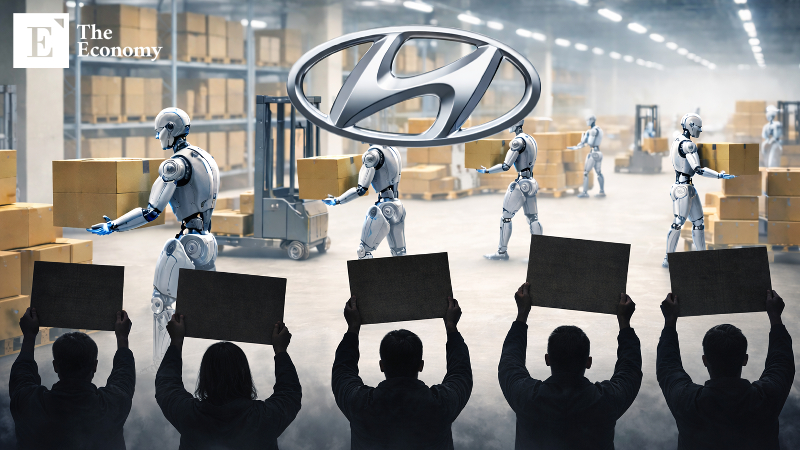
Hyundai Motor’s labor union (the Hyundai branch of the Korean Metal Workers’ Union under the KCTU) has come out strongly against management’s plan to deploy robots on the factory floor. As AI advances accelerate and more companies move to replace workers with humanoid robots, what amounts to a 21st-century version of the Luddite movement is now unfolding inside Hyundai. The Korean government, however, maintains that stopping this shift is effectively impossible and that policy should focus on minimizing side effects such as job polarization.
Hyundai Motor Union Takes a Hardline Stance
On the 29th, the Hyundai Motor union said in a bulletin that “judging by management’s recent moves, they will first pull volumes out to overseas plants where robots can be deployed,” adding that “after trying to piece together production with the remaining domestic volume, the final missing piece appears to be moving ahead with idling plants.” The union argued that idled facilities would eventually be replaced by new plants designed either for robot deployment or for maximum automation.
The union also said that at the Global Leaders Forum (GLF), Hyundai Motor Group’s top strategy meeting held on January 7, the company discussed “DF247,” an unmanned factory project described as a “dark factory” that can run 24 hours a day, seven days a week without even turning on the lights. It stressed that management is seeking to build a “dream factory” that excludes people from production sites and operates solely with AI-based robots.
Union officials warned, “Humans build robots, and then those robots build robots that replace every job,” adding, “There is no place for people anywhere.” They argued that the balance between consumption and supply would break down and that Korea’s economic vicious cycle would persist. Responding to criticism that the union is acting out of self-interest, it asked, “Are we supposed to stay silent as robots arrive without any alternatives and production is moved overseas?”
The Hyundai Motor union had made similar claims in a bulletin on the 22nd, referencing the introduction of the mass-produced humanoid robot “Atlas” at overseas plants and asserting that “not a single robot can enter the production floor without labor-management agreement.” At the time, it said that “the deployment of AI robots to cut labor costs at Hyundai is becoming a reality,” adding that “we will never tolerate any introduction without labor-management agreement.”
Resembling Britain’s Luddite Movement
In the market, Hyundai Motor’s union’s moves are increasingly being described as closer to a 21st-century version of the Luddite movement. Most union members at Hyundai are skilled production workers directly involved in manufacturing, and their jobs are being threatened by advanced technology. The Luddite movement refers to the machine-breaking protests carried out by workers in Britain’s factory regions from the late 18th century to the early 19th century. Machines were destroyed across most industrial cities that powered Britain’s Industrial Revolution, including Arnold, Nottingham, Leeds, Sheffield, and Manchester, and in some cases entire factories were left in ruins.
The movement was led by artisans and workers who faced unemployment and downward pressure on wages as the Industrial Revolution advanced rapidly. With the invention of the power loom in the late 18th century and the introduction of mass production, skilled weavers began to lose their footing. Factory owners replaced weavers with machines and with women and minors, raising productivity while cutting labor costs, and the weavers, calling for “survival,” smashed the machines they saw as the root cause. It was the first instance in human history of people fighting against machines.
The British government, however, deployed troops to suppress workers and enacted the Frame Breaking Act, sentencing participants in the Luddite movement to death. Under this crackdown, the movement ultimately failed, but it became an important turning point that made workers recognize the need for laws and institutions. About two decades later, British workers secured universal forms of political rights, including universal and secret ballots, through movements such as Chartism, and unions were legalized. Companies also succeeded in cutting costs through automation-driven mass production. Britain used this as a springboard for tremendous economic growth, but the process came with social costs, including the spread of urban poverty and extreme inequality.
Korean Government’s Response Strategy
The government sees efforts to suppress AI-driven upheaval across industry as effectively impossible. Acknowledging that the spread of robots powered by AI technology could lead to problems such as job polarization, it believes preparations must begin proactively. President Lee Jae-myung himself addressed the issue on the afternoon of the 29th at a meeting of senior presidential aides at the Blue House, saying, “We cannot avoid the huge cart rolling toward us,” and adding, “In the end, we have to adapt quickly to a society driven by AI.”
President Lee stressed that “a world is coming very soon in which AI machines make decisions on their own, work tirelessly without eating, and operate in pitch-dark spaces without lights, and it cannot be avoided.” He went on to say, “Those who own the means of production will accumulate enormous wealth, while most people will find it hard to secure jobs,” explaining that “there will be jobs, but they will either be extremely high-level roles that AI truly cannot do, or cheaper forms of labor that AI robots do not take on.” This reflects a view that the labor market will be rapidly reshaped, new hiring will shrink, and the gains from automation will concentrate among those who own capital and technology. “When I put it this way, people predict that jobs will become polarized,” he said, adding, “It’s coming faster than we think.”
President Lee also cited South Korea’s experience around the early 2000s, when abacus academies that once lined neighborhood streets turned into computer institutes and later into PC cafés. “I see AI as similar,” he said, reiterating that “there is no way for all of our citizens not to use this.” He continued, “The most important thing we need to do is to recognize this as quickly as possible, learn quickly, have the government provide opportunities to learn, and create chances for many people to participate in production by using this as a tool,” urging preparation for a shift in mindset.
Relevant ministries are also focusing on the need to overhaul institutions. For example, on the 26th, Ryu Hyun-cheol, head of industrial safety and health at the Ministry of Employment and Labor, said at a press briefing in Government Complex Sejong that “there needs to be a stage where norms, rules, and legal issues are reviewed from a safety and health perspective when problems arise alongside the introduction of robots.” He noted in particular that “if robots work mixed in with people, it could actually become more dangerous for humans, but this has not yet been properly examined,” adding that “both companies and the government need to prepare.” The aim is to establish industrial accident countermeasures in advance for risks that may emerge as robots replace human labor.
Similar Post