Safe-Haven Premium Evaporates as ‘Hawkish’ Fed Pick Emerges, ‘Warsh Shock’ Jolts Gold Market

Siobhán Delaney is a Dublin-based writer for The Economy, focusing on culture, education, and international affairs. With a background in media and communication from University College Dublin, she contributes to cross-regional coverage and translation-based commentary. Her work emphasizes clarity and balance, especially in contexts shaped by cultural difference and policy translation.
Authored On
Modified
Trump-Fueled Dollar Distrust Drove Gold Frenzy
Speculative Funds Exit En Masse on Warsh Nomination Talk
Viewed as ‘Relatively Less Pro-Trump’ Figure
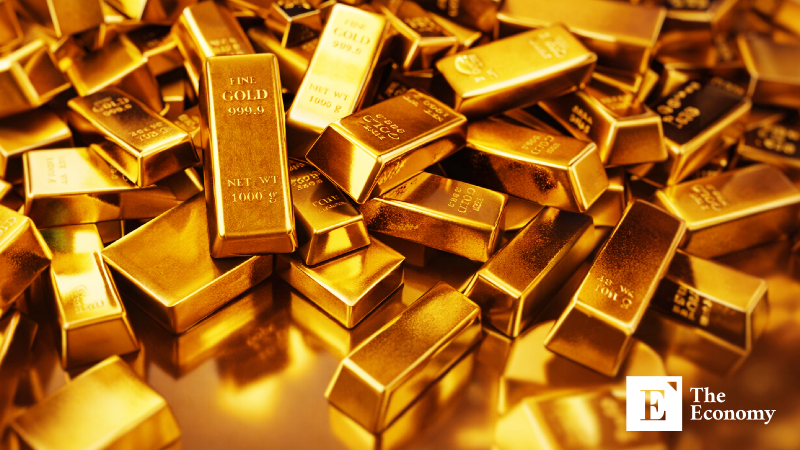
Gold prices, which had been on what many described as a “ceiling-less rally” amid China’s massive stockpiling and expectations of U.S. rate cuts, have suffered a historic plunge. Distrust toward the administration of U.S. President Donald Trump, driven by erratic policymaking, had propelled gold—the quintessential safe haven—sharply higher. That dynamic reversed abruptly after Kevin Warsh, a former Federal Reserve governor known for his cautious stance on rate cuts, emerged as the leading candidate for the next Fed chair. As expectations for monetary easing weakened and the dollar strengthened, the investment appeal of safe-haven assets diminished sharply.
Gold Market Cools Abruptly After Sustained Bull Run
According to Reuters on the 1st (local time), spot gold fell 9.5% on the 31st from the previous session to trade at 4,883.62 dollars per ounce. This came just one day after prices surged to a record high of 5,594.82 dollars per ounce, having broken above the 5,500-dollar threshold for the first time ever. On the New York Mercantile Exchange, April gold futures settled at 4,745.10 dollars per ounce, down 11.4% from the prior session. International gold prices had crossed the 5,000-dollar mark for the first time on the 26th of last month and continued to climb on heavy buying, extending a historic rally into last week.
The single largest driver behind the surge in gold prices has been China’s so-called “gold hoarding.” Australia and New Zealand Banking Group estimates that China holds roughly 5,500 tons of gold. This figure is more than double the officially disclosed holdings of the People’s Bank of China, which stand at about 2,300 tons. If accurate, China would surpass Germany, with roughly 3,350 tons, to become the world’s second-largest gold holder after the United States, which holds about 8,100 tons.
China’s decision to conceal its gold purchases is widely interpreted as a strategic move to gradually reduce dependence on the dollar. As U.S.-China tensions become entrenched and Washington increasingly deploys financial sanctions as a policy tool, Beijing is seeking to build a buffer by accumulating gold as a means of circumventing dollar dominance. China is also reported to be encouraging developing countries with which it maintains friendly relations to store their gold reserves in China. The Financial Times recently reported that China has been working with developing countries such as Cambodia to settle gold transactions in yuan and store bullion in vaults at the Shanghai Gold Exchange, an effort aimed at expanding the yuan’s influence in global finance while counterbalancing the dollar. In the process, gold prices accumulated a substantial financial premium far exceeding underlying physical demand.
Trump Nominates Hawkish Figure as Next Fed Leader
Expectations of U.S. rate cuts also played a major role in fueling gold’s explosive rise. Last month, reports that Fed Chair Jerome Powell was facing the threat of criminal indictment pushed international gold prices to yet another record high. Markets viewed the mere exposure of the Fed chair to judicial risk as a serious threat to the neutrality and credibility of monetary policy. As a result, risk aversion intensified and capital flowed rapidly into safe-haven assets.
Should Powell’s indictment ultimately undermine the Fed’s independence, the likelihood of excessive political pressure for rate cuts would increase significantly. Such a scenario could reignite inflation expectations, push long-term Treasury yields higher, and trigger capital outflows from dollar-denominated assets. When President Trump raised the possibility of dismissing Powell in April of last year and intensified pressure for rate cuts, gold prices surged sharply. Since then, persistent concerns over the erosion of Fed independence have underpinned a structurally bullish trend in gold.
The reversal in gold prices, however, came suddenly. Markets widely view President Trump’s choice for the next Fed chair as the immediate catalyst. On the 30th of last month, Trump announced via social media that he had nominated Warsh as the next Fed chair. Until then, speculation that Trump might appoint an even more dovish figure than expected—one inclined toward aggressive monetary easing—had bolstered gold prices. The nomination of Warsh, who is broadly regarded as hawkish, abruptly dampened expectations for rate cuts.
Dollar Strength Triggers Gold Selloff
Markets had initially expected Trump to appoint a dovish Fed chair who would exert heavy pressure on the Federal Open Market Committee and deliberately weaken the dollar. Warsh’s nomination, however, represents a markedly different choice. Warsh is known for his belief that monetary policy should be conducted in a predictable manner. He is particularly associated with rule-based frameworks such as the Taylor rule, developed by economist John Taylor. The Taylor rule prescribes raising rates when inflation exceeds its target and cutting rates when growth falls below potential.
Warsh served as a Fed governor from 2006 to 2011 and acted as a key liaison between the central bank and financial markets during the 2008 global financial crisis. A former Morgan Stanley executive who also worked at the White House National Economic Council, he has experience spanning both Wall Street and Washington. During his tenure under then-Fed Chair Ben Bernanke, Warsh opposed a range of monetary easing measures. In 2008, amid the height of the financial crisis, he warned that additional rate cuts could stoke inflation. In 2011, he resigned in opposition to the Fed’s 600-billion-dollar quantitative easing program, which involved large-scale bond purchases.
Even after stepping down, Warsh continued to criticize the Fed’s monetary policy and financial regulation. He has argued that quantitative easing and the excessive expansion of the Fed’s balance sheet fueled asset price bubbles and moral hazard. This history underpins expectations that, as Fed chair, Warsh would pursue a “orderly” approach to rate cuts. His nomination, seen as prioritizing monetary discipline and central bank independence, helped calm market fears. As a result, speculative capital that had poured into safe havens such as gold rotated back into the dollar and U.S. Treasuries, triggering the sharp selloff.
That said, Warsh has recently shown some openness to rate cuts. In an interview with Fox News last year, he said he “somewhat sympathized” with President Trump’s frustration toward Chair Powell’s reluctance to cut rates. In recent columns, Warsh has also criticized the Fed for excessive reliance on data and for policymakers becoming trapped in similar models. This has been interpreted as an argument for preemptive rate cuts before economic conditions deteriorate. Christopher Hodge, chief economist at Natixis, noted that “Warsh believes policies such as deregulation and tax cuts can boost overall economic productivity, which could provide justification for more aggressive rate cuts.”
Siobhán Delaney is a Dublin-based writer for The Economy, focusing on culture, education, and international affairs. With a background in media and communication from University College Dublin, she contributes to cross-regional coverage and translation-based commentary. Her work emphasizes clarity and balance, especially in contexts shaped by cultural difference and policy translation.
Similar Post