Tesla’s ‘TeraFab’ Vision: A Foundry Internalization Experiment Driven by AI Chip Supply Insecurity

Matthew Reuter is a senior economic correspondent at The Economy, where he covers global financial markets, emerging technologies, and cross-border trade dynamics. With over a decade of experience reporting from major financial hubs—including London, New York, and Hong Kong—Matthew has developed a reputation for breaking complex economic stories into sharp, accessible narratives. Before joining The Economy, he worked at a leading European financial daily, where his investigative reporting on post-crisis banking reforms earned him recognition from the European Press Association. A graduate of the London School of Economics, Matthew holds dual degrees in economics and international relations. He is particularly interested in how data science and AI are reshaping market analysis and policymaking, often blending quantitative insights into his articles. Outside journalism, Matthew frequently moderates panels at global finance summits and guest lectures on financial journalism at top universities.
Authored On
Modified
Tesla’s high-stakes bet on its own semiconductor manufacturing facility, TeraFab, faces skepticism amid formidable entry barriers
Intel’s loss-making push into advanced manufacturing raises fears of a bruising war of attrition if Tesla joins the fray
Samsung Electronics secures short-term relief from Tesla orders, but long-term competitive pressures loom
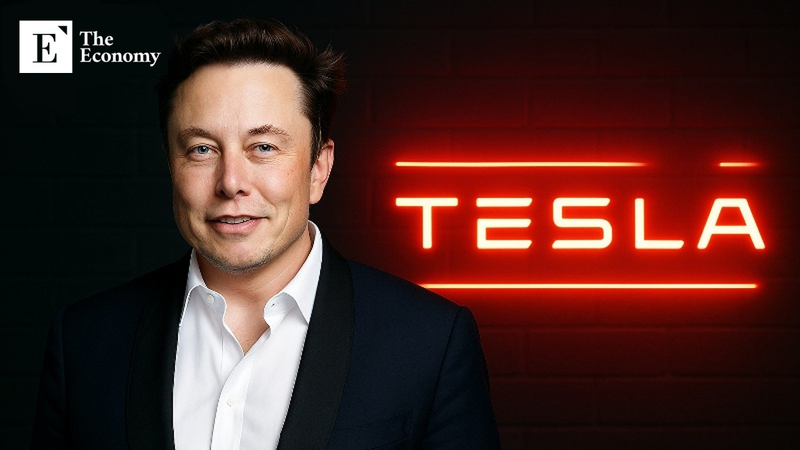
Elon Musk, Chief Executive Officer of Tesla, has sent shockwaves through the global foundry industry by formally unveiling plans to build Tesla’s own semiconductor manufacturing facility, dubbed “TeraFab,” aimed at mitigating persistent instability in the chip supply chain. Yet doubts abound over the feasibility of the project, given the immense capital intensity and technical expertise required in semiconductor manufacturing. Even Intel, long regarded as a pillar of the industry and now seeking to restore its former stature, continues to struggle under the weight of massive operating losses. Samsung Electronics, while benefiting in the near term from securing Tesla orders, is simultaneously confronting a more complex long-term risk landscape shaped by potential customer attrition and the emergence of a well-capitalized new competitor.
Supply Chain Anxiety as the Catalyst
According to industry sources on February 2, Musk formally articulated the necessity of constructing TeraFab during Tesla’s fourth-quarter 2025 earnings conference call. The envisioned facility goes well beyond a conventional contract manufacturing plant, encompassing foundry operations, memory production, and advanced packaging capabilities in a fully vertically integrated semiconductor manufacturing complex to be built in the United States. The concept mirrors Tesla’s Gigafactory model, which consolidates battery, component, and vehicle production to maximize efficiency, and aspires to wafer output exceeding 100,000 units per month—capacity comparable to that of the world’s top-tier foundries.
The rationale behind Musk’s ambitious plan lies in his assessment of structural constraints and geopolitical vulnerabilities embedded in the existing semiconductor supply chain. He has argued that even if key partners such as Samsung Electronics, Taiwan Semiconductor Manufacturing Co. (TSMC), and Micron operate at full capacity, they would be unable to meet the surging demand for AI chips projected three to four years ahead. Musk has repeatedly highlighted the concentration risk inherent in the fact that more than 90% of advanced semiconductor production is clustered in South Korea and Taiwan, warning that escalating tensions in the Taiwan Strait could severely disrupt TSMC’s supply chain.
These concerns are reinforced by memories of the acute chip shortages during the COVID-19 pandemic, recent remarks by Apple CEO Tim Cook regarding bottlenecks in 3-nanometer processes, and mounting price pressures in high-performance memory markets. Musk has gone so far as to warn that without timely access to AI chips, Tesla’s flagship Optimus humanoid robot would be rendered as useless as the Tin Man from The Wizard of Oz, underscoring his view that semiconductor procurement has become a matter of corporate survival.
Despite the urgency of Musk’s narrative, the feasibility of TeraFab remains highly uncertain. Nvidia CEO Jensen Huang has described foundry operations as an exceptionally demanding domain that fuses engineering, science, and artistry, suggesting that even Intel’s struggles illustrate how formidable the challenge is. Technology outlet Tom’s Hardware has likewise criticized the notion that Tesla—lacking any prior experience in semiconductor manufacturing—could leap directly into 2-nanometer production, a domain currently occupied only by Samsung Electronics and TSMC, arguing that such assumptions underestimate the sheer complexity of leading-edge fabrication.
Samsung Electronics’ Foundry Strategy: Short-Term Opportunity, Long-Term Uncertainty
As industry experts note, TeraFab would have to overcome the steep entry barriers of a foundry market defined by colossal capital requirements and decades of accumulated know-how. Intel’s recent experience provides a sobering case study. In March 2021, CEO Pat Gelsinger unveiled the “IDM 2.0” vision during a global media briefing, committing to invest $20 billion in the construction of two new fabrication plants in Arizona as part of Intel’s return to the foundry business. The results have been punishing: Intel’s foundry division posted an operating loss of $2.26 billion in the fourth quarter of 2024 alone, with full-year losses totaling $13.41 billion.
Analysts expect Intel’s net losses to widen from $267 million last year to $400 million this year, marking a third consecutive year in the red. Nevertheless, Intel continues to press ahead with aggressive technological investments, including the planned deployment of next-generation High-NA extreme ultraviolet lithography tools from ASML, the world’s leading supplier of semiconductor exposure equipment, each priced at roughly $400 million. While TSMC has opted to rely on existing equipment through 2028, Intel aims to mass-produce 14A (1.4-nanometer-class) chips by 2027, leveraging early adoption of High-NA EUV tools to regain technological competitiveness.
This strategy has begun to yield tentative signs of progress in the United States. Intel has showcased a large AI chip testbed incorporating next-generation technologies, demonstrating both manufacturing and advanced packaging capabilities at its 18A (1.8-nanometer-class) node. U.S. investment bank KeyBanc estimates Intel’s 18A yield rate at around 60%—below TSMC’s roughly 80%, but competitive with Samsung Electronics. Observers also point to Nvidia’s participation as a strategic investor and indications that major hyperscalers, including Amazon Web Services, are evaluating Intel’s process technologies, suggesting growing momentum within the U.S. semiconductor ecosystem underpinned by government support.
Even so, many in the industry warn that if Musk’s projections of explosive market growth materialize, the resulting investment race could devolve into a destructive chicken game that erodes profitability. The most pressing constraint is scarcity: with Intel already committing massive resources within the United States, the addition of Tesla’s TeraFab would intensify competition for limited equipment, skilled labor, and government subsidies. Experts caution that regardless of demand growth, the exponential escalation of upfront investment costs makes breakeven exceedingly difficult for late entrants. In such a scenario, TSMC—armed with unmatched scale and yield advantages—could ultimately consolidate its dominance and emerge as the primary beneficiary.
Samsung Electronics’ Foundry Strategy: Short-Term Opportunity, Long-Term Uncertainty
Musk’s TeraFab initiative and Intel’s renewed push carry mixed implications for Samsung Electronics. In the near term, Musk’s determination to secure AI chip supply represents a clear opportunity for Samsung’s foundry business. On January 18, Musk disclosed via social media platform X that the design of Tesla’s “AI5” chip was nearing completion and that development of “AI6” had already begun, outlining a roadmap extending to “AI9” with design cycles of roughly nine months. Samsung Electronics is widely cited as a key partner in executing this plan.
In July last year, Samsung signed a supply agreement with Tesla valued at $16.5 billion and is set to begin mass production of AI5 and AI6 chips at its Taylor, Texas, facility in the second half of this year. As Tesla’s orders are split between TSMC and Samsung, the Korean firm has secured a meaningful backlog, supporting revenue visibility and providing a critical reference for its 2-nanometer gate-all-around process. Alongside recent wins such as Apple image sensors and Nintendo application processors, Tesla’s volume is seen as a potential catalyst for a broader turnaround in Samsung’s foundry performance.
Over the longer horizon, however, Tesla’s internalization strategy injects a new layer of uncertainty into its partnership with Samsung. Industry observers argue that Musk’s ultimate objective is to gain full control over production, driven by frustrations over yield management and cost negotiations. Reuters has reported that while Tesla continues to publicly endorse a dual-sourcing strategy, the TeraFab announcement signals an intent to reduce external dependence over time. This raises the possibility that Tesla’s collaboration with Samsung may represent a transitional phase rather than a durable strategic alliance.
Moreover, TeraFab itself implies future competition. Should Tesla achieve self-sufficiency and subsequently utilize surplus capacity to manufacture chips for other big tech firms such as Google or Meta, the structure of the foundry market could shift. In a landscape already dominated by TSMC, with Intel mounting a determined challenge, Tesla’s entry would further intensify competition and pressure margins. Samsung thus finds itself facing a dual challenge: narrowing the technology gap with TSMC while simultaneously defending its position against well-funded challengers in an increasingly crowded and unforgiving market.
Matthew Reuter is a senior economic correspondent at The Economy, where he covers global financial markets, emerging technologies, and cross-border trade dynamics. With over a decade of experience reporting from major financial hubs—including London, New York, and Hong Kong—Matthew has developed a reputation for breaking complex economic stories into sharp, accessible narratives. Before joining The Economy, he worked at a leading European financial daily, where his investigative reporting on post-crisis banking reforms earned him recognition from the European Press Association. A graduate of the London School of Economics, Matthew holds dual degrees in economics and international relations. He is particularly interested in how data science and AI are reshaping market analysis and policymaking, often blending quantitative insights into his articles. Outside journalism, Matthew frequently moderates panels at global finance summits and guest lectures on financial journalism at top universities.
Similar Post