Employment Landscape Reshaped by AI, White-Collar Layoffs Put Blue-Collar Jobs to the Test

Oliver Griffin is a policy and tech reporter at The Economy, focusing on the intersection of artificial intelligence, government regulation, and macroeconomic strategy. Based in Dublin, Oliver has reported extensively on European Union policy shifts and their ripple effects across global markets. Prior to joining The Economy, he covered technology policy for an international think tank, producing research cited by major institutions, including the OECD and IMF. Oliver studied political economy at Trinity College Dublin and later completed a master’s in data journalism at Columbia University. His reporting blends field interviews with rigorous statistical analysis, offering readers a nuanced understanding of how policy decisions shape industries and everyday lives. Beyond his newsroom work, Oliver contributes op-eds on ethics in AI and has been a guest commentator on BBC World and CNBC Europe.
Authored On
Modified
Layoffs Spread Across U.S. Tech Giants Including Amazon and Meta
AI Development Already Outpacing Human Adaptation
Robots Emerging as General-Purpose Labor Capable of Replacing Humans

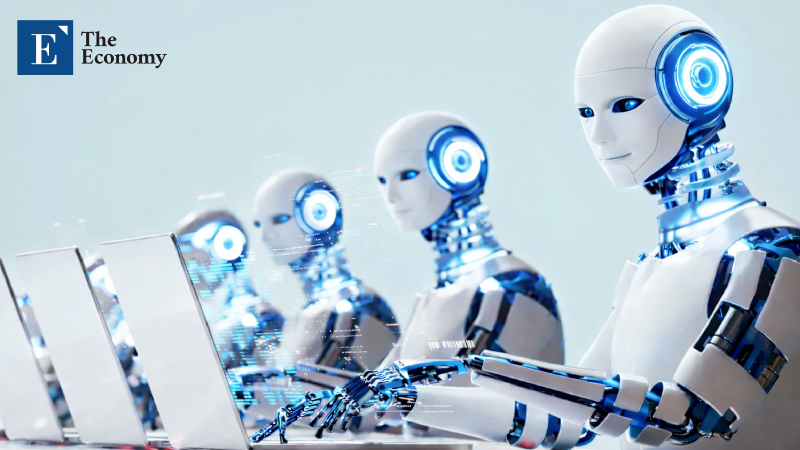
The global labor market is undergoing a rapid restructuring driven by the accelerated advancement of artificial intelligence. As large-scale layoffs ripple through U.S. technology giants such as Amazon and Meta, unemployment among highly educated young workers has entered a phase of structural transition. With white-collar positions shrinking at speed, migration toward blue-collar jobs is emerging as an alternative. Yet warnings are mounting that advances in robotics and automation will make even this shift an unreliable long-term buffer.
AI Adoption Extends to Complex Professional Decision-Making
According to local media including The Wall Street Journal on the 1st (local time), Amazon announced late last month plans to cut an additional 16,000 positions, primarily across white-collar roles. This brings total layoffs over the past three months to 30,000. Reuters reported that the cuts amount to roughly 10% of Amazon’s office workforce, marking the largest downsizing in the company’s 30-year history. Amazon had already laid off 14,000 employees last October. At the time, Beth Galetti, Amazon’s senior vice president, cited AI-driven innovation as a key factor behind the decision, stating that “AI is enabling companies to innovate faster than ever before.”
This trend is not confined to Amazon. Meta has announced a phased layoff of 1,500 employees—around 10% of staff—within Reality Labs, the virtual and augmented reality division that once symbolized the company’s identity. Layoffs.fyi, a website tracking corporate downsizing, estimates that nearly 40,000 workers were laid off last year by tech companies headquartered in the San Francisco Bay Area alone. This figure is roughly four times the combined headcount of OpenAI and Anthropic. Hiring conditions are also deteriorating rapidly. Data from job platform Indeed show that job postings in the San Francisco region fell 37% compared with 2020, while entry-level hiring at the top 15 U.S. tech firms dropped 55% from 2019 levels.
Against this backdrop, warnings are intensifying over the disruptive impact of AI’s rapid evolution on the labor market as a whole. Geoffrey Hinton, a University of Toronto professor widely regarded as a godfather of modern AI, argues that the pace of AI advancement has already surpassed humanity’s capacity to adapt. “AI’s computing and processing power is doubling roughly every seven months,” Hinton noted, emphasizing that the speed is on a fundamentally different scale from past industrial revolutions or digital transitions that unfolded over decades. He warned that if this trajectory persists, the employment market is more likely to experience abrupt structural collapse at a tipping point rather than gradual adjustment, as the foundations of existing jobs erode.
The transformation is unfolding in distinct phases by occupation. Hinton projects that within the year, AI substitution will become pronounced in basic cognitive tasks such as customer service, scheduling, and administrative support. By 2027, AI adoption is expected to spread across broader white-collar domains including accounting, legal research, standardized news writing, and marketing copy production. By 2028, AI systems may reach the stage of handling complex professional decision-making, and by the early 2030s, a significant share of white-collar labor could be rendered nonessential. The software engineering sector, in particular, is expected to face severe disruption as programming projects that once took months can now be completed by AI in a matter of hours.
Rising Senior Productivity Eliminates the Need for Entry-Level Roles
Young workers are also absorbing the direct shock of AI expansion. In a report analyzing U.S. federal unemployment data, Oxford Economics observed that unemployment rates among college-educated youth across major economies are rising rapidly, undermining long-standing assumptions of employment stability. The report concludes that the shift reflects a structural transformation driven by technological change rather than a cyclical downturn. While educational attainment once created clear gaps in unemployment rates, the contraction in high-skilled hiring has sharply narrowed those differences.
Following the 2008 global financial crisis, the unemployment gap between degree holders and non-degree workers exceeded 8 percentage points, but shrank to around 1 percentage point last year. Unlike the COVID-19 pandemic, when service-sector collapse disproportionately hit non-degree workers, the current phase is marked by AI-driven pressure on highly educated labor. Where technological progress previously replaced jobs while generating new ones, productivity gains are now enabling organizations to bypass entry-level hiring altogether.
In practice, AI adoption has sharply increased the productivity of senior staff, reducing demand for junior positions and rapidly entrenching this pattern. The AI-induced employment shock is no longer confined to specific industries or roles but is reshaping vertical organizational structures as a whole. Oxford Economics cautioned that even computer science degrees—once regarded as a near-guarantee of employment—are losing their former appeal, warning that a sustained slowdown in demand for technical talent could eventually constrict the future supply of such professionals.
China, which has long leveraged vast labor resources to build industrial competitiveness, is not immune to these pressures among highly educated youth. McKinsey & Company noted that Chinese firms are pivoting toward heavy investment in emerging industries rather than reviving traditional economic sectors, channeling trillions of dollars annually into AI development. The consultancy warned that rapid automation could accelerate the spread of already severe unemployment across Chinese society. Yi Gang, a former central bank governor and now a professor at Peking University, echoed concerns that AI-driven human substitution could entrench long-term mismatches between labor supply and demand.
China’s youth unemployment situation has become a ticking time bomb. Official data released last December put the youth unemployment rate at 16.5%, but academic estimates suggest the true figure may be approaching 50%. Competition is intensifying even in digital and innovation-driven sectors that once suffered labor shortages. According to recruitment platform Maimai, the talent supply-demand ratio in new-economy sectors hit a record high of 2.23 last October, meaning job seekers outnumbered available positions by more than two to one. Maimai added that the AI sector itself has entered an oversupply phase for the first time this year, with the ratio exceeding 1.
White-Collar Contraction Drives Youth Toward Blue-Collar Work
The rapid transformation of the labor market is reshaping young people’s career perceptions, shifting priorities from status to practical returns. Data from the China New Employment Forms Research Center show that 68% of those born in the 1990s are considering blue-collar occupations, with 32.7% having already transitioned from white-collar roles. China’s blue-collar labor market is expanding both quantitatively and qualitatively. As of 2024, the country had 425 million blue-collar workers, with average monthly wages rising 1.77% year-on-year to approximately $854. Wage growth has been particularly strong in technology-intensive roles, highlighting a clear skills premium.
A similar shift is emerging among South Korea’s younger generations. In a survey conducted last year by recruitment platform Catch involving 1,603 job seekers born between 1995 and 2007, respondents were asked to choose between a blue-collar job paying roughly $52,000 annually with shift work and a white-collar job paying about $22,000 with no overtime. A total of 63% expressed positive views toward blue-collar employment, while only 7% responded negatively. Among those favoring blue-collar work, 80% cited higher pay and lower layoff risk. As white-collar jobs lose their status as a stable fallback, more young workers are prioritizing income predictability and employment security.
Yet some argue that blue-collar roles are far from a safe haven. Tesla CEO Elon Musk has described the company’s humanoid robot Optimus as a general-purpose labor force capable of fully replacing human workers, predicting that labor market restructuring will begin around 2030. With mass production, Optimus is expected to be priced at roughly the level of a mid-sized passenger vehicle, potentially accelerating adoption. As AI integration further enhances robotic intelligence, even skilled technical trades may face substitution pressure. With automation and robotics advancing in tandem, blue-collar employment is unlikely to offer a definitive solution, leaving labor market uncertainty deeper and more pervasive than before.
Oliver Griffin is a policy and tech reporter at The Economy, focusing on the intersection of artificial intelligence, government regulation, and macroeconomic strategy. Based in Dublin, Oliver has reported extensively on European Union policy shifts and their ripple effects across global markets. Prior to joining The Economy, he covered technology policy for an international think tank, producing research cited by major institutions, including the OECD and IMF. Oliver studied political economy at Trinity College Dublin and later completed a master’s in data journalism at Columbia University. His reporting blends field interviews with rigorous statistical analysis, offering readers a nuanced understanding of how policy decisions shape industries and everyday lives. Beyond his newsroom work, Oliver contributes op-eds on ethics in AI and has been a guest commentator on BBC World and CNBC Europe.
Similar Post