“Digital Sovereignty Over Iconic Architecture” Saudi Arabia’s ‘The Line’ Pivots to an AI Data Center Hub Amid Cost Overruns and Construction Delays

Authored On
Modified
From Surreal Vision to Reality Check
A Choice Forged by AI Competition and Fiscal Pressure
NEOM’s Geography Optimized for Cooling and Renewable Energy Supply
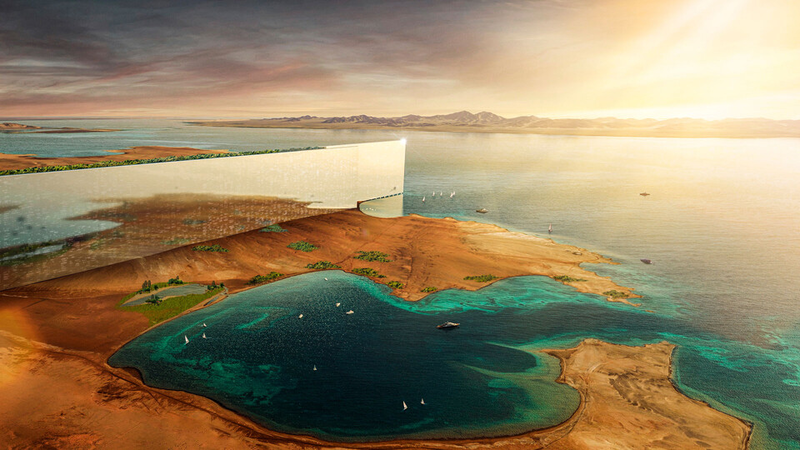
Saudi Arabia’s ambitious future city project, The Line, has shifted its strategic direction—from a linear residential city designed to house nine million people to an artificial intelligence (AI) data center hub. The NEOM project, a flagship of Saudi Arabia’s Vision 2030 aimed at reducing dependence on oil, is moving its center of gravity from icon-driven architectural spectacle toward pragmatic efforts to secure real computing competitiveness. The assessment appears to be that securing data-processing capacity—the core resource of the computing era—offers greater economic returns than constructing the world’s longest building.
Fiscal Pressure Spurs Downsizing of The Line
According to the Financial Times on February 2, the Saudi government is currently discussing plans to reconfigure NEOM into a data center–centric hub. At the center of the deliberations is The Line, the ultra-tall linear city that had been envisioned as a 170-kilometer-long structure composed of mirrored walls 200 meters wide and 500 meters high. Designed to operate entirely on renewable energy without cars or roads, it was once described as a miracle rising from the desert.
However, surging raw material prices and the cost burden associated with highly complex construction methods have fueled doubts over the project’s economic viability. These concerns emerged during a year-long review of NEOM’s progress by the Saudi government. Despite more than $50 billion already invested, construction progress has been sluggish. As a result, Saudi Arabia’s Public Investment Fund (PIF) recorded impairment losses of $8 billion last year, while the first-phase completion target—originally set at 20 modules by 2030—was reduced to just three.
At the same time, workforce restructuring is underway at construction sites, with hundreds reportedly laid off from a staff of roughly 6,000. Saudi Arabia has also tightened its fiscal stance across other high-cost initiatives, including sports league acquisitions and gaming industry investments. Prolonged oil price weakness has reduced the financial headroom of the sovereign wealth fund created to facilitate economic diversification. Preparations for Expo 2030 and the 2034 FIFA World Cup are further adding to the government’s financial burden.
Against this backdrop, Saudi Arabia has fundamentally revised its original plan to relocate millions of residents. Large portions of the space initially allocated for apartments and public facilities are now slated to be converted into data centers and AI infrastructure. The shift reflects the judgment that server infrastructure for AI model training and deployment offers stronger future economic competitiveness than residential construction. The pivot to a data center hub also leverages Saudi Arabia’s geographic advantages. AI servers generate immense heat, making efficient cooling systems essential. Located along the Red Sea coast, The Line can utilize seawater-based natural cooling, enabling cost-effective data center operations even amid the desert climate.

Big Deals With NVIDIA and AMD Accelerate Saudi Push
The technology industry views Saudi Arabia’s strategic shift as a rational response to global economic demand. As the proliferation of large language models (LLMs) strains server capacity worldwide, Saudi Arabia’s combination of vast land, stable power supply, and seawater cooling positions it well to attract investment from global big tech firms.
Saudi Arabia has been laying the groundwork for its transformation into a data center hub through close cooperation with leading global semiconductor and AI companies. Through Humain, an AI company under PIF, the Saudi government has announced plans to build 6.6 gigawatts of data center capacity over the next decade. Humain is currently in the process of securing AI chips from U.S. semiconductor firms.
A flagship partnership is with NVIDIA. In May last year, the two companies signed a strategic agreement to develop Saudi Arabia into a global hub for AI, GPU cloud computing, and digital transformation, leveraging NVIDIA’s platforms and technological expertise to jointly drive global innovation.
Humain plans to integrate state-of-the-art infrastructure, world-class AI models, immersive digital platforms, and talent development systems to establish itself as a leader in the global AI industry. Over the next five years, it intends to build hyperscale AI factories with capacity of up to 500 megawatts. These facilities will be powered by hundreds of thousands of NVIDIA GPUs, beginning with the deployment of 18,000 NVIDIA GB300 Grace Blackwell AI supercomputers in the first phase. Equipped with InfiniBand networking, the system will provide a secure and high-performance infrastructure for training and deploying large-scale sovereign AI models.
Humain will also adopt NVIDIA’s Omniverse 3D simulation and digital twin platform in a multi-tenant environment. This will enable digital simulation, optimization, and operation of real-world environments across manufacturing, logistics, and energy industries, accelerating the emergence of physical AI and robotics. In parallel, Humain is launching large-scale education and capability-building initiatives to disseminate AI expertise among Saudi citizens. Through hands-on training in AI, simulation, robotics, and digital twin technologies, the company aims to cultivate thousands of skilled professionals and contribute to Vision 2030’s core objectives of economic diversification and digital leadership.
In addition, Humain has signed a $10 billion AI infrastructure agreement with AMD. Discussions reportedly included the possibility of AMD acquiring an equity stake in a Saudi special-purpose fund. Saudi Arabia has also partnered with Qualcomm and Cisco, while Humain has signed a 500-megawatt data center construction contract with xAI, the AI startup founded by Elon Musk.
UAE Also Accelerates Its AI Hub Ambitions
Saudi Arabia is not alone in its push to become a global AI hub. The United Arab Emirates (UAE) is also stepping up its efforts. According to Bloomberg, the UAE government last year explored plans to build advanced semiconductor manufacturing facilities in partnership with Taiwan Semiconductor Manufacturing Company (TSMC), the world’s largest foundry. Bloomberg reported that TSMC held multiple meetings in recent months with U.S. Middle East envoy Steve Witkoff and representatives of UAE investment firm MGX to discuss the project. If realized, TSMC would construct a gigafab in the UAE capable of processing more than 100,000 wafers per month.
Microsoft has also committed a total of $15.2 billion in investment in the UAE. This includes $7.3 billion invested between 2023 and last year, plus an additional $7.9 billion planned through 2029. The funds will support G42, a state-backed AI company, as well as the expansion of AI and cloud infrastructure across the UAE. The country is also pursuing the Stargate UAE project, a 5-gigawatt AI data center in Abu Dhabi in collaboration with OpenAI, NVIDIA, Oracle, and SoftBank—equivalent to the electricity consumption of roughly three million average U.S. households.
To strengthen its AI ecosystem, the UAE is aggressively securing specialized talent. It has set a target of training one million AI professionals by 2027 and established the Mohamed bin Zayed University of Artificial Intelligence (MBZUAI) in Abu Dhabi. Leveraging low tax rates, the UAE is also actively attracting overseas talent. According to an OECD analysis of LinkedIn data, the UAE ranked third globally in net inflows of AI-skilled professionals between 2019 and 2024.
Similar Post