[AI Robots] Humanoid With Body Heat Unveiled, China’s Robot Industry Eyes the High-End Market

Authored On
Modified
Entering a Phase of Precise Replication of Human Physical Conditions
Dual Strategy Combining Mass-Market Expansion and Premium Models
Proving Technology While Targeting High-Value Profitability
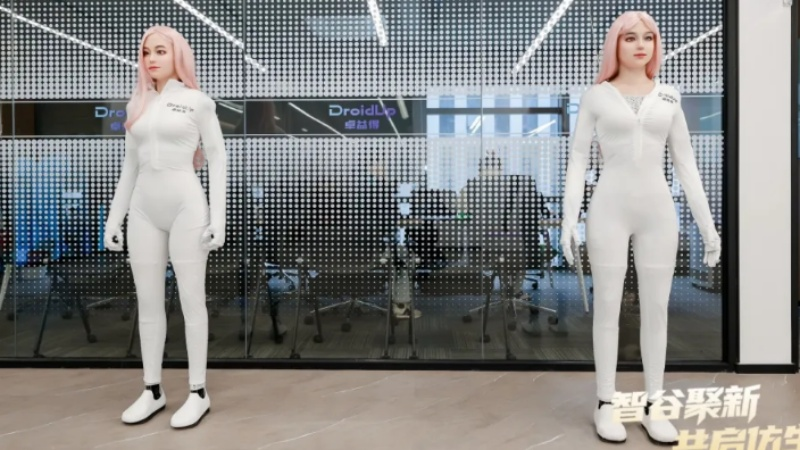
China has unveiled an ultra-high-priced humanoid robot capable of replicating human body temperature and skin texture, signaling a strategic shift across the country’s robotics industry. Moving beyond basic walking and motion execution, the emergence of a model that precisely mimics biological conditions highlights how far China has pushed the upper limits of humanoid technology. At the same time, China continues to rapidly expand the market base through large-scale production of low-cost humanoid robots. Within this dual structure—where mass adoption and premium positioning proceed in parallel—ultra-high-end models are emerging as a key instrument not only for showcasing technological prowess but also for testing profitability and industrial competitiveness.
Attempt to Reproduce Human-Like Warmth and Touch
According to tech outlet Sohu.com on the 3rd, Shanghai-based humanoid robot developer Zhuoyide Robotics recently unveiled Moya, an ultra-high-priced humanoid robot designed to faithfully reproduce human body temperature and skin texture. Standing 165 cm tall and weighing 32 kg, the robot resembles an adult woman in appearance and differentiates itself primarily through its “contact sensation.” Using eco-friendly silicone skin and an embedded intelligent temperature-control system, Moya is engineered to continuously maintain a body temperature of 32–36°C, an attempt to technologically recreate the warmth and tactile sensation experienced during human contact.
Moya’s biomimetic capabilities extend beyond touch. Its head contains 25 high-precision actuators capable of producing subtle facial muscle movements such as smiling, frowning, and nodding. The body features a joint structure with 16 degrees of freedom (DOF), allowing it to maintain balance during flat-surface walking, directional changes, and stair navigation. Zhuoyide stated that “Moya’s gait matches human walking patterns by approximately 92%,” adding that “high-precision 3D navigation combined with a distributed pressure-sensor system enables obstacle recognition and path planning even in complex indoor environments.”
The intelligence architecture also reflects a premium-model design. Moya incorporates Zhuoyide’s proprietary large language model (LLM), which retains conversational context and learns user responses over time. Designed for long-term interaction, the system identifies user preferences and emotional states to deliver customized responses. The company envisions Moya as an “emotional companion” deployable in caregiving, educational assistance, and high-end service environments. The launch price ranges from $168,000 to $210,000, underscoring a focus on technological completeness and symbolic value rather than mass distribution.
Industry observers have highlighted the rapid advancement of China’s humanoid robotics capabilities. The sector is simultaneously pushing premium features—such as temperature, tactile feedback, and emotional interaction—while developing industrial humanoids capable of operating in extreme environments. A representative example is Unitree’s humanoid G1, which demonstrated long-distance autonomous walking in temperatures as low as –47.4°C, proving all-weather operational viability. Such cases suggest that China is expanding humanoid robotics across a broad technological spectrum rather than confining development to a single application.
Localization of Components Accelerates Low-Cost Commercialization
Behind the push toward advanced robotics, China is also intensifying price competition through low-cost models. Ultra-high-end bio-mimetic robots define the technological ceiling, while mass-produced entry-level models rapidly expand market reach. Kaiyuan Securities noted in a report late last year that China’s humanoid robotics industry has moved from the “0-to-1” phase to the “1-to-10” phase, projecting entry into the “10-to-100” stage—mass production and full-scale diffusion—by 2026. Gaogong Robot Industry Research Institute forecast that humanoid robot shipments this year would reach 62,500 units, a year-on-year increase of over 650%.
Actual orders and deliveries suggest even faster momentum. UBTECH reported cumulative shipments of more than 1,000 units of its industrial humanoid Walker S2, with annual deliveries exceeding 500 units and annual order value approaching $196 million. Accordingly, its production target for this year was set at over 10,000 units. AgiBot is expected to expand from 5,100 units shipped last year to tens of thousands this year, while Galbot announced plans to deploy more than 1,000 embodied-intelligence robots in cooperation with Baida Precision. EngineAI reported securing orders for over 3,000 units in patrol and inspection applications alone.
This acceleration has been enabled by a sharp decline in component costs. Zhang Lei, chief scientist at the National-Local Joint Humanoid Robotics Innovation Center, noted that “the cost of electric humanoid robot joints, which stood at $7,000–$8,400 in 2018, has fallen to roughly one-tenth of that level following localization,” adding that this directly facilitated commercialization of low-cost models. Unitree Robotics’ Unitree R1 Intelligent Partner is priced at $4,186, while Noetix Robotics’ small humanoid Boomi launched with a pre-sale price of just $1,400.
As a result, China’s humanoid robotics market is crystallizing into a price-segmented dual structure. Low-cost models target consumer markets and large-scale industrial deployment, emphasizing price competitiveness and baseline performance stability. High-end models, by contrast, focus on emotional interaction, high-precision motion, and specialized environmental adaptability to serve distinct demand segments. The simultaneous expansion of mass-market robots priced below $1,400 and ultra-premium models exceeding $140,000 illustrates China’s strategy of combining technological diffusion with profitability experimentation.
Designing Sustainable Revenue Models Through Maintenance and Services
Within this dual strategy, China is increasingly prioritizing profitability through high-end products. While mass-market robots—often supported by government policy and industrial promotion—face margin constraints as standalone businesses, premium humanoids offer higher unit prices and clearer use cases, making revenue structuring more feasible. Companies including Unitree are expanding applications of high-end robots in precision manufacturing, hazardous operations, premium services, and R&D validation—fields where price sensitivity is low. This reflects a strategic push to raise per-unit profitability through technological intensity.
From a revenue perspective, premium humanoids also serve as hubs for ancillary income. Although initial acquisition costs are high, long-term operation contracts, maintenance services, software updates, and customized feature additions enable recurring revenue streams. This business model differs fundamentally from that of low-cost, volume-driven products. Consequently, Chinese robotics firms are concentrating proprietary control systems, high-DOF joints, high-torque actuators, and advanced sensor-fusion technologies in their premium offerings. Using high-end models to elevate overall technological maturity and subsequently transfer advancements to mass-market products mirrors a strategy long employed across China’s manufacturing sector.
Integration with artificial intelligence represents another core pillar of the premium strategy. China has rapidly combined high-performance AI with advanced humanoids through a specialized hardware-software ecosystem. Domestic AI systems such as Huawei’s Pangu model have been integrated with robotics platforms, delivering marked improvements in situational awareness and task-context understanding. This progression feeds into the acquisition of “embodied intelligence,” enabling large-scale physical data generated in real-world environments to loop back into algorithmic refinement. In this process, premium humanoids function as testbeds producing the richest datasets.
Similar Post