“Without a federation, there is no competitiveness” — Europe’s limits amid security and fiscal crises, as seen by a former ECB president

Stefan Schneider brings a dynamic energy to The Economy’s tech desk. With a background in data science, he covers AI, blockchain, and emerging technologies with a skeptical yet open mind. His investigative pieces expose the reality behind tech hype, making him a must-read for business leaders navigating the digital landscape.
Authored On
Modified
Call for “pragmatic federalism” spanning fiscal and industrial policy
Fiscal integration gap persists despite growth pressures in major economies
Security and foreign-policy autonomy issues reignite debate
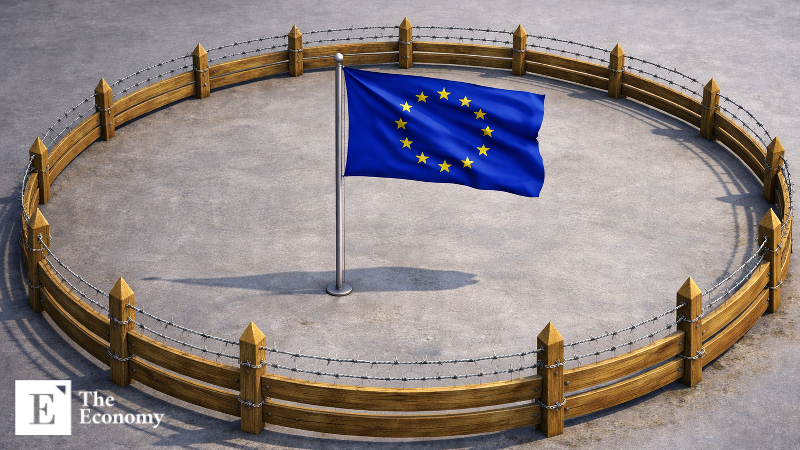
Europe risks deindustrialization and long-term decline unless it moves toward a “genuine federation,” according to a stark warning, as intensifying U.S.–China competition and mounting security uncertainty expose the limits of Europe’s fragmented fiscal, industrial, and defense policy framework. With fiscal pressure deepening across core economies such as France, Germany, and the United Kingdom, the absence of a common budget and tax system has emerged as a central constraint blocking deeper federal integration. A shift in the United States’ security posture has further sharpened the debate, fueling calls within Europe to reassess both the scope and the pace of integration.
“Crisis response is slow, policy execution weak”
According to Euronews on the 2nd (local time), Mario Draghi, former president of the European Central Bank (ECB), said in a commencement address at the Catholic University of Leuven in Belgium that the European Union (EU) must build a tighter federal structure to avoid deindustrialization and prolonged decline. He warned that “despite falling behind the United States and China in competitiveness, the EU has yet to fully grasp the seriousness of the situation,” adding that “with the current speed of response and policy intensity, Europe risks undermining both its industrial base and its political autonomy.”
Draghi stressed that Europe’s operating environment has changed fundamentally. He described today’s international setting as a “dysfunctional system,” tracing its roots to the period following China’s accession to the World Trade Organization, when Western economies aggressively expanded trade. Those choices, he argued, ultimately produced political backlash and weakened norms. “The bigger problem lies in what followed,” Draghi said, noting that the United States now combines tariffs, industrial subsidies, and security arguments to exert direct pressure on Europe, while China leverages control over key supply-chain links and adjusts volumes to project influence.
He contrasted areas such as trade, competition, and monetary policy—where Europe already operates in a quasi-federal manner and can act as a single entity—with defense, industry, and foreign policy, where fragmented national authority leads to delays and paralysis, leaving Europe vulnerable to pressure from major powers. This fragmentation, he said, contributes to perceptions of Europe as a “loose collection of mid-sized states.” “The current degree of fragmentation gives external actors room to pressure Europe sequentially,” Draghi warned.
Draghi has raised similar concerns before. In September 2024, in his report on “The Future of EU Competitiveness,” he argued that restoring competitiveness would require additional annual investment of about $944 billion (converted from €800 billion). Yet only 11.2% of that target has been implemented over the subsequent year. Against the backdrop of confirmed policy outcomes—deindustrialization and weak growth—his renewed emphasis on a “genuine federation” and “pragmatic federalism” reflects the view that Europe can no longer afford loose consensus and country-by-country calculations.
Common budget and tax agreement remains elusive
Europe’s deepening sense of crisis is rooted in the deteriorating fiscal position of its core economies. France stands out as particularly vulnerable. According to Eurostat, French government debt exceeded $3.89 trillion (converted from €3.3 trillion) as of the first quarter of last year, with the debt-to-GDP ratio reaching 114.1%. The fiscal deficit stood at -5.8% of GDP, far above the EU’s recommended ceiling of -3%. Even after Finance Minister Éric Lombard warned that International Monetary Fund (IMF) intervention could not be ruled out, meaningful fiscal consolidation has yet to materialize.
The United Kingdom is also flashing warning signals. Public debt amounts to 96.3% of GDP, among the highest in advanced economies, while yields on 30-year government bonds hover around 6%. The UK Office for Budget Responsibility estimates annual debt-interest payments at $152 billion (converted from £111.2 billion). In June alone last year, the government borrowed an additional $28.8 billion (converted from £21 billion), the second-largest monthly increase in 32 years, reinforcing concerns that fiscal management is increasingly reliant on borrowing.
Germany, long a champion of fiscal restraint, has likewise eased its constitutional “debt brake” amid economic slowdown and pressure to raise defense spending. For years, the rule capped the federal deficit at 0.35% of GDP, but policymakers found it untenable in the face of prolonged negative growth. The Financial Times projects Germany’s fiscal deficit to widen from $39.3 billion (converted from €33.3 billion) in 2024 to $148.8 billion (converted from €126.1 billion) by 2029, citing the difficulty of simultaneously funding defense and infrastructure.
Despite differing national circumstances, no mechanism exists to absorb these pressures collectively. The most glaring gap is the EU’s budgetary structure. The 2021–2025 EU budget amounts to just 1.14% of gross national income, rising to about 1.5% even when pandemic recovery funds are included. This contrasts sharply with U.S. federal spending of roughly 23% of GDP. Temporary tools such as the NextGenerationEU fund and Ukraine assistance have been mobilized during crises, but they have not restored durable fiscal capacity.
Security uncertainty and political variables
Changes in the United States’ transatlantic posture have become a direct external catalyst for renewed federal debate in Europe. Following Donald Trump’s return to the presidency, repeated signals questioning NATO commitments and pressing allies on defense-spending burdens have unsettled Europe’s security assumptions. As Washington increasingly treats alliances as transactional, European governments have been forced to reconsider security not as a national issue but as a matter of collective authority and shared fiscal capacity. This has strengthened arguments for bundling defense, fiscal, and foreign policy into a single policy framework.
U.S. interest in Greenland further exposed Europe’s fragile political cohesion. Citing strategic and security considerations, Washington raised demands regarding the Danish autonomous territory’s legal status. Despite the stakes—Arctic shipping routes, critical minerals, and missile-defense infrastructure—Europe failed to present a unified response, with national positions taking precedence amid the absence of EU-level foreign and security authority. The episode underscored how European territory and security interests can become bargaining chips for external powers.
Security uncertainty is also reshaping energy and industrial policy. In reducing reliance on Russian energy after the Ukraine war, Europe increased dependence on U.S. liquefied natural gas, tying prices and supply conditions more closely to geopolitical and security variables. At the same time, the United States has intensified domestic-first industrial policies and technology controls, directly pressuring European firms and markets. Fragmented national responses have struggled to generate sufficient bargaining power.
As alliance shifts and unpredictable political actions compound Europe’s low growth and internal divisions, the need for federal-level policy tools has grown more acute. With defense, diplomacy, and fiscal policy still segmented, Europe risks an inconsistent response to external shocks. Draghi’s warning—that Europe could lose strategic choice unless it reconstitutes collective authority and responsibility—captures the urgency of the moment. With security uncertainty likely to persist, European governments face a reality in which further delay of the federal debate may no longer be an option.
Stefan Schneider brings a dynamic energy to The Economy’s tech desk. With a background in data science, he covers AI, blockchain, and emerging technologies with a skeptical yet open mind. His investigative pieces expose the reality behind tech hype, making him a must-read for business leaders navigating the digital landscape.
Similar Post