Manpower Shortages, Obsolete Infrastructure, and Supply Chain Collapse Push ‘U.S. Shipbuilding Revival’ Further Out of Reach, Leaving Allied Shipyards as the Only Viable Solution

Authored On
Modified
U.S. Shipbuilding Loses Competitiveness, With Sixfold Cost and Sevenfold Time Gaps
Severe Shortage of Skilled Workers at U.S. Yards, High Wages Add to the Burden
Subsidies and Foreign Technology Alone Insufficient to Restore the Industrial Ecosystem
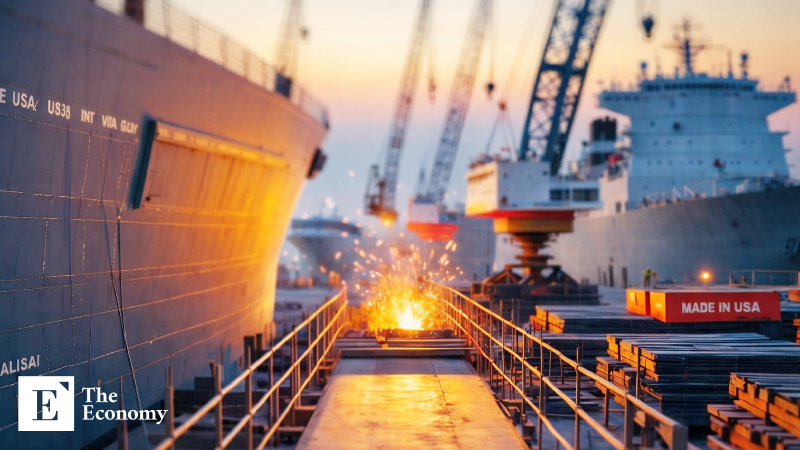
Pessimistic forecasts are mounting that U.S. President Donald Trump’s flagship second-term slogan, “Make American Shipbuilding Great Again,” will collide with harsh structural realities. With the United States having lost both price and delivery competitiveness in the global shipbuilding market, critics argue that restoring a collapsed industrial ecosystem within a short timeframe is virtually impossible. Ultimately, leveraging the capabilities of allied shipyards—particularly those in South Korea—is increasingly cited as the only realistic option to fill gaps in U.S. naval power and preserve maritime dominance.
U.S. Shipbuilding Market Share at 0.04%, A Stark Decline
According to the U.S. shipbuilding industry and Washington policy circles on February 3 (local time), Colin Grabow, deputy director of the Cato Institute, sharply criticized the Trump administration’s shipbuilding revival agenda in a January 28 commentary published by the Center for International Maritime Security (CIMSEC), calling it a “misplaced obsession.” He argued that America’s fixation on “Made in USA” is undermining security efficiency, dismissing attempts to revive a collapsed supply chain through subsidies as unrealistic.
The Trump administration’s shipbuilding push reflects the grim reality of a U.S. industry that lags far behind China. According to Grabow’s analysis, the U.S. commercial shipbuilding sector is in a state of near-total collapse. While China built 1,800 vessels in 2023, the United States completed just five. In terms of total commercial fleet size, the U.S. has only 178 vessels, compared with China’s fleet of more than 7,000. As of 2024, U.S. shipyards account for a mere 0.04% of global market share, with fewer than three large oceangoing commercial vessels built annually on average over the past decade.
The most critical issue is the loss of price competitiveness. The per-unit construction cost of an Aloha-class container ship currently being built at a U.S. yard stands at $334.5 million—more than six times the cost in China, where a comparable vessel can be built for about $55 million. The disparity extends to tankers as well: a vessel that would cost roughly $47 million overseas requires at least $220 million if built in the United States.
The gap is just as severe in delivery speed. For example, construction timelines at Korean and U.S. shipyards differ by roughly a factor of seven. The most recent container ship delivered by a U.S. yard took more than 40 months from keel-laying to delivery, while Korean shipyards delivered vessels of similar size in under six months during the same period. Grabow commented that “keeping an industry alive with taxpayer money after it has completely lost price and delivery competitiveness is not a security strategy—it is budgetary waste.”
Korean Shipbuilders’ Delivery Competitiveness, 70% of Orders Delivered Ahead of Schedule
Skepticism is also growing over the bipartisan “Shipbuilding and Harbor Infrastructure for Prosperity and Security Act (SHIPS Act)” promoted by the Trump camp. The bill envisions injecting $25 billion in federal funding to rebuild outdated shipyard infrastructure and expand the U.S. Navy fleet from around 290 vessels to 355. Eric Labs, senior naval analyst at the Congressional Budget Office, warned in a recent report that “without resolving the skilled labor shortage, increasing budgets alone will not make fleet expansion targets achievable.”
Labor constraints in the United States are indeed severe. At the Philadelphia Shipyard—acquired last year by Hanwha Ocean—annual employee turnover approaches 100%, compounded by widespread substance abuse issues among workers. Securing even basic labor, let alone skilled craftsmen, has become a major challenge. Infrastructure conditions are equally dire, with most facilities dating back to World War II and lagging decades behind technologically advanced Korean shipyards. High steel tariffs and the absence of a domestic component supply chain further drive construction costs sharply higher.
The Jones Act, which mandates domestic construction for vessels operating between U.S. ports, is also cited as a major impediment. Enacted in 1920, the law requires such vessels to be built in the United States, owned by U.S. entities, and crewed by at least 75% U.S. nationals. At the time, when U.S. shipbuilding was globally dominant, the law was designed to protect domestic industry and ensure rapid mobilization capacity during wartime.
Today, however, the significantly higher cost of U.S.-built vessels has constrained demand. While South Korea, China, and Japan expanded their global market share through cost competitiveness, the United States remained bound by the Jones Act, as its manufacturing capabilities steadily eroded. By retreating from fiercely competitive overseas markets and relying on a stable, high-margin domestic market, U.S. shipbuilding has seen its core competencies hollowed out. Once a global shipbuilding powerhouse in the mid-20th century, the United States now faces systemic industrial collapse across both commercial and naval yards due to aging facilities, workforce attrition, and chronic underinvestment.
Korean Shipbuilders’ Delivery Competitiveness, 70% of Orders Delivered Ahead of Schedule
Against this backdrop, the only viable path to reviving U.S. shipbuilding lies in leveraging allied shipyards. Experts broadly agree that sourcing modules or completed vessels from highly skilled shipyards in countries such as South Korea and Japan represents a far more realistic and cost-effective security strategy. Korean shipbuilders, in particular, are widely recognized for strict adherence to delivery schedules and overwhelming construction capacity, often outperforming Chinese competitors in securing new orders.
Rapid delivery has emerged as one of the most powerful competitive advantages in the global shipbuilding market. As freight rates decline, the value of early vessel delivery has increased further. Lower rates incentivize shipowners to accelerate fleet deployment, bringing vessels into operation sooner to maximize revenue. In this context, construction speed and delivery timing function as strategic determinants of shipowner profitability.
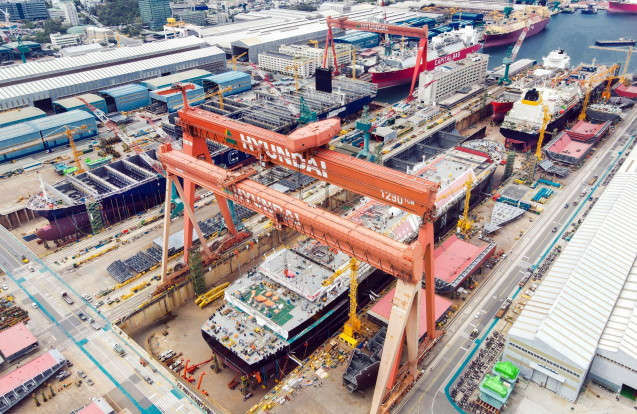
Korean shipbuilders’ ability to deliver vessels faster than overseas rivals is rooted in decades of dock operation expertise. HD Hyundai Heavy Industries, for example, operates nine docks simultaneously. By calculating block-level progress across each dock and optimizing dock allocation schedules, the company minimizes time and cost inefficiencies. It also employs the “tandem method,” which utilizes 30–40 meters of space between vessel blocks in fully occupied docks to conduct parallel block construction.
Kwon Hyo-jae, a researcher at Seoul National University’s Marine Systems Engineering Research Institute, noted that “inserting a new vessel schedule between existing slots requires simultaneously drafting designs and placing material orders under extreme time pressure,” adding that “only Korean shipyards with advanced technical capabilities and extensive experience can execute such high-difficulty operations.” An industry source echoed this view, stating that “Korean shipyards benefit from deep pools of highly experienced skilled workers, enabling superior manual craftsmanship and adaptive problem-solving during construction—areas where Chinese shipyards still lag despite heavy automation.”
Similar Post