[SMR] “Renewables Are Not Enough”: Europe’s SMR Drive Accelerates as East Asia Pushes Toward Commercialization

Aoife Brennan is a contributing writer for The Economy, with a focus on education, youth, and societal change. Based in Limerick, she holds a degree in political communication from Queen’s University Belfast. Aoife’s work draws connections between cultural narratives and public discourse in Europe and Asia.
Authored On
Modified
Europe shifts energy policy, steps up SMR development
EU expands institutional and financial backing
East Asia’s three major economies also focus on SMRs, with South Korea and Japan struggling on commercialization
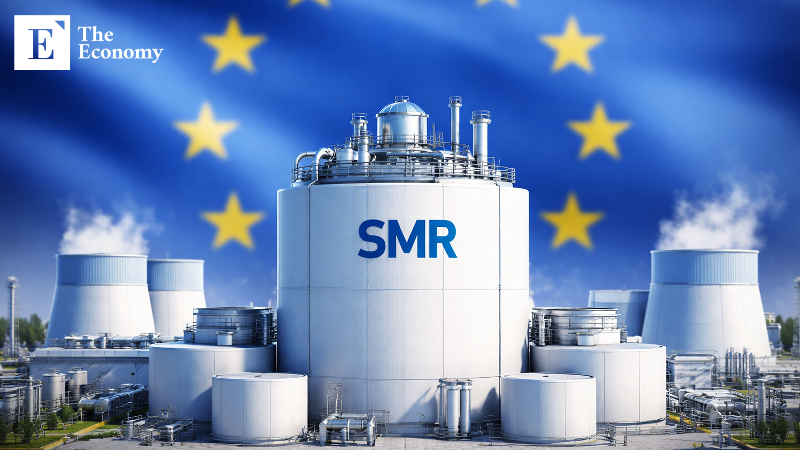
Across Europe, efforts to build small modular reactor (SMR) power plants are gaining momentum. The European Union and its member states, long at the forefront of decarbonization through renewable energy, are increasingly turning back to nuclear power in the name of energy security. This push to deploy SMRs is not confined to Europe; similar moves are being observed in major Asian economies including South Korea, China, and Japan.
European Countries Rally Behind SMRs
According to the nuclear industry on Feb. 4, Romania’s state-owned nuclear power operator Nuclearelectrica is set to make a final investment decision on the Doicesti SMR project at its shareholders’ meeting scheduled for Feb. 12–13 local time. The project involves constructing a 462-megawatt SMR facility on the site of a former coal-fired power plant in Doicesti. It will deploy six 77-megawatt modules of U.S.-based NuScale Power’s VOYGR-6 model, with total project costs estimated at $4.9 billion.
Latvia, which has relied heavily on renewable energy, has also recently launched a feasibility assessment for introducing SMRs, signaling a major shift in energy policy. The move reflects an assessment that SMRs are more suitable for the country’s conditions than large-scale nuclear plants, both technically and economically. Conventional large reactors, typically exceeding 1,000 megawatts, can strain the grids of countries with limited electricity demand such as Latvia, whereas SMRs can be more flexibly integrated into smaller grids. Their modular construction—manufacturing core components in factories and assembling them on-site—shortens construction timelines and lowers upfront capital burdens. In addition, SMRs can adjust output more flexibly, making them well suited to serve as backup power sources that offset the intermittency of renewables, which form the backbone of Latvia’s power supply.
The Czech Republic, under its SMR Roadmap approved in 2023, has set a goal of bringing its first SMR online by the mid-2030s. The government plans to develop an “SMR Nuclear Park” in the South Bohemia region and has begun technical demonstration work and licensing preparations. Rolls-Royce SMR has been selected as the primary technology partner, while discussions are also ongoing with other global leaders, including South Korea, to diversify supply chains.
EU Steps Up Support
At the EU level, institutional discussions are also advancing. In November last year, the European Commission launched the European SMR Alliance, a public-private partnership aimed at accelerating SMR technology development and deployment. The alliance unveiled a Strategic Action Plan that sets a target of operating SMRs in Europe by the early 2030s. Key implementation measures include revitalizing supply chains, expanding research and development and workforce training, and simplifying regulatory frameworks.
Budgets allocated to Euratom, the EU’s nuclear research program, are also expanding rapidly. The European Commission has proposed increasing Euratom’s nuclear fusion research budget from about $120 million in 2025 to roughly $305 million by 2028. Funding for nuclear fission research, which stood at around $60 million in 2025, is slated to rise to approximately $131 million by 2028. EU member states and the European Parliament will review the proposal and negotiate the final budget through 2028.
Industry experts, however, argue that current EU support remains insufficient. In an interview with Science|Business last year, Emmanuel Brutin, director general of nuclear industry group NuclearEurope, said that SMR vendors need substantial funding and clear targets to advance their research, accelerate deployment, and expand supply-chain capacity. While the planned increase in Euratom’s fission R&D budget is a positive step, he noted, it falls short of bridging existing gaps. Additional support through other EU funding mechanisms will be essential to speed up SMR deployment, he added.
East Asia’s Push Toward SMR Commercialization
Moves toward SMR commercialization are also evident across major Asian economies. China, under a new nuclear energy law that took effect this month, has explicitly codified the standardization of next-generation reactor designs such as SMRs and the deployment of high-safety technologies, laying the legal groundwork for mass production. The SMR known as Linglong One, currently under construction at the Changjiang nuclear power complex in Hainan province, is scheduled to enter full operation in the first half of this year. If the project proceeds as planned, China will become the first country to commercially operate a land-based SMR, roughly seven years after launching the project in July 2019.
Japan, in its revised energy plan released in February last year, removed its long-standing policy of “minimizing nuclear power” and set a target of raising nuclear’s share of the energy mix to 20% by 2040. Nevertheless, reactor restarts in some regions remain delayed due to local opposition and societal concerns. Hiroki Sato, chief executive of Chubu Electric Power, has stressed that overseas demonstration projects will be necessary to build confidence in next-generation reactors, projecting that domestic SMR commercialization in Japan will likely come after 2040.
In South Korea, the Ministry of Science and ICT and the Ministry of Climate, Energy and Environment are jointly backing the Innovative SMR (i-SMR) Technology Development Program, which aims to develop a Korean-designed i-SMR, secure regulatory approval by 2028, and achieve commercialization by 2030. Progress, however, has been slow due to limited policy support. According to the National Assembly’s legislative information system, a Special Act on the Promotion and Support of Small Modular Reactor Development cleared the Science, ICT, Broadcasting and Communications Committee in December last year and is currently pending before the Legislation and Judiciary Committee.
The bill mandates that the government establish a basic SMR system development plan every five years, assess implementation progress, foster capable private-sector players, and provide sites and funding necessary for rapid demonstration. While both ruling and opposition parties agree on the need for a dedicated legal framework beyond existing nuclear laws designed around large reactors, legislative momentum has stalled. Lawmakers’ attention is focused on the upcoming June local elections, and the ruling party has shown relatively greater interest in other clean energy sources than in SMRs, further delaying progress.
Aoife Brennan is a contributing writer for The Economy, with a focus on education, youth, and societal change. Based in Limerick, she holds a degree in political communication from Queen’s University Belfast. Aoife’s work draws connections between cultural narratives and public discourse in Europe and Asia.
Similar Post