Stability Versus Boldness: SK Hynix and Samsung Electronics Clash in Intensifying HBM4 Race, Nvidia Emerges Smiling

Authored On
Modified
SK Hynix confident in defending HBM leadership on the back of high yields and mass-production experience
Samsung Electronics opts for aggressive design, secures early HBM4 initiative through performance gains
As competition heats up and supply chains begin to shift, is Nvidia the ultimate beneficiary?
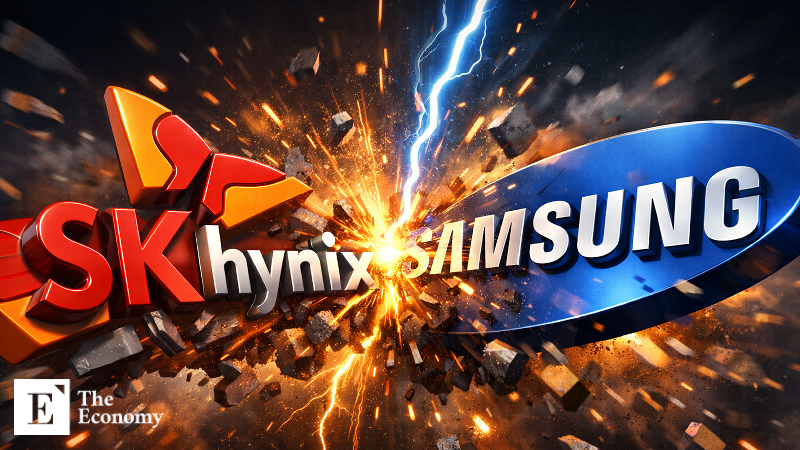
Competition between Samsung Electronics and SK Hynix over sixth-generation high-bandwidth memory (HBM4) is intensifying. While SK Hynix is doubling down on proven stability to defend its market leadership, Samsung Electronics appears to be gaining the upper hand in the early phase by embracing yield risk and making a decisive performance-driven bet. As the HBM market—long dominated by SK Hynix—rapidly reshapes with Samsung’s full-scale entry, analysts are increasingly suggesting that Nvidia, the key customer, stands to reap the greatest windfall.
SK Hynix’s Confidence in HBM4
On the 5th, Taiwan-based IT outlet DigiTimes reported that although both Samsung Electronics and SK Hynix have secured mass-production technology for 16-high stacked HBM4, a significant yield gap has resulted in a wide disparity in effective supply capacity. Samsung’s yield for its HBM-dedicated 10-nanometer-class sixth-generation (1c) DRAM is reportedly hovering in the 50–60% range. Given that the breakeven point for HBM mass production is generally considered to be around a 60% yield, this level remains underwhelming.
By contrast, SK Hynix has already achieved yields of 80–90% on its fifth-generation HBM3E products and is understood to be maintaining comparable yield levels for HBM4 through improvements in packaging processes.
SK Hynix has expressed confidence in its ability to maintain an edge over Samsung Electronics. During its earnings conference call following the release of fourth-quarter 2025 results on the 29th, an SK Hynix executive noted, “We are currently maximizing HBM production, but it remains difficult to meet 100% of customer demand,” adding that “entry by certain competitors is expected.” Even so, the executive asserted, “Market leadership and our position as a primary supplier—built on performance, manufacturability, and quality—will be sustained.”
The executive pointed to SK Hynix’s status as a first mover that has cultivated the HBM market since the era of third-generation HBM (HBM2E) in close collaboration with customers and infrastructure partners under a ‘one-team’ approach. Leveraging years of accumulated mass-production experience and customer trust in product quality, the company sought to send a clear signal to rivals. SK Hynix further stated, “Expectations and preferences among customers and infrastructure partners for HBM4 are exceptionally high,” adding that “there is a strong demand for SK Hynix products to be prioritized.”
Samsung Electronics Gains Early Upper Hand
However, it remains uncertain whether SK Hynix’s optimistic outlook will fully materialize. Samsung Electronics has significantly narrowed the gap by aggressively enhancing HBM4 performance through a bold design strategy. Unlike SK Hynix, which combines a mature fifth-generation (1b) DRAM with a base die manufactured on TSMC’s 12-nanometer process, Samsung has applied its 1c DRAM process directly to HBM4 and deployed its own foundry’s 4-nanometer process for the base die.
As a result, Samsung’s HBM4 has achieved an operating speed of 11.7 gigabits per second, meeting Nvidia’s required threshold of 11 gigabits per second.
Samsung’s relatively weak HBM4 yield is largely attributed to this performance-first, high-risk design choice. The 1c DRAM adopted for HBM features higher circuit density and more challenging thermal management than conventional DRAM, making manufacturing considerably more complex. While this approach has forced Samsung to shoulder a greater share of production risk, it has also enabled the company to effectively secure supply contracts with key customers ahead of SK Hynix and Micron.
During its fourth-quarter 2025 earnings conference call, Samsung Electronics stated, “Qualification tests with major customers have progressed smoothly and have now entered the final stage,” adding that “starting in February, we plan to begin full-scale shipments, including the industry-leading 11.7-gigabit-per-second products.” This marked Samsung’s formal confirmation that it would become the first supplier to deliver HBM4 to Nvidia on a commercial basis, going beyond paid sample shipments.
SK Hynix’s HBM4, meanwhile, is understood to remain in the qualification and refinement stage. In late October last year, SK Hynix reportedly discovered certain circuit defects during a near-final certification phase for large-scale HBM4 supply to Nvidia. An industry source commented, “After modifications, SK Hynix’s HBM4 has recently reached a level where mass production is feasible,” adding that “the company is gradually aligning performance with Nvidia’s 11-gigabit-per-second requirement.” Once qualification is completed, SK Hynix is expected to continue supplying samples throughout the first quarter under Nvidia’s terms, with full-scale shipments likely to begin as early as late in the first quarter or in the second quarter.

Nvidia’s ‘Windfall’ From Escalating Competition
The intensity of competition between the two firms is also evident in their willingness to pursue high-risk ramp-up strategies. Risk production—defined as activating manufacturing lines before customer qualification tests are completed—is widely regarded as a high-stakes approach, as any failure in final qualification or subsequent design changes can result in the entire output being written off. Despite these risks, SK Hynix is reported to have launched HBM4 production lines around September last year, with Samsung following in October. This aggressive move is interpreted as a strategic bid to secure demand ahead of Nvidia’s Rubin platform launch. Given that HBM4 carries a lead time of at least four to five months, waiting until after certification to begin mass production would make timely delivery to Nvidia effectively impossible.
As Samsung Electronics—previously sidelined in the HBM3E race—rapidly emerges as a peer competitor to SK Hynix, market observers anticipate a seismic shift in the AI semiconductor supply chain that had long revolved around SK Hynix. Until now, the HBM market has been characterized by SK Hynix’s dominance with Micron in pursuit, amid chronic supply shortages. Samsung’s overwhelming production capacity could partially alleviate these imbalances and reshape the competitive landscape. According to Counterpoint Research, projected global HBM4 market shares this year stand at 54% for SK Hynix and 28% for Samsung Electronics—a notable change given SK Hynix’s historical share of over 60% in the broader HBM market.
There is also growing consensus that the escalating rivalry between SK Hynix and Samsung Electronics will translate into substantial benefits for Nvidia, the industry’s largest customer. HBM prices have been soaring amid intensifying competition for AI leadership. As competition between suppliers deepens, bargaining power in price negotiations is likely to shift partially toward Nvidia. Even for supply-constrained products such as HBM, the pace and scale of price increases could slow. Over the medium to long term, this effect may become even more pronounced as both suppliers compete not only on pricing but also on non-price terms—including long-term supply agreements, priority allocation, and customization—to accelerate yield improvements and packaging responsiveness. In such a scenario, upward momentum in average selling prices for HBM would naturally face increasing constraints.
Similar Post