“The Cheapest Place to Develop AI Is Space” — Elon Musk Moves Head-On to Solve Power and Heat Constraints with Orbital Data Centers

Anne-Marie Nicholson is a fearless reporter covering international markets and global economic shifts. With a background in international relations, she provides a nuanced perspective on trade policies, foreign investments, and macroeconomic developments. Quick-witted and always on the move, she delivers hard-hitting stories that connect the dots in an ever-changing global economy.
Authored On
Modified
Ambition to build space-based data centers
Solar power and laser communications
A solution to power shortages and land constraints
Elon Musk has put forward the construction of space-based data centers as the strategic rationale behind the merger of his space company SpaceX and his artificial intelligence startup xAI. The proposal amounts to a declaration that the center of gravity of AI computing infrastructure should shift from Earth to orbit. While the idea of launching one million satellites immediately triggered skepticism over cost and feasibility, it simultaneously presents a solution that addresses, in one stroke, the structural constraints facing terrestrial data centers: power supply, cooling, and physical space.
SpaceX–xAI Merger Formalized, Massive Launch of Compute Satellites Envisioned
According to Bloomberg on the 5th (local time), SpaceX announced on the 2nd that it had acquired xAI. Musk serves as CEO of both companies. While the transaction terms, including valuation and purchase price, were not disclosed, Bloomberg estimates the combined entity to be valued at approximately 1.25 trillion dollars. In a statement, Musk said the acquisition would allow the company to build “the most ambitious vertically integrated innovation engine on Earth—and beyond—spanning AI, rockets, space-based internet, mobile communications, and a world-class real-time information and free-speech platform.”
The merger is expected to accelerate SpaceX’s space data center ambitions. SpaceX recently applied to the U.S. Federal Communications Commission (FCC) for permission to launch up to one million satellites as part of its orbital data center plan. In its filing, SpaceX argued that such a satellite swarm represents “the most efficient way to meet surging AI compute demand,” framing the initiative as “a first step toward a Kardashev Type II civilization that harnesses the full energy of the sun.” The Kardashev scale, proposed in 1964 by Russian astronomer Nikolai Kardashev, classifies civilizations by their energy-use capacity: Type I uses planetary energy, Type II harnesses stellar energy, and Type III exploits energy on a galactic scale.
Musk reiterated the timeline last month at the World Economic Forum in Davos, predicting that space-based data centers could become a reality within two to three years. He reaffirmed that vision alongside the merger announcement. At the core of the concept is an integrated ecosystem that unites launch vehicles, energy storage systems, and AI computation. SpaceX already dominates the commercial launch market in terms of volume. Combined with Tesla’s energy storage manufacturing capabilities, solar generation and storage systems could be deployed in orbit, providing xAI’s models with an environment in which training and inference can proceed without constraint. Tesla’s humanoid robot, Optimus, could also be used to build, maintain, and service orbital data centers. The result would be a vertically integrated space-based data center ecosystem spanning rockets, infrastructure, and AI.
One Million Satellites, Annual Investment Estimated at Five Trillion Dollars
The scale of implementation, however, implies astronomical costs. According to a scenario outlined by global research firm MoffettNathanson, if SpaceX were to launch 200,000 satellites per year over five years, it would require roughly 3,300 launches annually—about nine per day. Even at peak levels, humanity’s total annual rocket launches have never approached such a figure, underscoring how radically different an industrial system this would demand.
The burden of launch vehicle production would also be immense. Even assuming SpaceX’s Starship vehicles could be reused 100 times each, at least 30 new Starships would need to be built every year. When additional missions for Mars, the Moon, and commercial launches are factored in, production would have to scale even further. And the challenge extends well beyond rockets. Supporting launches at this scale would require explosive expansion across the entire supply chain, from tanks and engines to satellite buses, electronics, solar panels, and optical communications modules—far beyond the capacity of today’s industrial framework.
The investment required is without modern precedent. MoffettNathanson estimates that building orbital data centers using Nvidia-based GPU systems would cost roughly 40–50 billion dollars per gigawatt of capacity. On that basis, adding 100 gigawatts annually would require 4–5 trillion dollars in capital expenditure. Once launch, satellite manufacturing, and infrastructure costs are included, total annual investment demand rises to around 5 trillion dollars. That figure is equivalent to roughly one-sixth of U.S. GDP and exceeds total global semiconductor capital expenditure, placing it well beyond the realistic capacity of any single private company. Even under a more optimistic scenario in which SpaceX introduces proprietary custom silicon to maximize efficiency, reducing annual investment to around 2 trillion dollars, the scale would remain historically unprecedented.
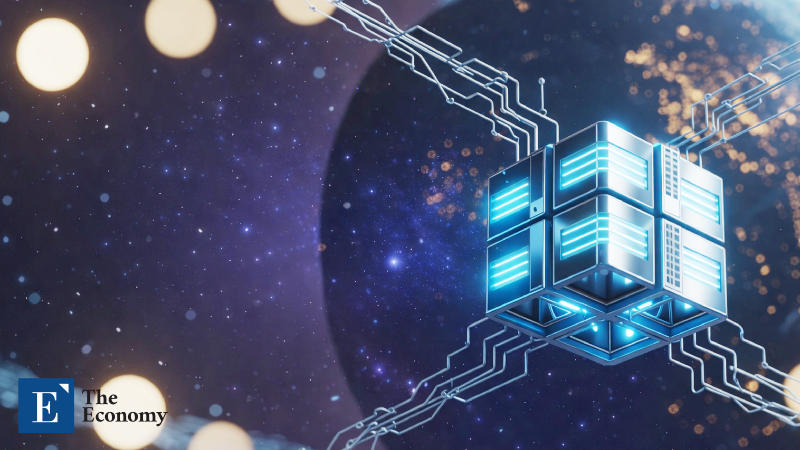
Round-the-Clock Power, No Cooling Water Required, Potential to Offset Build Costs
Over the long term, however, the cost structure could shift dramatically. The fundamental advantage of space lies in energy economics. Large language models require vast amounts of power not only during training but also during inference. AI data centers typically consume more than one gigawatt of electricity—roughly equivalent to the power usage of 800,000 households. On Earth, grid constraints and limited flexibility in power generation have delayed capacity expansion, driving concerns over supply stability and pushing electricity costs higher.
In orbit, solar panels operate without atmospheric interference, achieving up to eight times the productivity of ground-based systems and generating power continuously, without night, clouds, or shadows. This allows the high power densities required by AI accelerators to be sustained around the clock. Thermal management, another critical bottleneck on Earth, also becomes far simpler. Heat generated during computation can be transferred via internal heat pipes to external radiators and dissipated directly into deep space, approaching absolute zero. This eliminates the need for massive water-based cooling systems, reducing strain on terrestrial water resources and ecosystems.
Space is effectively limitless as well. While securing land for large-scale computing complexes on Earth is increasingly difficult, orbit offers ample room to deploy hundreds or even thousands of data center satellites. Regulatory burdens are also lighter. Whereas terrestrial data center projects often face approval processes lasting months or years, orbital deployment in the United States requires primarily mass-launch authorization from the Federal Aviation Administration (FAA) and constellation approval from the FCC.
Significant challenges remain. Chief among them is exposure to intense cosmic radiation, which can degrade or damage servers over time and complicate maintenance. The risk of collisions with meteoroids or space debris also persists. Yet these obstacles are increasingly seen as solvable. Advances in reusable rockets, space robotics, high-bandwidth laser communications, and modular hardware design are progressing rapidly. At the same time, technologies such as space-based solar power, on-orbit assembly and maintenance robots, and orbital manufacturing facilities are under active development, raising the likelihood that the technical barriers to space-based data centers can ultimately be overcome.
Anne-Marie Nicholson is a fearless reporter covering international markets and global economic shifts. With a background in international relations, she provides a nuanced perspective on trade policies, foreign investments, and macroeconomic developments. Quick-witted and always on the move, she delivers hard-hitting stories that connect the dots in an ever-changing global economy.
Similar Post