France Declares “Electricity Is the Core of Decarbonization,” Formalizes Nuclear Expansion Amid Post-Phaseout Repercussions

Authored On
Modified
First New Reactor in 25 Years Signals Industrial Re-entry
Power Supply Instability and Cost Pressures Rise After Nuclear Phaseout
Energy Strain Deepens Following Russian Gas Cutoff
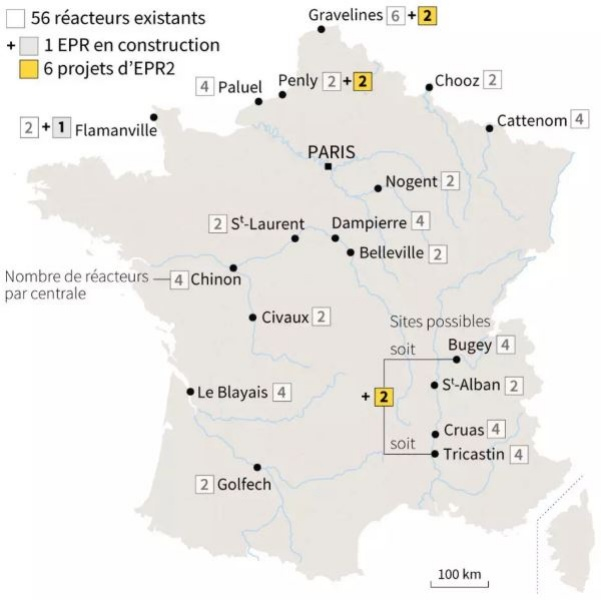
The French government has finalized a multi-year energy plan that includes the construction of six new nuclear reactors, declaring it will raise electricity’s share of total energy consumption from the current 30% to 60%. After years of prioritizing renewable energy under its decarbonization strategy, France is now shifting policy weight back toward nuclear power as renewable-driven efforts have failed to deliver sufficient results in both energy stability and cost control. Germany and Italy’s troubled nuclear phaseouts, recommendations from European scientific institutions labeling nuclear power a “strategic asset,” and accelerating initiatives in the Netherlands and Eastern Europe are collectively reshaping Europe’s perspective on nuclear energy.
Macron: “Europe Must Now Act Like a Global Power”
On the 10th, according to Euronews, French Prime Minister Sébastien Lecornu stated in an interview that “the core of national decarbonization lies in reviving electricity production,” adding that France will raise electricity’s share of energy consumption from roughly 30% to 60% by 2030. The government plans to formalize the measure through a decree and treat it as a major turning point in national energy policy. Lecornu explained that a broad electrification strategy will run in parallel, converting fossil fuel–dominated sectors such as transport, construction, and manufacturing to electricity-based systems.
Nuclear power has been positioned at the center of this expansion. The government confirmed a multi-year energy program that includes building six new nuclear power plants, combining nuclear as baseload power with renewable energy as supplementary capacity. This aligns with a renewed nuclear push that gained traction around 2024, when France connected the new Flamanville 3 reactor to the national grid, marking the country’s first new reactor in 25 years. Built by state-owned EDF, the European Pressurized Reactor (EPR) has a capacity of 1.6 gigawatts and can supply power to approximately two million households at peak output.
French industry has responded positively to the renewed nuclear push. In addition to confirming six new reactors, the plan includes an option to review up to eight additional units, moving beyond rhetoric toward implementation. The government also emphasized that nuclear and renewables should not be treated as mutually exclusive, pledging continued investment in solar, offshore wind, and geothermal energy while focusing on high-efficiency repowering for onshore wind projects in consideration of regional acceptance. The approach reflects an effort to balance supply stability with cost predictability.
Momentum has also been reinforced by President Emmanuel Macron. According to the BBC, Macron said Europe “must no longer remain confined to rules and procedures, but become an actor capable of exercising real power amid geopolitical competition.” He called for bold fiscal and political decisions in security, industry, and technology, placing energy independence at the center of that agenda. Macron also proposed raising $1.43 trillion annually through joint European debt and prioritizing investment in security, energy, and artificial intelligence, further strengthening the case for expanding domestic electricity capacity.
Gap Between Environmental Rationale and Policy Outcomes
France’s pivot back to nuclear power reflects the perceived failure of nuclear phaseout policies in neighboring countries. Germany began a gradual phaseout following the 2011 Fukushima disaster and shut down its final three reactors—Emsland, Neckarwestheim 2, and Isar 2—in 2023. However, renewable sources failed to fully replace nuclear baseload power. Solar and wind energy proved highly variable depending on weather conditions, while coal and gas reliance increased to maintain grid stability.
As a result, Germany has faced rising electricity prices and growing dependence on energy imports. Policies justified on environmental grounds have drawn criticism for failing to ensure power stability or cost control, while also complicating emissions reduction targets. The perception that nuclear phaseout failed to simultaneously achieve carbon reduction, supply stability, and cost management has spread across Europe. France’s decision to raise electricity consumption to 60% by 2030 reflects a determination not to repeat neighboring countries’ missteps.
Italy offers a stark example of the cost dimension. According to GlobalPetrolPrices.com, Italy’s average household electricity price from 2023 to 2025 was $0.417 per kilowatt-hour—2.3 times higher than in the United States and 5.5 times higher than in China. Italy voted to phase out nuclear power in 1987 following the Chernobyl disaster and shut down its last reactor in 1990. As a result, Italy’s annual spending on energy and electricity imports rose to approximately $61.9 billion, increasing fiscal pressure.
High electricity prices have had visible social consequences. Restaurants and cafés in tourist areas have posted electricity bills publicly to explain price hikes. Households have shifted appliance use to cheaper nighttime hours, increasing disputes over noise. In some cases, citizens have staged protests by burning electricity bills in public. These experiences in Italy and Germany have reinforced skepticism within Europe about nuclear phaseout policies.
Warnings of “Economic Risk” in Reactor Closures
European research institutions have underscored the strategic value of nuclear power. The High Scientific Council of the European Nuclear Society, headquartered in Brussels, recently described existing reactors as a “strategic asset” for the European Union. The council warned that Europe “does not have the economic or strategic margin to prematurely close safe, low-carbon nuclear plants,” urging immediate integration of long-term operation into national and EU-level energy strategies. The report emphasized the proven safety and low emissions of existing facilities.
These warnings have gained traction amid energy price volatility and supply instability following disruptions in Russian natural gas supplies. In Belgium, for example, three of four reactors at the Doel plant were shut down beginning in 2022, drawing criticism that the country’s energy independence had weakened. Concerns have also grown that premature closures of viable facilities would shift the financial burden of new infrastructure investments directly onto consumers.
Some countries have moved quickly to reverse course. The Netherlands’ new coalition government has approved construction of four nuclear reactors—including both large-scale plants and small modular reactors—aimed at achieving carbon neutrality and energy independence. Eastern Europe has also advanced nuclear-related projects. Romania is building a tritium removal facility under an EPC contract structure, with Czech firms supplying cable equipment.
South Korea has emerged as a potential partner in these developments. Korea Hydro & Nuclear Power recently secured a contract to supply power, communications, control, and fire protection cable equipment for Romania’s tritium removal project and plans to expand its European supply network in collaboration with Czech companies. Observers in Asia and elsewhere are closely watching Europe’s policy shift. The Netherlands’ nuclear expansion and Eastern European projects indicate that Europe’s redefinition of nuclear energy as a strategic asset has moved from declaration to execution.
Similar Post