[Semiconductor Supercycle] Surging NAND Prices Fuel Optimism and Caution, Debate Grows Over Supercycle Extension

Authored On
Modified
Production cuts in consumer NAND → price surge and supply instability
Supercycle expectations accelerate capital investment
China’s YMTC draws attention with strategy to scale into higher value segments
Global NAND flash prices have surged far beyond earlier projections, rapidly shifting the center of gravity in the market. As artificial intelligence (AI) infrastructure expands and demand for storage devices rises, NAND has emerged as a core strategic asset. The NAND market had long been dominated by Korean companies, but aggressive capacity expansion by U.S. and Japanese firms now signals a potential reshuffling of the competitive landscape. Adding to the uncertainty, Chinese players are leveraging NAND as a springboard to expand into higher value-added segments, pushing the market into an increasingly unpredictable phase.
U.S., Japanese, and Chinese Firms Accelerate Entry Into NAND Market
According to market research firm TrendForce on the 11th, global NAND flash contract prices in the first quarter are projected to surge by as much as 60% quarter-over-quarter. That figure nearly doubles the earlier forecast of around 30%, suggesting that the “supercycle” previously seen in the DRAM market is now unfolding in NAND as well. The broader growth trajectory of the NAND market also stands out. TrendForce explained that as AI infrastructure transitions from training to inference, demand for high-capacity enterprise solid-state storage (eSSD) has surged, elevating NAND flash to a core strategic asset.
The price spike stems largely from a reallocation of production resources on the supply side. With output of consumer NAND reduced and priority given to AI server demand, available supply has tightened sharply. Counterpoint Research projected that NAND flash prices in the first quarter would rise about 40% quarter-over-quarter, noting that average prices per gigabyte (GB) are expected to increase by at least 30%, while entry-level 128GB PC products have reportedly traded at premiums of around 50%. Samsung Electronics raised NAND contract prices by more than 100% quarter-over-quarter in the first quarter.
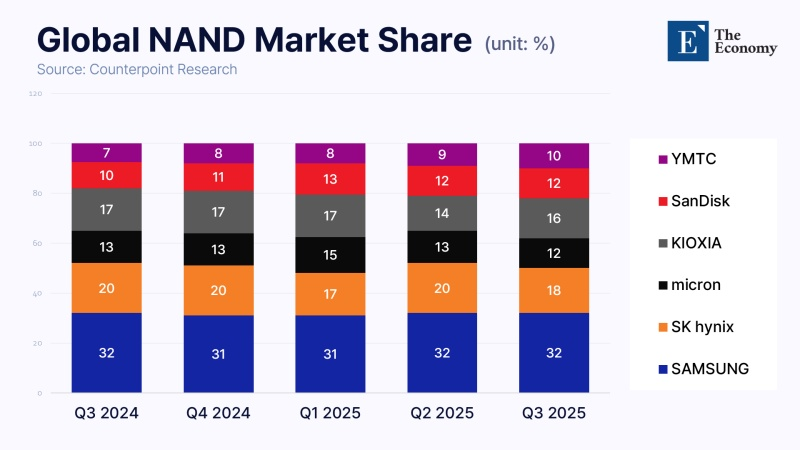
The global NAND market has traditionally been led by Samsung Electronics and SK hynix. As of the third quarter of last year, their respective market shares stood at 32% and 18%. Recently, however, U.S., Japanese, and Chinese companies have accelerated their push. Micron announced plans to double its NAND production capacity by 2028. The Kioxia–Western Digital (WD) alliance declared that its NAND output for 2026 is fully sold out and advanced mass production of its 332-layer 10th-generation NAND to within this year. China’s YMTC has also entered mass production of 270-layer NAND, positioning itself to expand market share.
Industry observers attribute this trend partly to NAND’s relatively lower technological barriers compared with DRAM. While DRAM competition centers on nanometer-level process scaling, NAND advances primarily through 3D stacking, leaving greater room for latecomers to expand influence. Continued price increases and expectations of further gains have further stimulated corporate investment sentiment. An industry official described the current trend as “close to the beginning of a memory golden cycle,” but cautioned that as Korean firms focus resources on high-bandwidth memory (HBM), leadership in the NAND market could shift.
Micron and Kioxia Move Aggressively on Capacity Expansion
Latecomers’ advances are materializing through large-scale investment and aggressive facility expansion. Micron announced plans to build a new advanced NAND fabrication plant in Singapore to expand capacity. In parallel, Micron is pursuing a long-term project in Clay, New York, investing $100 billion to construct four fabs. The structure places a NAND plant near an HBM packaging complex previously built with a $7 billion investment. Industry analysts characterize this as a strategic expansion aimed at balancing Micron’s memory portfolio.
Kioxia has likewise clarified its expansion strategy. At its Fab2 production line in Kitakami, Iwate Prefecture, Kioxia plans to mass-produce its 10th-generation 332-layer 3D NAND, BiCS10, starting next year. Equipped with a DDR 6.0 interface delivering up to 4.8Gb per second transfer speed, the model improves interface speed by more than 30% over the previous 8th generation. Bit density has also increased by approximately 59%. The 332-layer structure competes directly with SK hynix’s 321-layer, Samsung Electronics’ 286-layer 9th-generation V-NAND, and Micron’s 276-layer products.
Kioxia plans to expand NAND production from 4.71 million wafers last year to 4.82 million wafers this year. Vice President Tomoharu Watanabe stated, “We are confident that the NAND market will maintain rapid expansion for the foreseeable future,” adding that new investment decisions will be made monthly to meet growing demand. Because Kioxia maintains a NAND-focused business structure, it avoids capital allocation pressures from DRAM and can concentrate resources on expansion, positioning it favorably to strengthen supply leadership.
Diverging Views on Sustainability of Market Upcycle
Chinese firms led by YMTC aim to scale up within NAND and ultimately extend their influence into high-value segments such as HBM. YMTC is expediting equipment installation at its third fab in Wuhan to bring forward operations from the first half of next year to the second half of this year. Based on shipments, YMTC’s market share exceeded 7% in the third quarter of 2024 and rose above 10% in the third quarter last year, up 3 percentage points year-over-year. The strategy reflects efforts to expand its production base and customer pool in NAND and enhance bargaining power across the broader memory market.
The technology gap with leading firms has narrowed. At the end of last year, YMTC began mass production of 270-layer 3D NAND, reducing the layer-count gap with Samsung Electronics’ 286-layer and SK hynix’s 321-layer products. YMTC has outlined plans to develop 400-layer or higher NAND in the next generation. Higher layer counts increase storage capacity per unit area and directly affect cost competitiveness. Success in this race could influence both cost structure and profitability. YMTC has secured hybrid bonding-related patents and continues to push technological catch-up efforts.
Technology gains and cash flow from NAND feed into DRAM expansion. Chinese companies began producing DDR5 in earnest in the second half of last year. While the technology gap in DRAM between Korea and China was estimated at about five years as recently as 2022, recent analyses suggest it has narrowed to around two years. TrendForce noted that while Korean firms have entered HBM4 mass production this year, China remains at the HBM3 stage, indicating a gap of roughly three years. Still, as China advances technologically, the practical significance of that gap continues to diminish.
China’s domestic policy environment also accelerates technological catch-up. Despite U.S. export restrictions on advanced equipment, China has rapidly expanded semiconductor production capacity through substantial local government subsidies and localization initiatives. Each year, tens of thousands of engineering professionals enter the industry, contributing to rapid industrial scaling. If China extends its strengthened NAND position into DRAM and HBM, the duration and profit structure of the memory supercycle may inevitably shift, according to industry consensus.
Similar Post