Surging Tariff Revenues Temper Fiscal Strain, Yet Supreme Court Uncertainty and Household Burden Risks Persist

As one of the youngest members of the team, Tyler Hansbrough is a rising star in financial journalism. His fresh perspective and analytical approach bring a modern edge to business reporting. Whether he’s covering stock market trends or dissecting corporate earnings, his sharp insights resonate with the new generation of investors.
Authored On
Modified
U.S. FY2026 Tariff Revenues Surge 304%, Delivering Short-Term Fiscal Relief
Delayed Supreme Court Ruling Sustains Risk of Retroactive Refunds
Tariff Burden Shifted to U.S. Firms and Households, Raising Growth Concerns
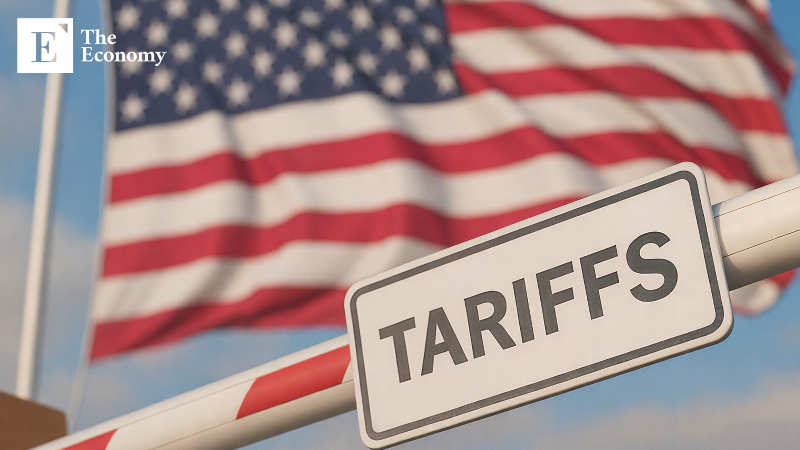
U.S. tariff revenues have climbed sharply. The protectionist trade posture advanced by President Donald Trump since April last year, marked by the imposition of reciprocal tariffs, has translated directly into a substantial expansion of federal receipts. While the short-term revenue windfall has partially eased fiscal pressures, the durability of this effect remains uncertain. The Supreme Court has yet to rule on the constitutionality of the tariff regime, and mounting analysis suggests the tariff wall may ultimately erode U.S. economic momentum.
Short-Term Validation of Trump’s Tariff Strategy
On Jan. 11 (local time), the U.S. Treasury reported that tariff revenues reached $30 billion for the month of January. Cumulative tariff collections for fiscal year 2026 have expanded to $124 billion, representing a 304% increase from the same period in fiscal year 2025. In April last year, the president imposed across-the-board tariffs on all goods and services imported into the United States and introduced additional country-specific reciprocal duties, significantly elevating trade barriers. Although the White House subsequently recalibrated certain high-rate tariffs through negotiations with key trading partners, the overarching protectionist framework remains intact.
The surge in tariff receipts has slowed the pace of federal deficit expansion. According to the Treasury, the federal budget deficit for last month stood at approximately $95 billion, down 26% year-on-year. On a cumulative basis, the fiscal year 2026 deficit totals $697 billion, a 17% decline from the comparable period in fiscal year 2025; adjusted for calendar effects, the reduction widens to 21%. This development offers meaningful relief for a government grappling with mounting debt obligations. U.S. national debt currently approaches $38.6 trillion.
A critical variable lies in the pending Supreme Court review of the tariff framework. In November last year, the Court heard oral arguments challenging the statutory authority underpinning the administration’s tariff justification. Market consensus had anticipated a ruling last month, yet no decision has been issued. The White House has reportedly expressed concern that an adverse ruling could necessitate refunds of previously collected tariffs. Should retroactive reimbursements materialize, much of the current fiscal improvement would dissipate.
Drivers of Intensifying Fiscal Pressures
With federal finances increasingly reliant on short-term revenue gains, economists identify rising interest expenses as a principal structural burden. Last year, federal net interest outlays amounted to 3.2% of gross domestic product. Projections from the Congressional Budget Office (CBO) indicate that this ratio will climb to 4.6% by 2036. The CBO baseline assumes inflation converges toward 2% annually over the coming decade, with the 10-year Treasury yield averaging 4.4% and the federal funds rate stabilizing at 3.3% by 2036.
The One Big Beautiful Bill Act (OBBBA), enacted last year, is also expected to amplify fiscal strain. CBO Director Phillip Swagel estimates that the legislation, which extends tax cuts while significantly increasing defense and border security spending, will generate an additional $4.7 trillion in deficits over the next decade. The administration’s stringent immigration restrictions further compound fiscal headwinds. The CBO projects that reduced immigration will constrain labor force growth and result in an additional $500 billion in cumulative deficits over ten years. Rising Medicare and Social Security expenditures driven by demographic aging continue to elevate federal spending trajectories.
Given the accumulation of adverse fiscal factors, deficit expansion is projected to persist. The CBO estimates that by 2036, the federal deficit will reach $3.1 trillion, equivalent to 6.7% of GDP, substantially exceeding the 50-year historical average deficit ratio of 3.8%. Federal debt held by the public, which stood at 99% of GDP at the end of last year, is projected to rise to 107.7% by 2030, surpassing the post-World War II peak of 106% recorded in 1946. A Supreme Court ruling mandating tariff refunds would further accelerate fiscal deterioration.
Mounting Criticism: Tariffs as Economic Self-Inflicted Pressure
A growing body of research challenges the premise that the tariff strategy confers net economic advantage on the United States. Analysts argue that the overwhelming share of tariff costs has been absorbed by domestic importers and consumers rather than foreign exporters. Last month, Germany’s Kiel Institute for the World Economy (IfW), analyzing more than 25 million U.S. import records encompassing $4 trillion in trade data, found that of the $200 billion increase in U.S. tariff revenues recorded in 2025, only 4% was borne by foreign exporters, while 96% was passed through to U.S. purchasers.
Julian Hinz, who led the study, stated that tariffs function as a domestic tax burden, with American buyers ultimately absorbing the cost. The analysis concludes that tariffs have effectively operated as a consumption tax within the United States, reducing product variety and import volumes. The IfW further warned that sustained tariff increases could compress corporate margins and elevate consumer prices over the longer term.
Similar conclusions have emerged elsewhere. A recent report from Yale University’s Budget Lab estimates that the administration’s tariff policy has raised consumer prices by approximately 1.3% in the short term and reduced purchasing power by an average of $1,751 per household. The report projects a 0.4 percentage-point reduction in U.S. real GDP growth this year and a potential increase in the unemployment rate of up to 0.7 percentage points. Researchers at Harvard Business School likewise concluded in October last year that tariff pass-through effects contributed roughly 0.7 percentage points to the Consumer Price Index.
As one of the youngest members of the team, Tyler Hansbrough is a rising star in financial journalism. His fresh perspective and analytical approach bring a modern edge to business reporting. Whether he’s covering stock market trends or dissecting corporate earnings, his sharp insights resonate with the new generation of investors.
Similar Post