"10 Trillion Dollars in Global GDP Could Vanish in the Event of a Chinese Invasion of Taiwan" Russia-Ukraine War Demonstrates Wartime Economic Shock, Taiwan Strait at Risk of Similar Turmoil

Authored On
Modified
A Chinese invasion of Taiwan could slash global GDP by 10%, with South Korea and Japan Facing Direct Impact
Semiconductor Supply Chain Collapse Threatens Advanced Industries and Financial Markets
Russia-Ukraine War Imposes Massive Economic Losses Amid Protracted Conflict
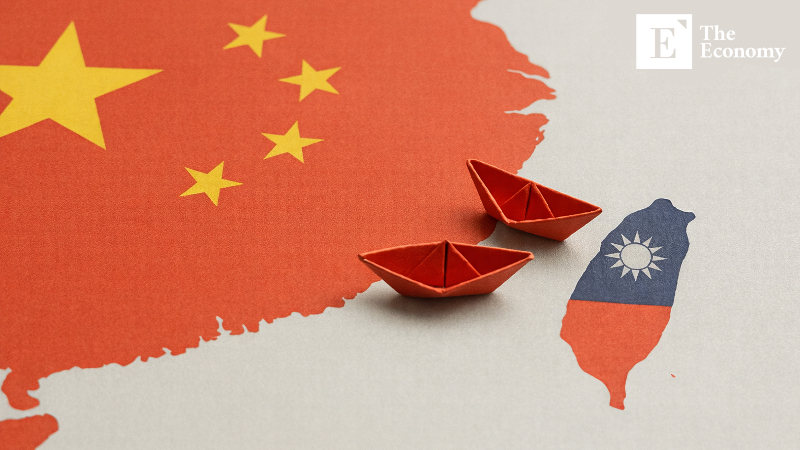
An analysis has warned that a Chinese invasion of Taiwan would deliver an unprecedented shock to the global economy. Damage to the semiconductor supply chain, the backbone of advanced industries, would rattle global manufacturing and financial markets alike, with projections indicating that roughly 10% of global gross domestic product could evaporate. In recent years, the Russia-Ukraine war has clearly demonstrated the severe economic fallout of armed conflict, and as tensions in the Taiwan Strait escalate, concerns across the international community are intensifying.
China-Taiwan Military Clash Poised to Deliver Severe Blow to Global Economy
According to a report released on the 10th (local time) by Bloomberg Economics, a war triggered by a Chinese invasion of Taiwan could erase $10.6 trillion, equivalent to 9.6% of global output, in the first year alone. The projected shock would exceed that experienced during the COVID-19 pandemic and the 2007–2009 global financial crisis.
The report forecasts that a conflict would effectively sever the world from the semiconductor supply chain. Taiwan Semiconductor Manufacturing Company (TSMC), the linchpin of Taiwan’s chip industry, accounts for 70% of global foundry revenue and manufactures semiconductors for leading global technology firms. The combined market capitalization of TSMC’s top 10 customers, including Nvidia and Apple, approaches $14 trillion. Any disruption to Taiwan’s semiconductor supply chain would therefore reverberate across the global industrial landscape. Given that these firms have been a primary driver of equity market gains in major economies, financial markets would likely face profound turbulence.
Global trade would also sustain a direct hit. In the event of war between China and Taiwan, revenues at China’s state-owned shipping giant COSCO are estimated to decline by 63% to 68%, while major South Korean carriers such as HMM could see revenues fall by 38% to 43%. The Taiwan Strait serves as a critical maritime corridor through which more than one-fifth of global seaborne trade passed as of 2022. Bloomberg noted that the analysis does not incorporate potential supply disruptions of critical minerals heavily dependent on China or a contraction in artificial intelligence capital expenditure, suggesting that the actual scale of damage could be even greater.
Severe Losses Anticipated for Belligerents and Neighboring Economies
Country-specific projections underscore the magnitude of potential losses. China, as a direct combatant, would likely incur simultaneous costs from large-scale troop casualties and sweeping international financial sanctions. The U.S.-based policy think tank German Marshall Fund projected last month that China could lose 100,000 troops and suffer economic damage amounting to $10 trillion, equivalent to roughly half of its annual GDP, in the event of an invasion of Taiwan.
Taiwan itself would face devastating consequences, given China’s status as a top-tier global military power ranked among the world’s strongest. Bloomberg estimates that Taiwan’s GDP could contract by approximately 40% within a year of conflict. Among non-combatant nations, South Korea and Japan are projected to sustain the largest impact, with South Korea’s GDP potentially shrinking by 23.3% and Japan’s by 13.5% in the first year of war. The United States, positioned in a manner that would likely necessitate involvement, could see its GDP decline by 6.7% over the same period. The repercussions would thus extend well beyond the Taiwan Strait, engulfing neighboring economies.
These projections are rapidly evolving from theoretical scenarios into tangible risks. Since the normalization of U.S.-China diplomatic relations in 1979, the pillars sustaining peace in the Taiwan Strait have steadily weakened. The United States has gradually ceded elements of its military advantage, while China has increasingly signaled a willingness to use force to achieve unification. Simultaneously, Taiwan’s internal consolidation of a distinct democratic identity has diminished the prospects for peaceful compromise. Against this backdrop, some experts argue that China could attempt a forcible takeover of Taiwan within the next decade. The Atlantic Council recently reported survey findings indicating that 70% of experts anticipate the possibility of a Chinese invasion within ten years.
Russia-Ukraine War Illustrates Enduring Economic Scars of Conflict
The adverse economic consequences of war have been starkly demonstrated by the Russia-Ukraine conflict. In February of last year, the Kyiv School of Economics reported that direct infrastructure damage in Ukraine from the onset of Russia’s full-scale invasion in February 2022 through November 2024 totaled $170 billion. With hostilities continuing well beyond the assessed period, the cumulative damage has likely grown further.
The financial resources required for postwar reconstruction are equally staggering. According to the Fourth Rapid Damage and Needs Assessment (RDNA4), jointly released last February by the Ukrainian government, the World Bank, the European Union, and the United Nations, reconstruction and recovery costs over the next decade are estimated at $524 billion. This figure represents approximately 2.8 times Ukraine’s nominal GDP in 2024.
Russia’s economic toll has materialized through the combined weight of military expenditures and sanctions. Based on U.S. government estimates, Russia’s direct fiscal outlays related to the war reached $250 billion between 2022 and 2024. In addition, $340 billion in Russian central bank foreign exchange reserves were frozen under Western sanctions, while the country’s energy sector, a principal source of fiscal revenue, sustained severe disruption. Last November, the administration of U.S. President Donald Trump imposed sanctions on Russia’s largest oil companies, Rosneft and Lukoil. The European Union likewise began enforcing a ban last month on imports of fuel produced from Russian crude oil.
As a result, Russia’s tax revenues from the oil and gas sector fell to $5.1 billion last month, down 32.8% from December’s $7.6 billion and 64.8% from $14.5 billion a year earlier, marking the lowest level since the COVID-19 pandemic. As the war drags on and military spending persists, Russia’s financing channels have begun to narrow. Reflecting these pressures, the International Monetary Fund last month downgraded Russia’s economic growth forecast to 0.6% for 2025 and 0.8% for 2026, the weakest projections since 2014 excluding the pandemic period.
Similar Post