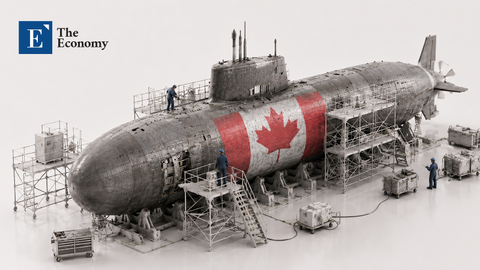
“An Illusion” Shadows U.S. Shipbuilding Renaissance Plan, as ‘Made in USA’ Cost Questions Mount

Stefan Schneider brings a dynamic energy to The Economy’s tech desk. With a background in data science, he covers AI, blockchain, and emerging technologies with a skeptical yet open mind. His investigative pieces expose the reality behind tech hype, making him a must-read for business leaders navigating the digital landscape.
Authored On
Modified
Gaps in production capacity, build costs, and supply chain concentration
Overseas construction followed by U.S.-based maintenance scenario
Skilled labor shortages and high wages complicate industrial revival
The U.S. government has elevated the revival of shipbuilding to a central pillar of its industrial strategy, rolling out large-scale support measures and institutional reforms. Yet among domestic research institutions and industry experts, skepticism prevails over whether a manufacturing base that has largely collapsed—and the competitiveness gap that has widened over decades—can be restored in the near term. As global shipbuilders, including those from South Korea, line up to expand into the U.S. market, questions surrounding the effectiveness of subsidy policies and the interplay of labor and immigration rules are converging, placing Washington’s “shipbuilding renaissance” vision at a crossroads of expectation and doubt.
Limits of a Subsidy-Centered Approach
The Cato Institute, a U.S.-based free-market think tank, described the government’s shipbuilding revival plan in a report published late last month as “little more than an illusion.” The institute argued that America’s “fixation on domestic production” risks weakening national security capabilities and criticized the notion that a deeply eroded supply chain can be revived through ancillary measures such as subsidies as fundamentally detached from reality.
Colin Grabow, associate director at the Cato Institute, characterized the U.S. commercial shipbuilding sector as being in a state of “near total collapse.” As of 2024, U.S. shipyards accounted for just 0.04 percent of global market share, and over the past decade delivered only 37 large oceangoing commercial vessels. By contrast, Chinese shipyards delivered 6,765 vessels—roughly half of global deliveries—while Japan and South Korea recorded 3,130 and 2,405 vessels, respectively, over the same period. On this basis, the report concluded that the United States resembles an outlier rather than a meaningful market participant and asserted that a short-term rebound is effectively unattainable.
Disparities in pricing and delivery timelines were also quantified. A container ship built at the Philadelphia Shipyard carries a price tag of approximately $330 million per vessel, compared with $55 million to $70 million at Asian shipyards—a gap exceeding fivefold. Construction timelines further underscore the divide: U.S. yards require roughly 40 months, while South Korean shipyards have reported delivering comparable vessels in just over six months in certain cases. Grabow noted that subsidies alone cannot compress both cost and time simultaneously.
The limits of policy instruments are equally apparent. President Donald Trump signed an executive order last April aimed at rebuilding the shipbuilding sector, acknowledging that “we are far, far, far behind.” The Office of the U.S. Trade Representative (USTR) subsequently introduced measures including sanctions on Chinese vessels and domestic build requirements, while Congress advanced subsidy legislation. Even so, the Cato Institute identified what it termed a “triple constraint” on U.S. shipbuilding recovery: shortages of skilled labor, aging facilities, and the absence of component and steel supply chains. It concluded that injecting public funds into an industry whose foundation has eroded is unlikely to restore competitiveness.
Full Local Construction Model Faces Profitability Questions
These structural challenges underpin skepticism that the recent wave of expansion into the U.S. by global shipbuilders from South Korea, Australia, Italy, and Canada will yield results commensurate with expectations. Since President Trump declared his intent to rebuild domestic shipbuilding, acquisition, joint venture, and facility investment plans centered on aging U.S. shipyards have followed in rapid succession. Yet industry observers caution that these moves should not be interpreted as an immediate pivot toward fully localized construction systems. Instead, most shipbuilders appear to be pursuing phased strategies to establish operational footholds in the United States.
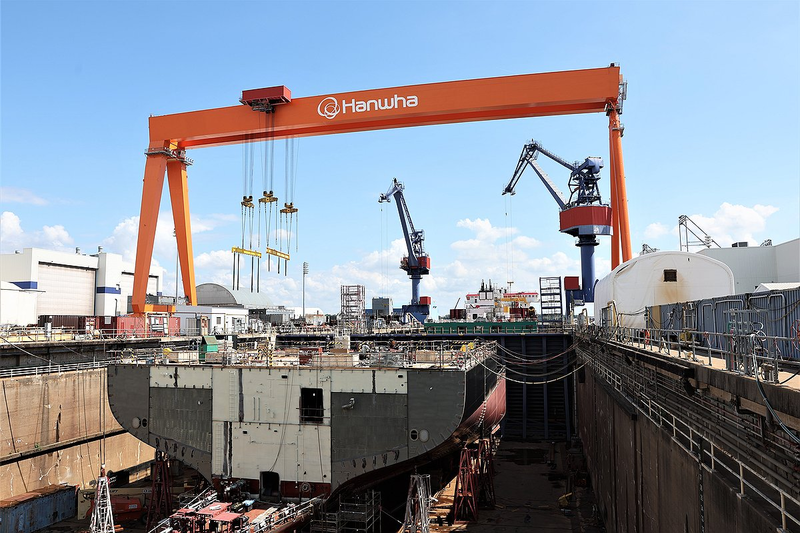
Hanwha Ocean has taken one of the most assertive approaches. After acquiring the Philly Shipyard in Pennsylvania in 2024, the company recruited retired U.S. Navy Rear Admiral Tom Anderson, who previously oversaw naval vessel programs, to strengthen its defense shipbuilding capabilities. However, with the yard currently focused on commercial vessels, any expansion into naval shipbuilding would require significant infrastructure upgrades and workforce expansion. Although President Trump has remarked that “South Korea’s nuclear-powered submarines will be built at the Philly Shipyard,” industry sentiment remains cautious regarding the feasibility of such plans.
HD Hyundai has opted for a collaborative model. It signed a memorandum of agreement (MOA) with U.S. defense shipbuilder Huntington Ingalls Industries (HII) to jointly construct next-generation logistics support vessels. This approach—deploying modules manufactured domestically along with skilled labor and equipment to U.S. yards—resembles a hybrid model that leverages existing global production capacity to expand into the American market. Rather than converting the United States into a wholesale replacement production hub, the strategy appears to focus on retaining overseas construction capabilities while gradually expanding local maintenance, repair, and overhaul (MRO) operations and selective joint builds.
Australia’s Austal has pledged an $800 million investment through its U.S. subsidiary, Austal USA, with plans to expand its workforce from 3,000 to 5,000 employees. Italy’s Fincantieri has hired more than 600 additional workers at its Wisconsin shipyard since the beginning of the year, while Canada’s Davie announced a $1 billion acquisition of a Texas shipyard to expand construction capabilities. Yet given that most of these facilities are prioritizing U.S. Navy and commercial MRO demand, it remains uncertain whether a full transition to localized construction will immediately translate into sustainable profitability.
Immigration Enforcement vs. Labor Supply Expansion Strategy
Cost structures, labor availability, and immigration policy represent additional variables that cannot be overlooked in any effort to rebuild U.S. shipbuilding. U.S. Navy vessels are classified as defense materiel, limiting participation in their construction to U.S. citizens. One shipbuilding executive noted that even when hiring locally, attrition rates can reach 100 percent, adding that many recruits lack adequate skill levels and face issues such as substance abuse. In response, the U.S. Department of Labor announced an $8 million, four-year International Fellowship Program. However, with annual funding of $2 million supporting the overseas dispatch of roughly 40 individuals, its effectiveness is widely viewed as limited.
Broader policy directions also appear inconsistent. In July of last year, the U.S. government dismantled the U.S. Agency for International Development (USAID) and scaled back food aid programs. Critics argue that the move weakened the stable cargo base relied upon by American shipping companies, many of which had depended on USAID food shipments as a steady revenue stream. With vessels idled, some operators have faced workforce reductions. Meanwhile, the Open Waters Act, which calls for repealing the Jones Act, has been introduced in both chambers of Congress, though its prospects remain uncertain. The Jones Act, which mandates that maritime transport between U.S. ports be conducted by U.S.-built, U.S.-owned, and U.S.-crewed vessels, is widely seen as a central regulatory barrier shaping the industry’s restructuring trajectory.
Immigration policy is directly linked to investment sentiment. In September last year, a raid by Immigration and Customs Enforcement (ICE) at LG Energy Solution’s plant in Georgia resulted in the detention of more than 300 South Korean technicians. Many of those detained held valid B-1 business visas, prompting industry backlash that the United States was requesting greater investment while treating essential foreign workers as criminals. Around the same period, the White House reduced staffing within the National Security Council’s shipbuilding office from seven to two, highlighting a disconnect between short-term rhetoric and long-term industrial strategy.
Stefan Schneider brings a dynamic energy to The Economy’s tech desk. With a background in data science, he covers AI, blockchain, and emerging technologies with a skeptical yet open mind. His investigative pieces expose the reality behind tech hype, making him a must-read for business leaders navigating the digital landscape.
- Previous "10 Trillion Dollars in Global GDP Could Vanish in the Event of a Chinese Invasion of Taiwan" Russia-Ukraine War Demonstrates Wartime Economic Shock, Taiwan Strait at Risk of Similar Turmoil
- Next Russia Floats ‘Comprehensive Economic Alliance’ With U.S., Signaling Intent to Rejoin Dollar System
Similar Post