Dollar Hegemony Shaken by U.S. Debt Crisis, Global Financial Order at an Inflection Point

Authored On
Modified
Soaring U.S. Sovereign Debt, Structural Erosion of Reserve-Currency Credibility
Controversy Over Federal Reserve Independence, Weak-Dollar Bias Threaten Dollar Primacy
Global South and BRICS Advance Alternative Payment Networks, Accumulate Hard Assets
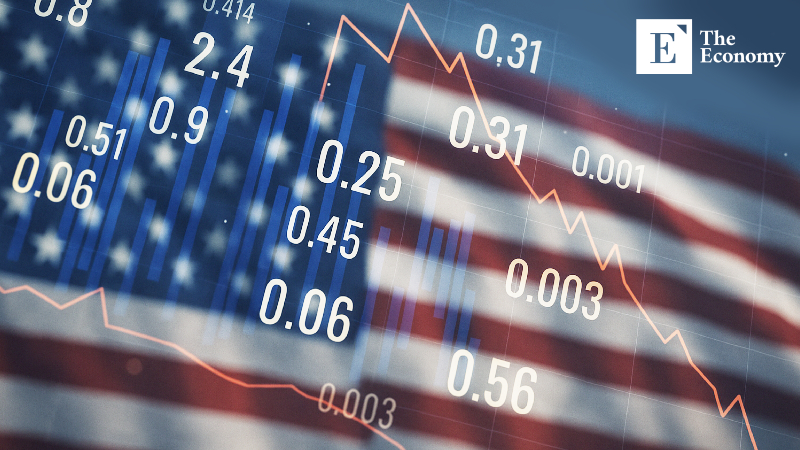
The convergence of America’s astronomical sovereign debt burden and mounting controversy over the independence of the Federal Reserve (Fed) has placed the decades-long dominance of the dollar at a critical juncture. As the institutional credibility underpinning the global reserve currency comes under strain from policy risk, the Global South and BRICS nations are accelerating de-dollarization by building digital currency infrastructure and independent payment systems. Objective indicators—including a declining share of dollar reserves and surging gold purchases—suggest that the global financial architecture is entering a multipolar era in which multiple currencies and assets coexist.
Ray Dalio Warns of Crisis of Confidence in U.S. Reserve-Currency Status
According to Reuters on the 18th (local time), Ray Dalio, founder of Bridgewater Associates, the world’s largest hedge fund, characterized the current U.S. debt trajectory as a “global crisis of confidence in the reserve currency.” Data from the U.S. Congress Joint Economic Committee (JEC) show total federal debt standing at $38.56 trillion, having surged by $2.35 trillion over the past year alone. Annual net interest payments have reached $1 trillion, making debt servicing the second-largest federal expenditure after Social Security and surpassing defense spending. Dalio underscored that the debt problem ultimately centers on confidence in the issuer’s capacity to repay and maintain policy consistency. With Treasury issuance accelerating and private and foreign demand insufficient to absorb supply, a “buyer vacuum” could amplify rate volatility and intensify downward pressure on the dollar.
Earlier, on the 15th, Dalio wrote on social media platform X that the current period corresponds to the sixth and final stage of the “Big Cycle” outlined in his book Principles for Dealing with the Changing World Order. The concept describes a roughly 250-year arc of imperial ascent and decline culminating in the dissolution and reconfiguration of the prevailing order. Citing the decline of the Spanish Empire—driven by excessive military spending and currency debasement to service debt—Dalio argued that present U.S. fiscal imbalances resemble patterns historically observed on the eve of systemic breakdown. He noted that episodes such as the 1933 suspension of the gold standard and the 1971 Nixon Shock demonstrate how governments have altered monetary commitments when debt pressures reach critical thresholds, thereby deepening creditor distrust.
Dalio identified five structural forces driving the Big Cycle: debt burdens, internal divisions, external conflict, natural disasters, and technological transformation. Extreme wealth polarization—where the top 1% in the United States holds 31.7% of total assets—alongside intensifying U.S.-China rivalry and fissures within the North Atlantic Treaty Organization (NATO), compounded by climate-related shocks and the artificial intelligence revolution, collectively test the resilience of the American system. These overlapping pressures erode confidence in fiat currencies as reliable stores of value.
With inflation-adjusted bond yields turning negative, investors are reallocating capital from sovereign debt—whose safe-haven status is increasingly questioned—into alternative assets capable of hedging inflation risk. Gold prices surged approximately 65% last year and reached a record $5,110 per ounce at the end of last month. The analysis follows that the more the U.S. government relies on monetary expansion to service its liabilities, the greater the erosion of dollar purchasing power. As capital preservation flows intensify toward alternative assets, the pace of dollar hegemony’s retreat could correspondingly accelerate.
Weak-Dollar Orientation and Federal Reserve Independence Concerns Undermine Dollar Primacy
The crisis of confidence highlighted by Dalio has already permeated market pricing, manifesting in skepticism toward both the dollar’s value and the conduct of monetary policy. Speaking at the American Economic Association (AEA) annual meeting in Philadelphia on the 3rd, Harvard professor Kenneth Rogoff warned that “the pillars supporting dollar hegemony are simultaneously under strain.” He identified three foundations of dollar dominance: security-based hard power, institutional credibility anchored in rule of law, and Federal Reserve independence. The dollar’s international standing, he argued, is not merely a byproduct of U.S. economic scale but the cumulative result of a security umbrella and durable institutional trust. Expanding tariffs, policy uncertainty, and controversy surrounding central bank independence now threaten that foundation.
The Trump administration’s weak-dollar orientation and the debate over Federal Reserve autonomy have emerged as pivotal factors unsettling reserve-currency stability. In pursuit of narrowing trade deficits and enhancing manufacturing competitiveness, the administration has repeatedly signaled its willingness to deploy currency depreciation as a policy lever. This stance diverges from the long-standing strong-dollar doctrine historically upheld by the U.S. Treasury, prompting global investors to question whether Washington continues to prioritize the financial stability responsibilities inherent in reserve-currency status. Pressure for rate cuts to alleviate debt-servicing costs has intensified concerns that monetary decisions could be distorted by political objectives rather than economic fundamentals.
In his book Our Dollar, Your Problem, Rogoff contended that such policy experimentation undermines the dollar’s core asset—trust. Should the Federal Reserve, long regarded as the anchor of the global financial system, forfeit its independence, the economic fallout in a crisis scenario would likely prove far more severe than in past episodes. Even if vulnerabilities remain latent, institutional fissures could surface abruptly under stress, imposing substantial systemic costs.
Rogoff outlined four potential policy responses to the debt challenge. The first involves orthodox fiscal consolidation through tax increases and spending cuts, though he assessed its feasibility as limited under current political conditions. The second entails tolerating higher inflation to erode the real value of debt. The third consists of financial repression—compelling private institutions to hold low-yielding government bonds through regulatory mandates—a scenario he views as increasingly plausible. The fourth, considered unlikely yet not inconceivable, is partial default.
These policy risks are reflected in deteriorating market indicators and subdued investor sentiment. According to the Financial Times and Bank of America (BoA), global fund managers’ sentiment toward the dollar has fallen to its lowest level in 14 years, since the 2012 European sovereign debt crisis. The dollar declined 9% last year and has continued to weaken against major currencies this year, approaching a four-year low. Investors have begun reassessing U.S. Treasuries not as risk-free assets but as instruments exposed to political uncertainty. Roger Hallam, Vanguard’s global head of rates, questioned historically low hedging ratios against dollar exposure, while Caroline Hoodrill, a multi-asset fund manager at Schroders, observed increasing repatriation flows by overseas dollar holders—an indication of shifting confidence in dollar dominance.
Accelerating De-Dollarization Led by the Global South and BRICS, Financial Order Turns Multipolar
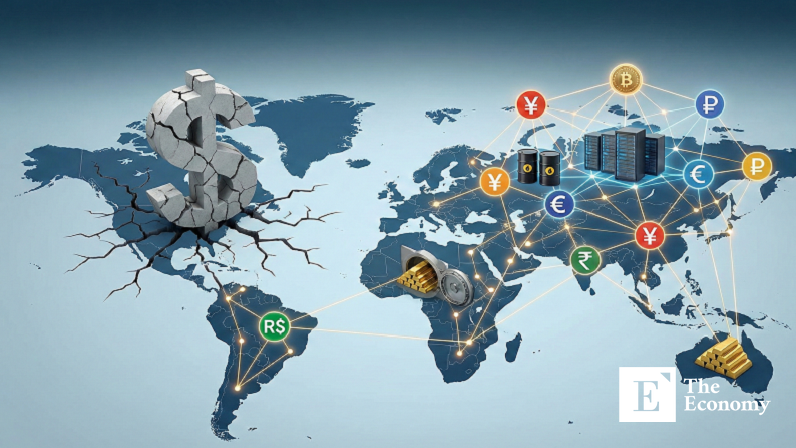
The erosion of dollar dominance has accelerated de-dollarization initiatives spearheaded by BRICS and Global South nations. In response to the perceived weaponization of finance through the reserve currency, these economies are seeking to safeguard domestic stability and enhance strategic autonomy. Encompassing India, the Association of Southeast Asian Nations (ASEAN), the Middle East, and Africa—together accounting for roughly 80% of the global population—this bloc is expanding local-currency settlement and constructing alternative payment networks to incrementally reduce reliance on a single monetary regime.
The multipolar trajectory is reshaping long-standing oil-settlement conventions and catalyzing the emergence of new digital payment infrastructures. Notably, the petrodollar system, which has underpinned dollar dominance for decades, shows tangible signs of strain. Saudi Arabia and the United Arab Emirates have adopted the petro-yuan in transactions with China, disrupting the traditional cycle in which oil was priced exclusively in dollars and recycled into U.S. assets. Regional platforms such as the Arab payment system BUNA and the Gulf Cooperation Council’s (GCC) real-time settlement network AFAQ are accelerating intra-regional financial integration without routing through the dollar, recalibrating the balance of trade and capital flows.
On the technological front, central bank digital currencies (CBDCs) have emerged as potential alternatives capable of bypassing the dollar-centric SWIFT system. China’s digital yuan (e-CNY) surpassed $2.3 trillion in cumulative transactions by the end of last year. The mBridge cross-border payment platform, jointly developed by the Bank for International Settlements (BIS) Innovation Hub and the central banks of China, Hong Kong, Thailand, and the United Arab Emirates, processed $55.5 billion in transactions last year alone, marking a 2,500-fold increase from its pilot phase.
Financial data further indicate that the dollar’s reserve-currency share has entered a downward trajectory. International Monetary Fund (IMF) data show the dollar accounting for 56.92% of global foreign exchange reserves in the third quarter of last year, the lowest level since 1994. Concurrently, central banks collectively purchased 863 tons of gold over the year, reinforcing efforts to secure tangible safe assets as part of broader portfolio diversification.
Economists broadly anticipate that the dollar’s dominance could recede to levels comparable to those observed in the 1950s or 1970s, when heavy military expenditures and trade imbalances eroded confidence. With the euro regaining share, the yuan ascending, and digital currencies proliferating, projections suggest the dollar’s reserve share could decline from roughly 56% today to 45–50% within a decade and toward 40% over the next two decades, ushering in a fully multipolar currency regime. Should U.S. interest rate differentials narrow further as the Federal Reserve enters an easing cycle, capital outflows may intensify. The emerging monetary order is thus more likely to feature a pluralistic configuration—where multiple currencies, tangible assets, and digital infrastructures coexist—than a wholesale replacement of the dollar by any single alternative.
Similar Post