“Detroit Gone by 2050”: Support Without Innovation in the U.S. Auto Industry and China’s Advance

Stefan Schneider brings a dynamic energy to The Economy’s tech desk. With a background in data science, he covers AI, blockchain, and emerging technologies with a skeptical yet open mind. His investigative pieces expose the reality behind tech hype, making him a must-read for business leaders navigating the digital landscape.
Authored On
Modified
Limits of an internal combustion–centered strategy delay innovation
Subsidy cliff triggers sales plunge and rising financial strain
China tightens its strategic encirclement, nearing the gates of the U.S. market
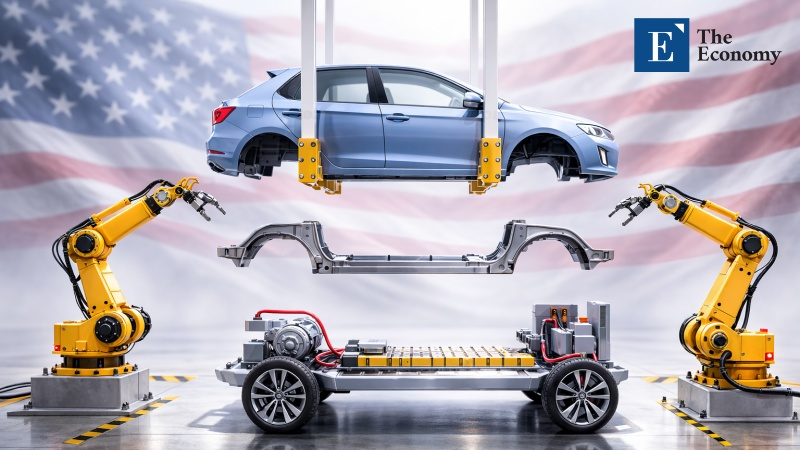
Major U.S. automakers that have long symbolized the nation’s automotive industry have posted sweeping losses in their electric vehicle divisions, raising red flags over the sector’s long-term sustainability. Despite policy support from Washington, companies continue to struggle with the pace of electrification and the challenge of securing profitability. With the reduction of EV subsidies amplifying market volatility and risks in auto financing surfacing, sources of instability across the industry have steadily mounted. At the same time, Chinese manufacturers are rapidly expanding their footprint in global markets, accelerating shifts in the competitive landscape.
Shrinking Production Bases Signal Industrial Decline
According to the Financial Times (FT), the three largest U.S. automakers—General Motors (GM), Ford, and Stellantis—reflected a combined $50 billion in losses tied to EV development and production in the second half of last year alone. Ford, in particular, is expected to incur up to $4.5 billion in additional EV-related losses this year. With all three Detroit-based manufacturers reporting substantial deficits, assessments have emerged that the U.S. auto industry may be entering a sustained period of decline.
On the surface, policy conditions appeared supportive. In January, President Donald Trump visited a Detroit plant and underscored his intention to scrap EV mandates and ease internal combustion engine regulations, presenting a 25% tariff on imported vehicles and regulatory rollbacks as tools to revive the sector. Markets responded favorably: over the past year, GM shares rose roughly 75%, while Ford gained about 50%. Yet beneath this stock rally, mounting investment burdens tied to electrification have strained profitability, deepening structural instability within the companies.
A shift in product composition has further weakened competitiveness. In Ford’s U.S. sales mix, conventional passenger cars account for just 2%, with the remainder dominated by high-priced pickup trucks and SUVs. Against a backdrop of elevated interest rates and persistent inflation, demand from middle-income consumers has contracted, leaving a lineup centered on higher-priced vehicles exposed to widening demand gaps. Automotive industry researcher Glenn Mercer noted that the Detroit Three’s global market share has fallen from 29% in 2000 to 13% today, warning that if current trends persist, the U.S. auto industry itself could disappear before 2050.
More fundamentally, critics point to shortcomings in managing the technological transition. Industry observers argue that U.S. automakers pushed into electrification without sufficiently internalizing core technologies, undermining investment efficiency. After the reduction of EV tax credits, GM’s EV sales fell 43%, underscoring the market’s heavy reliance on policy support. By contrast, the global EV market expanded to 20.7 million units last year. By country, EV penetration reached 50% in China, 20% in Korea, and 96% in Norway, while the United States remained below 10%. Under such conditions, many conclude that policy support alone cannot sustain industrial competitiveness.
Rising Financial Risks Emerge as a Macroeconomic Variable
The suspension of EV purchase subsidies has further deepened industry pressures. According to S&P Global Mobility, new EV registrations in the United States totaled approximately 1.27 million units last year, down about 2% from the previous year. This contrasts with a 2.2% increase in overall U.S. auto sales over the same period. Following the effective disappearance of subsidies in October (reference article timeframe), the decline accelerated, with December registrations plunging 48% year over year. The earlier pace of EV adoption had relied heavily on government incentives.
Heightened sales volatility has amplified stress in auto financing. In October of last year, subprime auto lender PremaLend Capital filed for Chapter 11 bankruptcy protection in the Northern District of Texas. Analysts attribute the collapse to surging delinquencies as lower-income borrowers struggled with high-interest auto loans. Fitch Ratings reported that as of January, the share of auto loans more than 60 days delinquent reached 6.56%, the highest level since records began in 1994. Fitch noted that the “Buy Here, Pay Here” (BHPH) sales model—under which dealers provide both vehicles and financing—has magnified financial risks.
The deterioration in auto finance has reverberated across broader financial markets. Shortly before PremaLend’s bankruptcy, another BHPH operator, Tricolor, also sought Chapter 11 protection. In the process, JPMorgan, which had provided financing to Tricolor, absorbed losses totaling $170 million. Bank of England Governor Andrew Bailey described the Tricolor episode as a “canary in the coal mine,” suggesting it could signal deeper financial vulnerabilities. Should slowing vehicle sales combine with rising loan defaults, the shock could spread from consumer spending into financial markets and the real economy.
As sales volatility and financial risks expand simultaneously, the auto industry has begun to take on the characteristics of a leading economic indicator. Automobiles, as high-priced durable goods, are highly sensitive to changes in interest rates and household income, and their reliance on financial leverage allows economic shocks to transmit quickly. The sharp decline in EV sales following subsidy cuts, coupled with rising loan delinquencies, reflects both weakening consumer purchasing power and deteriorating credit conditions. The current EV downturn is therefore increasingly viewed not as an isolated industry issue but as a broader headwind for the U.S. economy.
China’s Surge Intensifies Competitive Pressure
Meanwhile, China’s influence in the global EV market has strengthened markedly. Data from the European Automobile Manufacturers’ Association show that in the European Union (EU), the European Free Trade Association (EFTA), and the United Kingdom last year, Chinese EV makers SAIC and BYD recorded sales of 306,000 units and 188,000 units, respectively. SAIC, in particular, surpassed Tesla’s 239,000-unit sales in the same market, underscoring a shift in competitive dynamics. In the European EV market alone, Chinese brands expanded their share to roughly 13%.
Although direct entry into the U.S. market remains restricted, Chinese manufacturers have expanded their presence in North America’s neighboring markets. According to Mexico’s National Institute of Statistics and Geography (INEGI), 306,351 Chinese-made vehicles were sold in Mexico last year, accounting for 18.8% of total vehicle sales of 1,625,722 units. Given that their market share stood below 1% just five years earlier, the expansion has been rapid. In Canada, developments have also unfolded: after Ottawa reduced tariffs on Chinese EVs from 100% to 6.1% and permitted annual imports of 49,000 units, companies such as Chery have moved to establish offices near Toronto and build distribution networks.
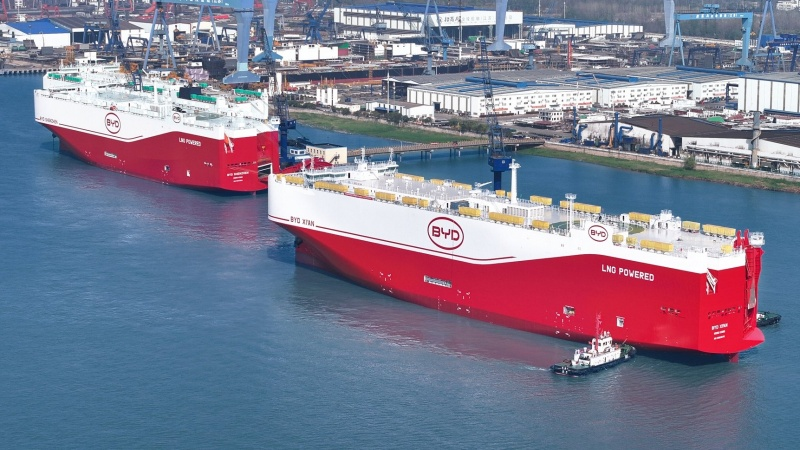
Chinese EVs have also gained a firm foothold in South America. BYD has established its own fleet of car carrier vessels to support exports, building an integrated global supply chain. Its flagship vessel, the “BYD Shenzhen,” can transport 9,200 vehicles, while other carriers in its fleet reportedly accommodate around 7,000 units each. Leveraging this logistics capacity to strengthen its push into Brazil and Argentina, BYD accounted for approximately 72% of Brazil’s 79,400 EV sales last year. The rise in market share is widely viewed as a direct outcome of combining proprietary logistics infrastructure with aggressive price competitiveness.
Stefan Schneider brings a dynamic energy to The Economy’s tech desk. With a background in data science, he covers AI, blockchain, and emerging technologies with a skeptical yet open mind. His investigative pieces expose the reality behind tech hype, making him a must-read for business leaders navigating the digital landscape.
Similar Post
















