U.S. AI Data Center Groundbreakings Fall for First Time in Five Years, Raising Post-Boom Questions for Memory Market

Authored On
Modified
Power procurement and permitting delays trigger an “AI slowdown”
Constraints on infrastructure expansion heighten the need for grid investment
Mismatch in memory demand signals a potential cycle shift
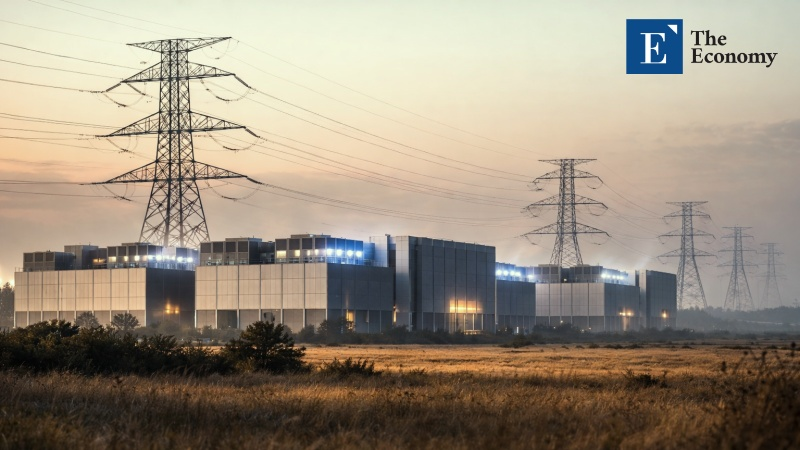
The scale of data center construction in the United States has declined for the first time since the COVID-19 pandemic, revealing broader shifts in artificial intelligence (AI) infrastructure investment. Analysts note that the slowdown differs in nature from a simple cyclical downturn, as expansion is being shaped by a combination of permitting hurdles, site availability, and power supply constraints. With concerns over grid stability and the burden of infrastructure investment coming to the forefront, questions have emerged over the future direction of capital spending. At the same time, the surge in memory semiconductor prices that had been driven by explosive data center demand is converging with these trends, bringing into focus a broader rebalancing of supply and demand across the AI industry.
Early Signs of a Shift in the Data Center Investment Cycle
According to a report released by CBRE, a global commercial real estate services firm, the capacity of data centers under construction in the United States declined from 6.35 gigawatts (GW) at the end of 2024 to 5.99GW at the end of 2025. This marks the first contraction in U.S. data center construction since 2020, when the sector entered a phase of rapid expansion following the pandemic. CBRE explained that “stringent permitting procedures, land-use regulations, delays in transmission grid interconnection, and uncertainty over power supply have collectively slowed new project starts across the board.”
Regional data clearly illustrate stagnation in traditional hubs that have approached infrastructure saturation. Projects under construction in Northern Virginia, the world’s largest data center cluster, fell 29% year over year, while Hillsboro, Oregon (-15%) and Silicon Valley (-14%) also recorded declines. In contrast, regions with comparatively easier site acquisition and greater available power capacity benefited from spillover demand. Data center groundbreakings in Chicago surged 169% from a year earlier, while Dallas–Fort Worth posted a 15% increase. Notably, Atlanta ranked first nationwide in project starts, with more than 2GW of construction underway as of the second half of last year (reference article timeframe).
Shifting public sentiment has also contributed to the construction slowdown. Once welcomed as generators of tax revenue, data centers are increasingly scrutinized for their surging electricity consumption, noise, and environmental impact. Illinois, for example, is reviewing the suspension of tax incentives previously granted to data centers in an effort to contain rising electricity costs, while in New Mexico, Oracle’s data center project has faced organized local opposition over environmental concerns.
Vacancy rates reveal a paradox in market indicators. Even as construction capacity declined, data center capacity absorbed by tenants last year jumped 38% year over year, driving the average vacancy rate in major U.S. markets down to a record low of 1.4%. In contrast to the slowdown in new groundbreakings, the operating market remains in a state of acute supply shortage. This has led to interpretations that the decline in construction reflects a moderation in the pace of expansion at a specific stage of industry growth, rather than a cooling of AI demand. In other words, the industry appears to have entered a phase in which physical infrastructure limits, not demand weakness, are shaping the speed of expansion.
U.S. Casts Grid Strain as Energy Security Priority
Industry observers have turned their attention to the acceleration of U.S. grid reinforcement efforts. Earlier this month, a nationwide Arctic blast left more than one million households without power, once again exposing vulnerabilities in the country’s electricity infrastructure. In southern states including Tennessee, Mississippi, and Louisiana, damaged transmission lines and facility failures resulted in at least 35 fatalities. The episode underscored that grid stability has not improved sufficiently despite preparedness standards strengthened after the 2021 Texas blackout, when more than half of the state’s generation capacity was disabled and more than 200 people died.
The aging condition of power infrastructure remains a critical concern. In its latest infrastructure report, the American Society of Civil Engineers (ASCE) assigned the U.S. power grid a D+ grade, down one notch from a C- in 2024. Key factors cited include shortages of distribution transformers, limits on transmission capacity, and an increase in extreme weather events linked to climate change. ASCE projected that U.S. electricity demand will rise from 17GW in 2022 to more than 35GW by 2030, yet warned that many transmission lines have been in operation for more than 30 years and roughly 70% of transformers are over 25 years old, limiting the grid’s ability to fully support rising demand.
The structure of energy supply has also heightened vulnerability. Since 2016, natural gas has rapidly increased its share of U.S. power generation, reaching 43% in 2024. During severe cold spells, however, simultaneous peaks in heating and power generation demand have strained supply. Earlier this month, gas supply constraints forced generation units offline, sending spot electricity prices sharply higher. PJM Interconnection, which manages the grid across 13 eastern states and Washington, D.C., issued five separate warnings of potential power curtailments due to transmission constraints.
Against this backdrop, investment in grid expansion has gained momentum. According to data from the U.S. Energy Information Administration (EIA), 53GW of new capacity was connected to the grid last year, the largest annual addition since 2002, with an additional 86GW projected this year (reference article timeframe). Of that total, solar is expected to account for 43.4GW, energy storage systems (ESS) 24GW, and wind 11.8GW. The challenge lies in the pace of demand growth outstripping infrastructure expansion. The North American Electric Reliability Corporation (NERC) warned that more than half of U.S. regions could face elevated risks of power supply shortages over the next decade, noting that the Midwest grid in particular may encounter an annual shortfall of 2.7GW by 2029.

Data Center Slowdown Signals Memory Demand Gap
Refocusing on AI data centers suggests the possibility of moderating demand for memory semiconductors. Given that the recent surge in memory prices was directly driven by concentrated data center demand, any shift in the pace of infrastructure expansion is likely to translate into changes in demand. According to market research firm Counterpoint Research, DRAM prices in the first quarter of this year rose more than 80% from the previous quarter, with the price of 8GB DDR4 modules for laptops surging 91% in just three months. Prices for NAND, a core component of solid-state drives (SSDs), climbed roughly 100%, while DDR5 module prices more than doubled across multiple product lines.
The concentration of demand has reshaped production patterns. Another research firm, TrendForce, projected that up to 70% of total memory hardware output this year will be consumed by data centers. TrendForce characterized this shift as a “permanent and strategic reallocation of global silicon wafer capacity,” noting that major manufacturers including Samsung Electronics, SK hynix, and Micron have concentrated production on high-bandwidth memory (HBM) and DDR5 server products, reducing relative supply for consumer-grade memory.
As manufacturers prioritize data center components, supply for consumer devices has tightened. In January, Micron announced it would withdraw from the retail memory business under its Crucial brand and focus on enterprise and data center customers. The resulting supply constraints have fed into price pressures in the end-product market. Major PC makers including Lenovo, Dell, HP, Acer, and Asus have already signaled price increases of 15% to 20%, while some manufacturers are reportedly considering reducing base memory specifications from 16GB to 8GB or introducing “BYORAM” models that exclude memory altogether.
Even so, industry participants increasingly believe that the current phase of steep price increases may eventually give way to demand volatility. If data center investment is constrained by infrastructure limitations, the surge in concentrated server orders could enter an adjustment phase after a certain point. High-performance memory orders, in particular, tend to include a significant front-loaded component, leading to patterns in which demand is rapidly absorbed up to a specific threshold before a temporary gap emerges. In an environment where infrastructure deployment remains constrained, installation schedules for new server racks are also likely to be affected, suggesting that the memory demand cycle may transition toward a more gradual period of adjustment.
- Previous Technology, Capital, and Risk-Sharing: Taiwan-Japan-India Semiconductor Alliance Forged, Consolidating Three-Nation Industrial Ambitions
- Next Glass Substrates Emerge as AI Semiconductor Game Changer as Mass Production Race Intensifies at Home and Abroad; Overcoming Glass Brittleness Seen as Key Hurdle
Similar Post