Formalizing the Pivot: Why “India labour formalization” Is the Strategic Move That Must Be Matched by Social Nets and Skills

David O’Neill is a Professor of AI/Policy at the Gordon School of Business, SIAI, based in Switzerland. His work explores the intersection of AI, quantitative finance, and policy-oriented educational design, with particular attention to executive-level and institutional learning frameworks.
In addition to his academic role, he oversees the operational and financial administration of SIAI’s education programs in Europe, contributing to governance, compliance, and the integration of AI methodologies into policy and investment-oriented curricula.
Authored On
Modified
India labour formalization is redefining the country’s economic base
Without social protection and skills, it will stall
Done right, it secures growth and worker protection

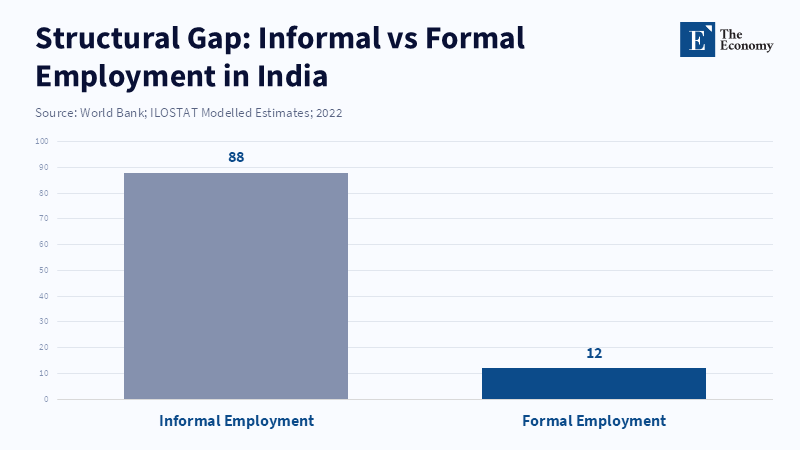
It is estimated that around 90% of Indian workers are employed in the informal sector. This informal employment has sustained families. It has also limited companies' expansion and workers' protection. Since 2025, the Indian government has combined 29 separate laws into four labor codes. According to a recent report, India has introduced new labour codes that expand social security and written contracts to cover jobs traditionally considered part of the informal sector. This change in the area of law is major, but still new and not complete. If India's labor formalization becomes mainly for publicity rather than creating long-term, real changes, the country will not be able to capitalize on the current opportunity to translate supply-chain interest into stable jobs, pay, and skills. It's not just about pay; formalization is needed to join export chains. It also provides public safeguards and helps build the industrial skills required to compete with China for important investments and resources. This change is big, inconsistent, and might cause political issues. It needs a new public agreement with solid protections, reliable income support, and quick training that matches job needs.
India labor formalization: what is changing and why it matters now
The new codes make it easier to follow the rules. They specify the work of gig workers and those on fixed-term contracts. Also, they set a minimum national wage and establish a social security system and a simple licensing system. This is a big change from the past hundred years, where Indian labor law was a mix of old colonial rules, different state laws, and informal practices. The goal is simple: clear rules lower the costs and risks of growing, so that we can grow instead of remaining small. Plus, more workers can get on payrolls with pensions, health checks, and benefits they can take with them when they change jobs. For a country aiming to be a global manufacturing center, clear laws are necessary for major investments. The reform is led by the government and designed nationally. But it will be implemented locally, and Indian states differ widely in how well they can handle it. If there is no effective enforcement and no money to cover the costs of change, companies will just follow the rules on paper. Much employment will remain uncertain. National rules are important, but the real test is whether these paper rights become real rights in factories and in online platform jobs.
The time to act on the world stage is limited. Global buyers are looking beyond China for their supply chains. Current state-level agreements on important minerals and trade show that India is entering a more competitive position. Taking advantage of this demand will depend on rapid, clear progress in labor management and workforce skills. Investors and leading companies want easy rule-following, reliable production times, and a skilled workforce. This reduces the risks of getting started and ensuring quality. If India is successful, factories will not just hire but also invest in things that boost production. According to the Ministry of Labour & Employment, the Government of India has put four Labour Codes into effect from November 21, 2025, to bring greater consistency and reduce risks for businesses. However, if the policy does not succeed, companies might look to countries where implementing changes is easier and less risky. The effectiveness of the policy should be measured by the number of workers added to payroll systems and the number who experience increased pay and stable employment.
India labor formalization and the data: progress, gaps, and what the numbers actually say
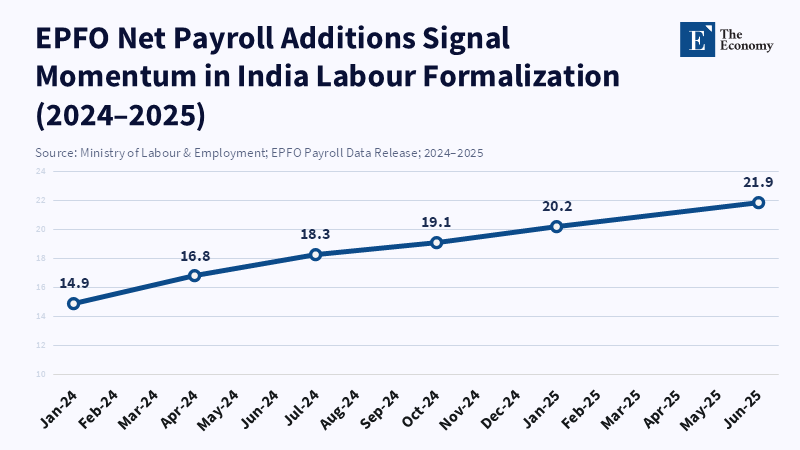
Checking formalization needs clear ways to measure it. The most direct measure, updated regularly, is the number of people on payrolls. Data from the EPFO shows big increases in recent months. For example, there was a record increase of about 2.19 million members in June 2025. This shows that many workers are being included in formal social security systems. However, surveys and data from international sources show the bigger reality: informal employment in India is still very high. Estimates say almost 90% of workers are informally employed. The informal sector also still makes up a large part of the GDP. In simple terms, registrations are rising quickly but from a low starting point. Overall, informal work is still common. It's a process happening at two speeds: there are visible gains in payroll numbers, but within a large informal sector. It's not a complete change yet.
In creating these estimates, I used frequent payroll reports (EPFO payroll additions), national reports on employment structure, and indicators on informal employment rates from the ILO and the World Bank. If the data differed in when it was collected or what it covered, I used careful, rounded numbers and noted the source. EPFO additions are a good way to measure formal payroll growth because they record new subscribers and net payroll changes. Still, they do not record all formal business activity. Some formal companies and contractors are not included in the EPFO, which is why different data sources are important. This method shows real progress while recognizing that informal work remains common.
India labor formalization: the policy design that will make formalization pro-worker
Formalisation needs to happen with income support during job changes. It also needs common, job-relevant training and local ability to enforce rules. First, there must be income support. The new codes and the Reskilling Fund are a start, but they don't provide real, short-term income support like unemployment insurance or wage-top-up programs used in other exporting countries. Without an income safety net, workers will either avoid formal jobs that may lead to layoffs or accept less security, despite having written contracts. Second, there must be skilling. Businesses say that training costs and skill gaps stop them from growing. A national effort to expand short training programs, industry skill standards, and required employer contributions will ease hiring. It makes workers more productive faster. Third, there must be enforcement. Registration is only the beginning. Good labor inspections, digital tools to address issues, and public measures of rule-following must be expanded across states. If the ability to enforce rules is weak, companies will exploit the rules. If it is strong, formal jobs will last. These design parts are necessary if India wants to turn legal changes into higher wages and export competitiveness.
The pushback is likely: unions are afraid of less job security; companies complain about higher costs; states are concerned about administrative burdens. In response, the answer must be based on fact and planning. For unions, offer unemployment support that can be checked. Also, give training vouchers to protect their ability to bargain while helping workers find new jobs. For companies, offer wage help for the first year of formal hiring and compliance credits for a set time. This can lower the costs of change without lasting financial burdens. For states, create a fund involving both the federal and state governments to reward checked compliance and lower start-up costs. This would lower political resistance. Each is conditional: they should be linked to measured results. include payroll registrations, social security contributions received, and confirmed skilling achievements. This ensures that public money is used for real change, not temporary relief. Other Asian exporters show that these tools speed up lasting formalization when used with strong monitoring.
What educators, administrators and policymakers must do next under “India labor formalization”
Educators should focus on skills instead of qualifications. Short classes that certify specific job tasks will narrow the gap between the skills taught and the skills needed. These tasks must align with employer demand in fields such as electronics, clothing, digital creation, and logistics. Coursework should be created in collaboration with major companies and checked regularly. Micro-internships and paid training should be expanded. The government should give money to employers for the first group of trainees. For public schools, budgets should be shifted to basic skill centers rather than long degree programs with limited employer interest. A report from the Directorate General of Employment highlights the importance of tracking and publishing data on EPFO and ESIC contributions at the district level to improve transparency and guide enforcement efforts. Making this information public could help motivate local compliance and indicate where audits may be needed. The report also notes the value of monitoring payroll and compliance indicators to support policymakers in strengthening formal employment systems. This program should be a short-term unemployment benefit and training allowance for displaced workers linked to confirmed training attendance. The goal is to ease political and social problems as companies relocate their production. These steps are doable, inexpensive if targeted, and politically justifiable. They directly link taxpayer money to employability and confirmed results.
Critics will say these steps are costly or slow. But the cost of remaining informal is higher. Informal work lowers production, shrinks tax amounts, hurts worker security, and limits bargaining power for big purchases tied to public contracts and incentives. A realistic approach makes the politics manageable: start with inexpensive wage support and expand training in states that show strong gains in EPFO enrollment. Use these early results to fund expansion elsewhere. According to a report from the ILO, international partners can support countries with limited local resources by providing digital tools like the LIFT system, which helps map enterprises, enhance risk detection, and improve enforcement across supply chains, offering practical implementation beyond legal reforms alone. This will recreate dual markets and waste chances.
If most workers start the decade in informal employment, then legally combining labor law is needed, but not enough. “India labor formalization” must be viewed as a plan to build state capacity, provide short-term income protection, and train workers to match job demand. It can be measured monthly and improved regularly. The new codes provide the structure. The missing effort is to make the structure support people rather than hide them behind documents. Policymakers should agree to a three-part action plan: (1) a short-term transition guarantee for displaced workers; (2) employer-linked rapid training with verified skill certificates; and (3) state performance contracts tied to payroll and compliance results. By doing this, India will be more appealing to global buyers and partners. It will also be closer to the goal of turning informal work into lasting, productive jobs.
The views expressed in this article are those of the author(s) and do not necessarily reflect the official position of The Economy or its affiliates.
References
Jha, P. and Mitra, D., 2026. India’s labour reforms need stronger social protection and rapid upskilling. East Asia Forum.
Press Information Bureau (PIB) Delhi, 2025. India’s Labour Reforms: Simplification, Security, and Sustainable Growth. Press Information Bureau, Government of India. Posted 21 November 2025.
Press Information Bureau (PIB) Delhi, 2025. EPFO Records All-Time Highest Net Addition of Nearly 22 Lakh Members during June 2025. Press Information Bureau, Ministry of Labour & Employment. Posted 20 August 2025. (Rini Choudhury/Anjelina Alexander)
Al Jazeera Staff and Reuters, 2025. India implements sweeping labour reforms despite union opposition. Al Jazeera, 21 November 2025.
UNCTAD, 2025. World Investment Report 2025: International Investment in the Digital Economy. United Nations Conference on Trade and Development.
World Bank / ILO (Human Capital / ILOSTAT), 2022–23. Informal employment and labour statistics (modeled estimates and national survey summaries).
Ahluwalia, G.K. and Kanupriya, 2025. From China to India: Navigating the Global Sourcing Landscape. MDIM Journal of Management Review and Practice, Vol. 3, Issue 1.
David O’Neill is a Professor of AI/Policy at the Gordon School of Business, SIAI, based in Switzerland. His work explores the intersection of AI, quantitative finance, and policy-oriented educational design, with particular attention to executive-level and institutional learning frameworks.
In addition to his academic role, he oversees the operational and financial administration of SIAI’s education programs in Europe, contributing to governance, compliance, and the integration of AI methodologies into policy and investment-oriented curricula.