Europe’s new burden: why European defence responsibility can no longer wait

Working across research, policy, and data-driven analysis, the Editorial Board ensures that published pieces reflect a consistent institutional perspective grounded in quantitative reasoning and long-term structural assessment.
Authored On
Modified
Europe must take greater responsibility for its own defence
Higher spending alone will not guarantee security
Real safety requires deeper European coordination
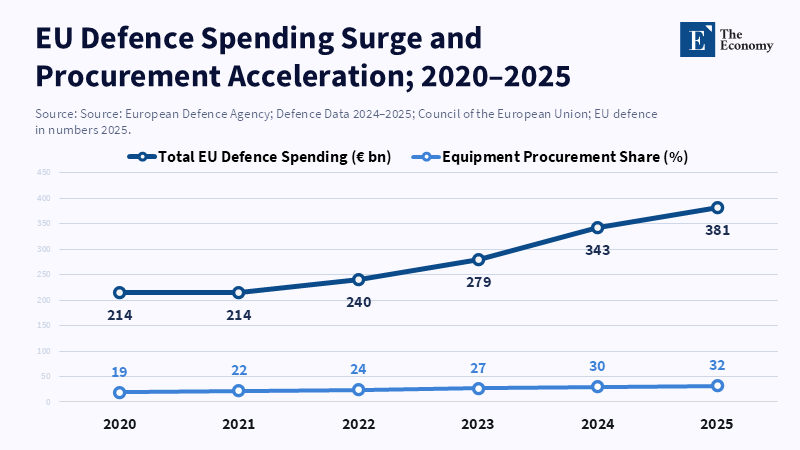
European defense spending has seen a rapid increase, with EU member states allocating €343 billion in 2024 and projecting around €381 billion for 2025 (Council of the European Union, 2025; European Defence Agency, 2025). This represents a near two-thirds increase since 2020. This figure has to prompt deliberate analysis and guide policy decisions. It not only reflects a reaction to the ongoing war on the continent's eastern border but also a shift in who bears the burden of ensuring European border security. The implications are both ethically and practically significant. For the past four years, European nations have financed weaponry, logistical activities, and political aid efforts (Reuters, 2026), while also depending on American security assurances, which are now less dependable (Politico Europe, 2026). The rise in EU defense investment to record levels, which included a 42% increase in procurement in a single year, shows that investments are being made (European Defence Agency, 2025). It is essential to realize that financial resources alone do not guarantee a successful strategy. If Europe seeks to become anything more than a supplier of military equipment, it must assume new responsibilities. The idea is to plan for common defense rather than providing sporadic support, integrate industrial and training resources across national borders, and to educate civic organizations to operate successfully during times of crisis. It is these duties that should now be included under the term European defense responsibility.
European defense responsibility: rethinking the problem for today's world
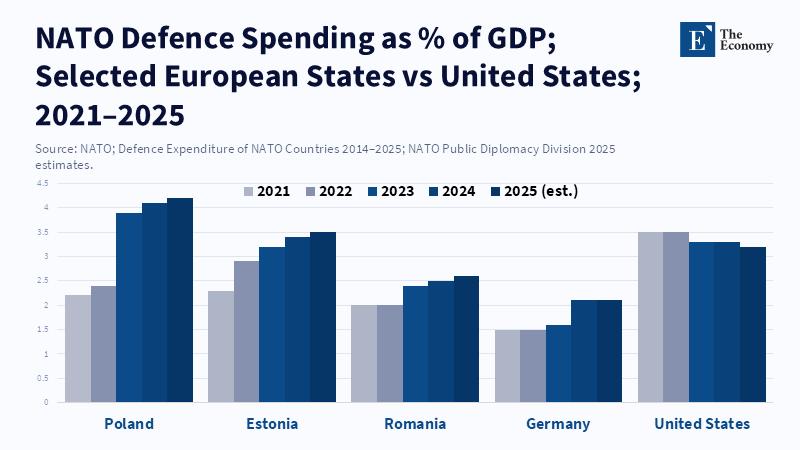
Until now, Europe's strategic discussions have often viewed defense as something guaranteed by allies: If the United States takes the lead, Europe should contribute financially and cooperate; if not, there is panic (Graefrath & Weber, 2026). This way of thinking overlooks two key points. First, European countries are already spending considerably more than before (Council of the European Union, 2025; NATO, 2025). Investments and procurement have increased significantly and are expected to continue rising as member states, on the whole, get closer to meeting the NATO 2% guideline (NATO, 2025). Second, increased spending does not automatically result in forces that can work together, shared logistical support, or consistent strategies (European Defence Agency, 2025). The issue is not just monetary but also organizational. While the numbers suggest progress in terms of volume, they don't guarantee that Europe has converted its budgetary resources into a unified deterrent. The suggested policy change shifts the emphasis from how much to what for. Europe needs to align its rising defense budget with a clear goal: guaranteeing the continent's collective survival. This focus should take precedence over supporting conflicts elsewhere (Aydıntaşbaş et al., 2026). This shift places importance on shared procurement practices, combined training exercises, standardized maintenance procedures, and command structures that reduce the risk of fragmentation during a crisis. This is not an argument to cut ties with NATO or the United States. It is an argument to stop viewing the U.S. as an unlimited stand-in for European political resolve and capabilities. Data showing continued increases in defense spending and equipment purchases across member states indicate a change in Europe's approach (European Defence Agency, 2025). The task now is to turn this change into permanent structures.
The United States has reconsidered its national priorities to focus resources on what it sees as its biggest risks and most important locations. The U.S. 2026 National Defense Strategy and its analysis suggest a shift in focus and more stringent requirements for allies to share the load (Cancian & Park, 2026). This update means that Europeans can no longer rely on the U.S. to provide unrestricted logistical support, access to technology, or political involvement in all circumstances (Politico Europe, 2026). The United States still retains significant conventional and nuclear advantages, and NATO remains a key alliance (NATO, 2025). However, American policy choices now include specific conditions and a stronger request that allies bear more of the expenses and assume certain command duties. This goes beyond simple statements; it changes risk calculations in financial plans and forces deployment strategies. As a result, European defense responsibility is both a budgetary and a political undertaking. Europe should move away from being a passive recipient of American security and toward becoming an active designer of a defense strategy that works regardless of changes in transatlantic politics.
Lastly, this new perspective recognizes that capability and trustworthiness are distinct. Purchasing equipment does not, by itself, create deterrence. Trustworthiness depends on strategies, logistics, readiness, civil defense, and clear political agreement on when to take action. It also requires buying lower-cost, high-utility systems such as air defense, counter-UAV measures, and precision-targeting and logistics centers to prevent wars of attrition or hybrid attacks from quickly shifting the balance of power in the early stages of a conflict (The Defense Post, 2026; The Japan Times, 2026). There are conflicting signs on whether European governments are heading in this direction. Procurement and R&D spending are at record levels, but there are still issues with a fragmented supplier base and continued dependence on non-European technologies for essential systems. Therefore, the policy challenge is to set up incentives and organizations that turn rising budgets into shared operating capabilities
European defense responsibility and the strategic effects of U.S. pullback
The conflict in Ukraine has been viewed by Central and Eastern European governments as a direct challenge to their own survival, not simply as an afterthought (Reuters, 2026). For many years, they have depended on NATO and the United Statespledge toto discourage significant aggression as the foundation of their security. Their assessments have changed after four years of conflict. There are growing calls from capitals and policy forums for Europe to assume primary responsibility for securing its borders (CNBC, 2026). This shift is both realistic and pressing. According to a Department of Defense report, the United States has recently made its military posture in the Indo-Pacific region more mobile, distributed, resilient, and lethal, signdenoting a shift inus that could affect the certainty of automatic American reinforcements in other regions.S. defense posture, which puts more pressure on European planners to make up for deficits in air defense, mobility, and quick reinforcement capabilities. The U.S. NDS of 2026 and expert studies stress a U.S. preference for focusing on what it sees as core regions and threats, while also pressing allies to assume local defense responsibilities (Cancian & Park, 2026). Because of the current geopolitical situation, Central and Eastern European decision-makers are forced to revise their threat perceptions and procurement plans from being based on emergencies to being based on long-term needs.
It's vital to recognize that this isn't a story of complete abandonment. Strong ties between Washington and Europe remain, and U.S. capabilities are essential in areas where Europe cannot yet replace them, especially in nuclear deterrence, strategic transport, and sophisticated technologies. Having said that, the manner and conditions have shifted to conditionality and reciprocity rather than open-ended aid. This explains why alliances based mostly on expectations rather than capabilities are weak (Graefrath & Weber, 2026). Therefore, Europe's increasing expenditure is a sensible reaction. It is a type of security purchased in light of diminished U.S. political capabilities and a U.S. system that now places greater priority on other areas and imposes financial restrictions. The policy implication is obvious but politically difficult. Europe must decide which missions it will continue to support and which it will not. These choices need to be clearly stated and tied to capability packages that can be used with dependable resources, not just hopes. New joint initiatives to develop affordable air defense and anti-drone systems, along with EU funding for military mobility, demonstrate Europe's efforts to address specific capability gaps (The Defense Post, 2026; The Japan Times, 2026). These projects represent initial steps toward a more flexible and robust European defense posture.
The senior partner myth also affects deterrence logic and isn't just a problem with how Europe perceives things (Graefrath & Weber, 2026). If adversaries believe the U.S. commitment is conditional or could be delayed, they may think that local coercion is worth the risk. This is why capability is important, both as a perception and as a function. To have a credible deterrence, there must be visible, integrated forces on the ground, as well as a political system that demonstrates common resolve without relying on a single external guarantor. The current trend in European spending presents a rare opportunity for decision-makers to invest now in air and missile defenses that can work together, in logistical routes, in joint reserves, and in command structures aligned with clear political boundaries (European Defence Agency, 2025). By doing so, the influence of any external power is diminished, and deterrence stability in Central and Eastern Europe is strengthened.
European defense responsibility: Actions to consider for decision-makers, administrators, and educators
The practical policy agenda is low-key since it is technical. It starts with integration: shared procurement, joint maintenance contracts, and shared stockpiles of ammunition and spare parts to prevent smaller countries from facing supply shortages during conflicts (European Defence Agency, 2025). The EU and NATO already have instruments that can be expanded: joint procurement frameworks, the European Defence Fund, and agreed-upon mobility routes (Council of the European Union, 2025). Growing these instruments necessitates political decisions to prioritize interoperability over safeguarding the domestic industry when there is a sense of urgency. That means consciously selecting multinational platforms and adopting standard procedures for logistics, maintenance, and training. Additionally, it entails providing financial support for collaborative R&D rather than funding identical national programs. While Europe's R&D spending on defense is rising, evidence suggests it still falls short of what is needed to reduce reliance on essential technologies from outside Europe (European Defence Agency, 2025). Channelling funds toward joint projects and dual-use projects would increase the return on investment and make supply chains more resilient.
Administrators need to ensure that civilian systems are ready to function during difficult times. Education ministries and school administrators should include civil capacity in the curriculum, teaching basic emergency response, plans to ensure learning continues, and information literacy to combat disinformation. As part of national and international centers for defense innovation, universities and technical institutes should be used. To meet the demands of both civilian technology and defense, these institutions should provide fast-track programs that close the gap between the two. Local governments need to coordinate logistics hubs with military planners to ensure roads, bridges, and railroads can support the rapid movement of troops and supplies. These are both financial and values-based options. They involve changing how public spending is discussed to move away from making peace-or-war decisions toward a continuous preparedness posture. This strategy would also improve everyday life by enhancing transport, adding redundancy to energy and communication networks, and improving crisis management. Data indicate that, rather than increasing civic resilience, much of Europe's increased defense investment has gone toward buying equipment and conducting R&D (European Defence Agency, 2025). As a result, it is essential to rebalance spending.
Policymakers should also agree to be strategically open and transparent. Vague commitments weaken deterrence and democratic accountability. Having clear laws on capability goals, joint procurement quotas, readiness standards, and obligations for mutual aid will help incorporate European defense responsibility into law rather than leaving it to casual understandings. Even though it is politically challenging, it lowers the chance that fear will lead to impromptu agreements during a crisis. Last but not least, Europe must invest in adequacy rather than attempting to replicate the United States. For the time being, America (and the Alliance) continues to offer nuclear deterrence as an umbrella. Europe's task is to increase conventional strength and rapid reinforcement capabilities, as well as to develop specialized technologies in which it can lead, such as layered air defense, electronic warfare, anti-UAV systems, logistics automation, and robust communications (The Defense Post, 2026). The first cooperative programs that member states have revealed to develop affordable air defenses show promise (The Japan Times, 2026). Increasing their scale will significantly improve conditions for countries on the front lines.
The statistic at the start of this writing is far more than a sign of how much money is being spent; it is a test. Europe is paying more, but paying and protecting are not the same thing. European defense responsibility must entail developing shared capabilities, building institutional processes, and teaching civil society and public institutions to become resilient. The alternative is easy to see: fragmented spending, fragile logistics, and dangerous assumptions about guarantees from other sources. The war in Ukraine has demonstrated that conflict can be nearby, last a long time, and cause widespread damage beyond narrow battlefields (Reuters, 2026). The time has come for Europe to recognize that defense is a public good that should be taken more seriously. It should be viewed not as something on ministers' shopping lists but as a continuous program of integration, training, and shared strategy. There will be political impediments. The result is very clear, but how we get there is not. Gradual, well-planned policy actions that connect budgets, industry, education, and law will result in a reliable defense at a lower cost over the long term than occasional panic buying. If European leaders act with focus and follow through, the rising defense bill can buy not only weapons but also the strategic freedom needed to keep the continent secure, acting on its own terms and in a way that protects the transatlantic alliance without relying on it.
References
Aydıntaşbaş, A., Baev, P. K., Budjeryn, M., Gordon, P. H., Grzymała-Busse, A., Hamilton, D. S., Karlin, M., Pifer, S., Sisson, M. W., Stelzenmüller, C. and Wright, T. (2026) What price for peace in Ukraine? Brookings Institution.
Cancian, M. F. and Park, C. H. (2026) The 2026 National Defense Strategy by the Numbers: Radical Changes, Moderate Changes, and Some Continuities. Center for Strategic and International Studies.
Council of the European Union (2025) EU defence in numbers. Council of the European Union.
European Defence Agency (2025) Defence Data 2024–2025. European Defence Agency.
Graefrath, M. S. and Weber, G. (2026) ‘Breaking Europe’s trans-Atlantic habit: the end of the senior partner myth’, War on the Rocks.
NATO (2025) Defence expenditure of NATO countries (2014–2025). North Atlantic Treaty Organization.
Reuters (2026) ‘Leaders of G7 reaffirm unwavering support for Ukraine on war anniversary’, Reuters.
The Defense Post (2026) ‘Europe’s Top Military Powers Launch “Low-Cost” Air Defense,’ The Defense Post.
CNBC (2026) ‘Four years into the Ukraine war, is Europe ready for its own army?’ CNBC.
Politico Europe (2026) EU leaders warn Europe must become defence giant; US role wanes. Politico Europe.
The Japan Times (2026) ‘Top European military powers to work on low-cost air defence,’ The Japan Times.
Fortune (2026) U.S. debt concerns and defence spending debates. Fortune.
Working across research, policy, and data-driven analysis, the Editorial Board ensures that published pieces reflect a consistent institutional perspective grounded in quantitative reasoning and long-term structural assessment.