The fragile anchor: why Ukraine political stability — not just economics — will decide any peace deal

Working across research, policy, and data-driven analysis, the Editorial Board ensures that published pieces reflect a consistent institutional perspective grounded in quantitative reasoning and long-term structural assessment.
Authored On
Modified
Ukraine political stability will decide whether peace holds
Support for a ceasefire depends on sovereignty and security guarantees
Without trust and accountability, any deal will fail
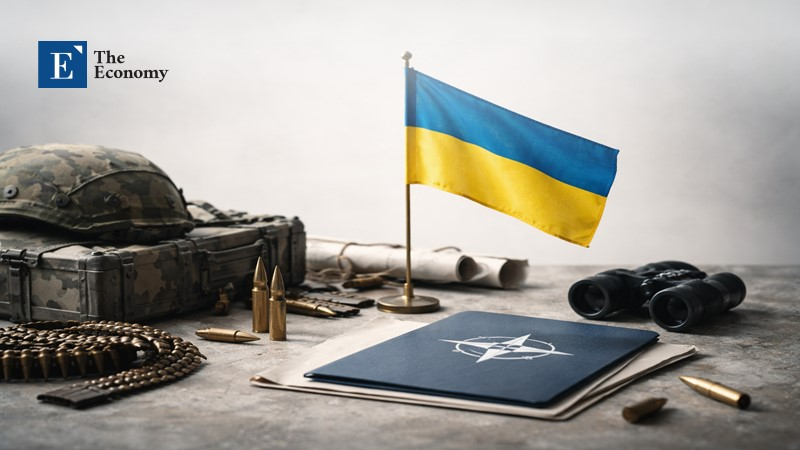
A key survey finding should inform any discussion of a negotiated pause: according to a report from the Kyiv Independent, 74% of Ukrainians oppose a peace plan that would require Ukraine to withdraw from the Donbas region and limit the size of its army unless there are reliable security guarantees (Kyiv Independent, 2026). This isn't a paradox; rather, it reflects the core political calculation. There's a desire to end the fighting, but there's little willingness to accept territorial losses or weakened defense capacities. Any sound resolution has to address these two concurrent demands: an aspiration for peace, coupled with a requirement for dignity and lasting security assurances. The policy challenge isn't just about whether Kyiv can afford a truce with financial aid or military supplies. It's about whether Kyiv's political arrangement—the implicit agreement among leaders, institutions, and a war-weary populace—can make serious concessions without creating a legitimacy crisis. This understanding, I contend, is the key factor determining whether negotiations will hold firm.
Ukraine's Political Stability: A New Perspective on the Agreement
Ukraine's political stability is more complex than a single metric such as GDP or presidential approval ratings. Here, stability rests on a three-way relationship: the trustworthiness of leaders, the sturdiness of institutions, and the conditional agreement of the citizens. The last four years have shown that these three aspects can coexist in an unusual balance. The military and other defense bodies enjoy widespread trust, while many civilian institutions do not (KBF – Kyiv School of Economics Foundation, 2025; Tamilina, 2024). Public faith in political figures has fluctuated in response to various events, peaking immediately following the invasion and dipping after controversial actions or scandals. Yet the system continued to function, exhibiting resilience such that weak general trust in the government doesn't immediately cause political breakdown. According to New Eastern Europe, Ukraine’s fortitude during the war has been bolstered not only by patriotic legitimacy and unity but also by strong support from civil society and volunteer groups, which have played an essential role in sustaining the country’s war effort (Sydorchuk, 2026). When corruption cases involve people close to the president, political understanding suffers from perceived betrayals of citizen confidence, beyond battlefield losses. Volodymyr Zelensky seems to represent both sides of this understanding: wartime leader and fighter against corruption. Scandals involving him or his close people cause special damage to the situation.
Thinking about this helps negotiators secure what will make a deal more secure. Typical security agreements focus on lines on maps and promises that can be put into action. Though still needed, they aren't enough. A lasting deal needs to keep the knowledge and moral ideas that keep society together: clear accountability for corruption, reliable assurance that people can believe in, and transparent systems that keep the military and civil governance free from corrupt, powerful people. If a contract makes commitments of peace, but does not work on these ideas, for example, if a peace requires Kyiv to accept land concessions when the elite who were involved in corruption remain free, the social agreement could break apart. This separation would bring about protests, questioning of political authority, and perhaps remobilization of any resistance to the settlement. We can learn from this that people involved in negotiations should see the legitimacy of the political process as an important part of the security structure.
Ukraine's Political Stability: Evidence from the Data
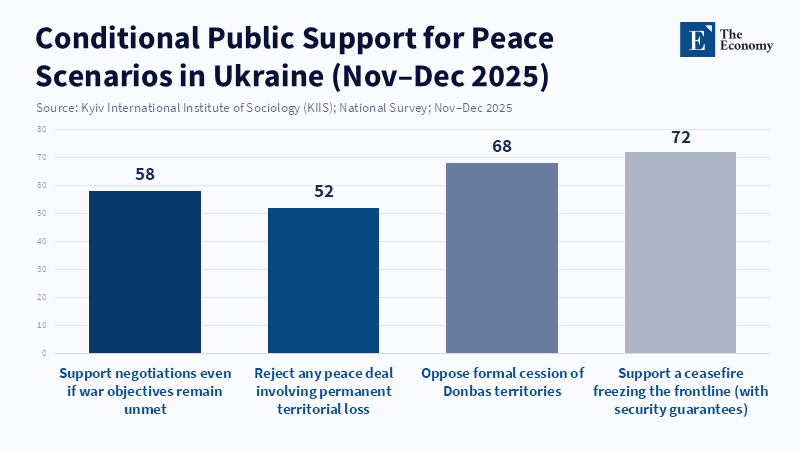
Public views are the fastest measurement of agreement. According to a report from Ukrainska Pravda, 82 percent of Ukrainians think the country should continue fighting Russia under any circumstances (KIIS, 2025). However, as demonstrated by the same poll, 52–75% also opposed large land handovers (KIIS, 2025; Reuters, 2025). Basically, openness to a stop in fighting depends upon what is agreed and these conditions need strong security promises, controls that keep Russia from using political pressure, and no official handover of power from the government of Ukraine. Political leaders who do not acknowledge how tired the people are of war, or who do not see through what they want regarding land risk, risk overstepping what the public will approve.
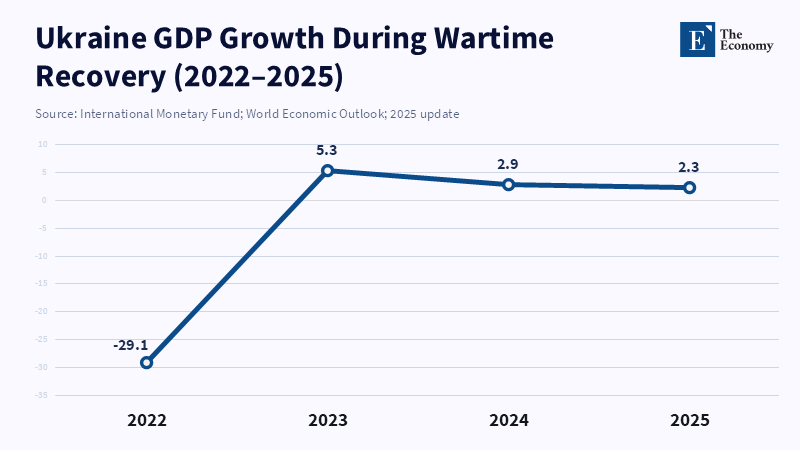
Financial and institutional scores put meat on the bones. Since the first shock of the full war, Ukraine's economy has shown an unorganized recovery: after a sharp fall in 2022, GDP rebounded in 2023 only to slow again, with most forecasts focusing on small growth in 2024–2025 (IMF, 2025; CES, 2026). International groups estimate the 2025 rate of increase at 1.8–3.0%, depending on the source and the time of calculation (IMF, 2025). Reconstruction needs remain significant – the World Bank has upgraded the cost of ten-year rebuilding efforts to the hundreds of billions – and power infrastructure remains weak(World Bank, 2026). Given these financial realities, whatever is offered to people in return for peace needs to be strong and achievable: weak promises of future economic security can’t be made as assurance of current safety. Please note: polling numbers mentioned here are from KIIS (about 1,000 people, Nov–Dec 2025). Financial increase assessments were checked against the IMF files.
The political destruction caused by corruption is key to keeping stability. The Midas review - an anti-corruption project looking into claimed kickbacks from power state purchases – opened up a claimed $100 million loss and mentioned upper-level leaders (CNN, 2026; Reuters – Peleschuk, 2026). The investigation led to upper-level detentions, resignations, and a public response, prompting Kyiv to reconsider its previous methods of limiting anti-corruption groups (The Washington Post – Khudov & Stern, 2026). Political mobilization and electoral results in the face of such scandals are unbalanced: Ukrainians can endure suffering from external aggression, but they have a weaker ability to address corruption, undermining the national goal. (Skorkin, 2025). When corruption steals gas, fuel, or tools from the war, the political cost rises. According to a report from Le Monde, recent polls show that more Ukrainians are open to negotiations, with 57 percent willing to talk in May 2024, up from 33% a year earlier, provided there are strong security guarantees (D’Istria, 2024). This swing in public opinion could influence leaders’ ability to build support for compromise, though the political costs may still make it difficult for any leader to persuade elites and the public at home during negotiations.
Ukraine's Political Stability: Dangers to Agreement and Future Roads
If support for compromise continues to grow, leaders in Kyiv might find it somewhat easier to propose deals, but they will still need to secure solid security assurances to address public and political concerns. One understandable road involves a deal that serves as a stopgap, without formal acceptance of land handover, along with supporting guarantees of safety from outside powers. That package could gain the careful permission of a good number of citizens if it includes actual monitoring, fast promises of rebuilding, and a system of public accountability for the elite. But there are three obvious ways of failing. The first is that if the plan involves known land cessions, a majority will probably refuse, which will add fuel to road protests and deepen division. If blame for corruption is placed solely on an individual, public outrage could damage trust in leadership and lead to resignations. Additionally, according to a report from the Associated Press, if external guarantees of protection are seen as temporary political gestures with no real operational backing, the public may perceive them as retreats rather than steps toward genuine and lasting peace (AP News, 2025) . Polls already show how sensitive people are to each of those risks.
The argument is that people will move on quickly when peace is provided, and that the benefits of safety will outweigh higher priorities, such as freedom or the corruption of the elite. The data complicates that claim. Even though war is very exhausting, the way things are traded off is what matters. Studies show that Ukrainians distinguish between a negotiated ending that preserves their freedom and one that hands over territory in exchange for weak assurances (Kyiv Independent, 2026; Reuters, 2025) . The limit on taking elite concessions decreases when dishonesty is linked to important public services. Briefly, public deals for peace aren't short-term territorial changes for hope; they concern reputation and organization.
Ukraine's Political Stability: What Educators, Administrators and Politicians Need to Do
Politicians must make a plan that works in two ways: it holds external promises, made to make compromise trustworthy, and home changes that restore and demonstrate accountability. Independent verification teams, multinational quick-response promises, and legally set security are needed, not just symbolic (Aydıntaşbaş et al., 2026). When it comes to reconstruction, givers and lenders should mix funds with clear purchase methods, and local boards that include people from society. This reduces bad politics and elite capture and creates real financial return for citizens, who only see fake promises. Administrators need to be clear about this, funds for safe removals, power repairs and safety for winter will be set aside and tracked in close to real-time- evidence that shows helping normal people.
Instructors and people who work in civics play a great role in keeping everything together. Schools, colleges, and professional communities can regain the public's trust all over again. Teaching what a negotiated hold/freeze means, teaching communities to watch over purchases, and teaching civics about transit systems will make citizens less at risk of control. Those mentioned above aren’t soft additions; they are realistic ways for political stability. In a shorter time, they weaken the power of propaganda that frames compromise as betrayal, and in the medium, the public's demand will increase the results. Support can be made with educational support, grants to schools and small technical grants to NGO watch groups to build purchase dashboards.
Some might argue that high domestic power helps Russia because public views trump the strategies of the elite. The reply is that strength isn’t weakness; it's using the power. According to a survey by the Kyiv International Institute of Sociology (KIIS) in May 2022, 82 percent of Ukrainians opposed making territorial concessions to Russia, demonstrating that any government negotiating without broad public support risks instability or backlash (KIIS, 2025). However, some argue that the immediacy of ending suffering could justify Kyiv taking swift actions that circumvent standard checks at home. That is tempting. History can tell that speed without legitimacy makes peace weak. According to a recent Ipsos survey, many Ukrainians support solutions that include well-defined agreements with defined timelines, emphasizing immediate humanitarian aid contingent on verified public accountability and security (Ipsos, 2025). The findings underscore the importance of citizen trust and consent as key elements of Ukraine's political stability. The survey also suggests that these attitudes may influence negotiators' willingness to consider proposals such as a temporary freeze in the conflict, but on what can hold people to their need for freedom, insurance of security, and the honesty that is shown to the people, elite accountability. Thinking of political stability as an input, instead of output, changes what is compromised. This requires people to create practical, open promises.
References
Aydıntaşbaş, A., Baev, P.K., Budjeryn, M., Gordon, P.H., Grzymała-Busse, A., Hamilton, D.S., Karlin, M., Pifer, S., Sisson, M.W., Stelzenmüller, C. and Wright, T., 2026. What price for peace in Ukraine? Washington DC: Brookings Institution.
Al Jazeera, 2026. Russia-Ukraine war: List of key events (January 2026). Al Jazeera.
AP News, 2025. Russia-Ukraine war anniversary coverage. Associated Press.
Centre for Economic Strategies (CES), 2026. War economy tracker — Ukraine. Kyiv: CES.
CNN, 2026. Former energy minister detained in Ukraine corruption case. CNN International.
D’Istria, T., 2024. Ukrainians increasingly open to negotiations on condition of security guarantees. Le Monde.
International Monetary Fund (IMF), 2025. World Economic Outlook: Ukraine country data. Washington DC: IMF.
Ipsos, 2025. Ukraine political sentiment survey findings. Ipsos Ukraine.
Kyiv Independent, 2026. Poll: 74% of Ukrainians against peace plan involving Kyiv’s withdrawal from Donbas and army cap. Kyiv Independent.
Kyiv International Institute of Sociology (KIIS), 2025. Public opinion surveys on peace negotiations and territorial concessions (Nov–Dec 2025). Kyiv: KIIS.
KBF (Kyiv School of Economics Foundation), 2025. Trust in Ukrainian state institutions: Leaders and outsiders of public confidence. Kyiv: KBF.
Reuters, 2025. Vast majority of Ukrainians reject major peace concessions, poll finds. Reuters.
Reuters, Peleschuk, D., 2026. Ukrainian anti-graft authorities detain ex-minister in major case. Reuters.
Skorkin, K., 2025. The corruption scandal engulfing Ukraine won’t die down anytime soon. Carnegie Endowment for International Peace.
Sydorchuk, M., 2026. The Ukrainian model of societal resilience: Why the country did not collapse under full-scale war. New Eastern Europe.
Tamilina, L., 2024. Do Ukrainians trust democratic institutions? Institutional confidence and democracy amid the war in Ukraine. VoxUkraine.
The Conversation, 2026. Ukraine battered by bombing and scarred by corruption. The Conversation.
The Washington Post, Khudov, K. & Stern, D.L., 2026. Ukraine detains ex-energy minister as high-level corruption case widens. Washington Post.
World Bank, 2026. Ukraine recovery and reconstruction needs assessment. Washington DC: World Bank.
Working across research, policy, and data-driven analysis, the Editorial Board ensures that published pieces reflect a consistent institutional perspective grounded in quantitative reasoning and long-term structural assessment.