Why a 20-Year US Security Guarantee for Ukraine Is Essential for Durable Peace

Working across research, policy, and data-driven analysis, the Editorial Board ensures that published pieces reflect a consistent institutional perspective grounded in quantitative reasoning and long-term structural assessment.
Authored On
Modified
A US security guarantee for Ukraine must be credible and long term
Twenty years is a recovery window, not a privilege
Without enforceable guarantees, peace will remain fragile
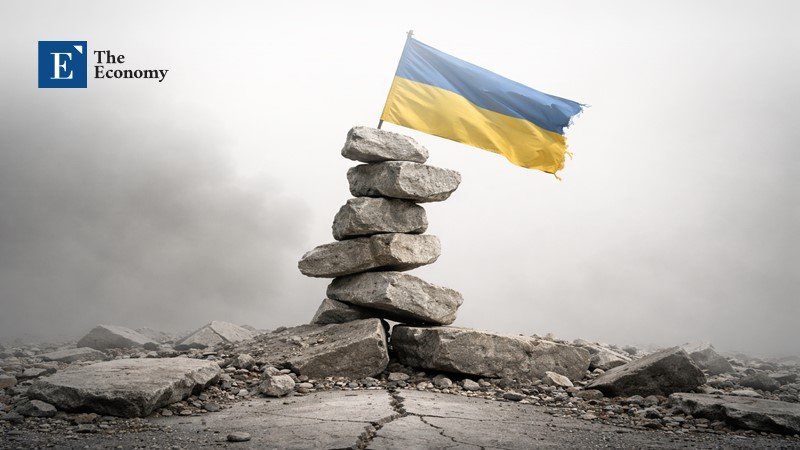
When Ukraine requests a 20-year security agreement from the United States, it's not looking for an advantage. It's seeking to turn its decision to give up nuclear weapons and the ongoing war into a political deal that provides time for recovery. The 20-year term is important: Ukraine gave up its Soviet nuclear arsenal in 1994 based on promises from the West (United Nations, 1994). Today, the U.S. has already spent considerable money to support Ukraine (Masters & Merrow, 2026). This difference between the promises made in the 1990s and the current support is why Ukraine's demand is both important and logical. If the West wants a lasting peace, the agreement must be clear, supported by resources, and enforceable internationally to ensure it is followed. Anything less would simply add to a history of broken promises, including past agreements and ceasefires that Russia has ignored.
What a 20-Year US Security Guarantee Would Really Offer Ukraine
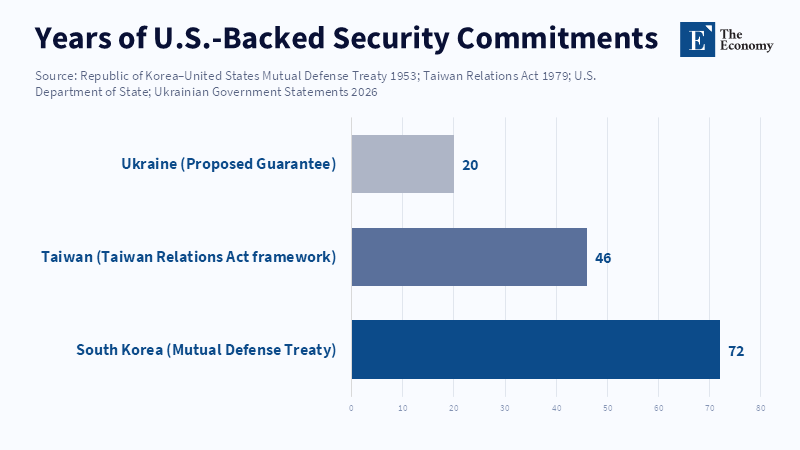
For those creating policy, the main question is: what would a reliable US security guarantee for Ukraine actually involve? A good guarantee would include clear commitments to military aid, support for economic reconstruction, and specific actions if those commitments aren't kept (Aydıntaşbaş et al., 2026). A 20-year agreement should include long-term funding for defense and arms production, legally binding agreements on intelligence sharing and assistance, and a practical, constant allied presence. The examples of South Korea and Taiwan are important because they show how long-term security arrangements can result in lasting defense, combined logistics, and time to rebuild systems. South Korea has had a formal mutual defense treaty with the U.S. since 1953, as well as a continual presence of American troops (Republic of Korea and United States, 1953). Taiwan's situation is different legally, but similar politically. For many years, the U.S. has provided Taiwan with weapons, training, and a strong defense under the Taiwan Relations Act (United States Department of State, 2025). Both examples show that lasting defense depends on steady policy, building local capabilities, and explicit steps that an opponent would understand. A 20-year American security agreement for Ukraine must be very clear on three points: what exactly the armed support will entail, how reconstruction will be funded, and which groups (NATO, EU, U.S. special groups) will oversee the agreement. Without these details, the promise is just for show, not a tool for stability.
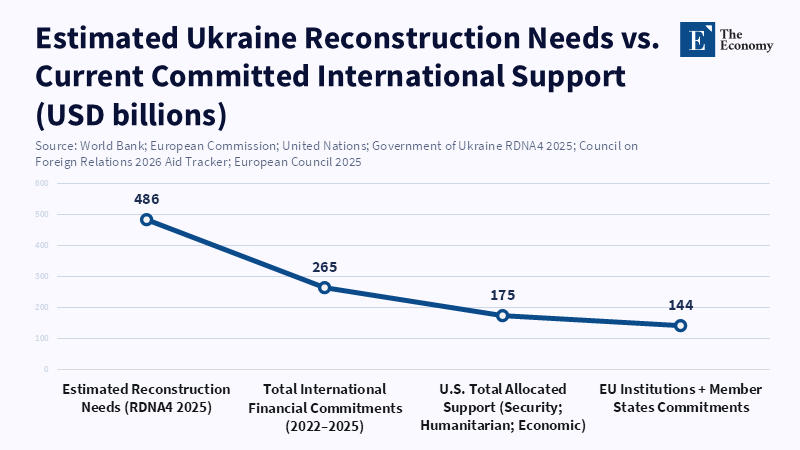
Economics is another key part. Estimates for rebuilding Ukraine are very high, with some assessments suggesting long-term needs could reach hundreds of billions of dollars (World Bank / European Commission / United Nations / Government of Ukraine, 2025). This means that any security guarantee that does not combine military support with a plan for rebuilding the economy will leave Ukraine at risk of economic collapse during a ceasefire. A strong U.S. guarantee that includes loans, grants connected to reforms, and support for local arms industries would give Ukraine time to rebuild its industries and its military. South Korea's development after the war took many years (Republic of Korea and United States, 1953). Expecting Ukraine to catch up in just a couple of years is unrealistic. That's why Ukrainian leaders are asking for a 20-year timeframe, not because they want to be dependent, but because it gives them the time they need to turn promises into real strength. The legal form of the guarantee is also important. The previous agreement proved unreliable (United Nations, 1994). The guarantor needs to establish various support mechanisms: a treaty, a political agreement supported by NATO/EU, and clear economic commitments that are easy to verify and therefore harder to abandon.
Risks, Russian Responses, and Making Defense Believable
Any believable US security guarantee for Ukraine will anger Russia. That is not a reason to avoid making a strong promise, but a reason to create the promise in a way that reduces the chances of escalation. Russia sees its borders and influence as essential. From Russia's perspective, a Ukraine close to NATO with security arrangements backed by the West would appear to be a permanent change in the area (Wintour, 2026). It's helpful to look at historical examples: after World War II, the winning countries created buffer zones and treated them as permanent security areas. Russia's reaction to a Western-led guarantee will depend on whether the guarantee is defensive and can be changed, or is permanent. If the guarantees secure borders in ways that Russia sees as threats, the risk is that Russia will continue to challenge the agreement rather than settle peacefully.
This forces us to evaluate several limitations. First, guarantees should focus on defense and security, not offensive actions that could be seen as planning to overthrow the Russian government. Second, they should include explicit timelines and ways to track progress, so that things can return to normal if the fighting truly ends. Third, to reduce Russia's reasons for feeling constantly insecure, guarantees should be international and include a strong role for Europe. The more the security agreement is shared, the harder it is for any country to claim it is just an American plan (Aydıntaşbaş et al., 2026). This is not about giving in, but about being realistic. The main plan must be to make the cost of Russia starting another war much higher than the value of taking more land, and to make a return to violence unattractive for Russian leaders. That requires investments in air defenses inside Ukraine, strong logistics, mobile anti-armor capabilities, and sanctions that are agreed upon by democracies. It also requires solid promises to punish any violations quickly, not months later when everyone has moved on.
A final risk is the political situation in the countries providing the guarantee. A 20-year program with large financial commitments will face debates, election changes, and growing weariness. The United States and its partners must create a guarantee that can withstand political changes. This can be done through long-term legal commitments with review clauses, contracts that create jobs across allied countries, and plans to transfer some responsibilities to Ukraine as it rebuilds. The economic aspect is important: guarantees that provide benefits back to the countries providing them are easier to maintain politically (Masters & Merrow, 2026).
Lessons for Educators, Administrators, and Policy Makers
If the West commits to a US security guarantee for Ukraine, there will be effects throughout different areas. For educators and administrators in schools, the immediate need is to plan for the workforce: rebuilding Ukraine will require technicians, engineers, construction managers, and demining and infrastructure restoration experts (World Bank / European Commission / United Nations / Government of Ukraine, 2025). Western universities and technical schools should develop quick programs, credit transfer agreements, and partnerships to train Ukrainians. Targeted scholarships for reconstruction work, joint research centers on infrastructure, and temporary accreditation pathways will quickly translate funding into real skills. These actions create stability by reducing the economic costs of long-term dependence and connecting Ukraine with European markets through human skills.
For defense planners and administrators, the lesson is to move from one-time donations to reliable supply chains. A credible guarantee requires long-term supply agreements for weapons and production lines within Ukraine or in nearby countries. According to the National Agency on Corruption Prevention, Ukrainian authorities are implementing a plan to reduce corruption risks in logistics procurement for the Armed Forces. This includes measures to improve contract transparency to help ensure that aid effectively supports military operations (Holland & Dey, 2026). For decision-makers, creating conditions that are strict on verification but supportive will be important. Guarantees with anti-corruption rules monitored by international groups will be more stable and effective.
Thinking about criticisms is part of making responsible policy. Some will say a strong U.S. commitment risks escalation with Russia. Others will argue that any guarantee gives long-term Western resources to a country that might cause problems. These criticisms miss two points. First, the alternative to a believable guarantee is not peace, but a fragile pause that allows Russia to regroup and return. Second, the best way to limit long-term Western burdens is to invest in Ukraine's capabilities and governance so that the country can progressively handle its own defense (Aydıntaşbaş et al., 2026). According to the Associated Press, the United States has proposed a 15-year security guarantee for Ukraine as part of a peace plan. A time-limited, conditional, and partnership-based guarantee can help reduce both short-term military risks and long-term financial responsibilities.
A US security guarantee for Ukraine remains politically challenging but is strategically important. Ukraine's request for 20 years is not a demand for permanent protection, but a request for time and resources to rebuild (Wintour, 2026). Washington and its allies must create enforceable, funded guarantees, combined with rebuilding and training programs that transfer responsibility back to Ukraine. That means writing clear statutory commitments, funding defense and reconstruction, organizing verification and enforcement, and investing in human abilities and industry so Ukraine can move from dependence to independence. History shows that long-term security guarantees work when they are believable, affordable, and part of broad alliances. They fail when they are unclear, underfunded, or controlled by one country. If the West wants to turn this war into a lasting peace, it must offer Ukraine a sensible, enforceable deal that unites military defense, economic rebuilding, and reform over 20 years. That is how broken promises become lasting stability.
References
Aslı Aydıntaşbaş, Pavel K. Baev, Mariana Budjeryn, Philip H. Gordon, Anna Grzymała-Busse, Daniel S. Hamilton, Mara Karlin, Steven Pifer, Melanie W. Sisson, Constanze Stelzenmüller, Thomas Wright, Brookings Institution (2026) What price for peace in Ukraine? Brookings Institution.
Holland, S. & Dey, B. (2026) US has told Ukraine it must sign peace deal with Russia to get security guarantees, Reuters.
Masters, J. & Merrow, W. (2026) Here’s how much aid the United States has sent Ukraine, Council on Foreign Relations.
Republic of Korea and United States (1953) Mutual Defense Treaty between the United States of America and the Republic of Korea.
United Nations (1994) Memorandum on security assurances in connection with Ukraine’s accession to the Treaty on the Non-Proliferation of Nuclear Weapons (Budapest Memorandum).
United States Department of State (2025) U.S. security cooperation with Korea (official briefings and force posture summaries).
World Bank, European Commission, United Nations and Government of Ukraine (2025) Rapid Damage and Needs Assessment (RDNA4) — Updated Ukraine recovery and reconstruction needs assessment.
Wintour, P. (2026) Ukraine wants 20-year US security guarantee to sign peace deal, The Guardian.
Working across research, policy, and data-driven analysis, the Editorial Board ensures that published pieces reflect a consistent institutional perspective grounded in quantitative reasoning and long-term structural assessment.