Technology, Capital, and Risk-Sharing: Taiwan-Japan-India Semiconductor Alliance Forged, Consolidating Three-Nation Industrial Ambitions

As one of the youngest members of the team, Tyler Hansbrough is a rising star in financial journalism. His fresh perspective and analytical approach bring a modern edge to business reporting. Whether he’s covering stock market trends or dissecting corporate earnings, his sharp insights resonate with the new generation of investors.
Authored On
Modified
Taiwan-Japan-India Forge ‘Division of Roles’ Semiconductor Alliance
Taiwan and India’s Public-Private Sectors Execute Aggressive Semiconductor Investments
Japan Mounts All-Out Revival Campaign After Elpida’s Collapse, With Rapidus at the Core
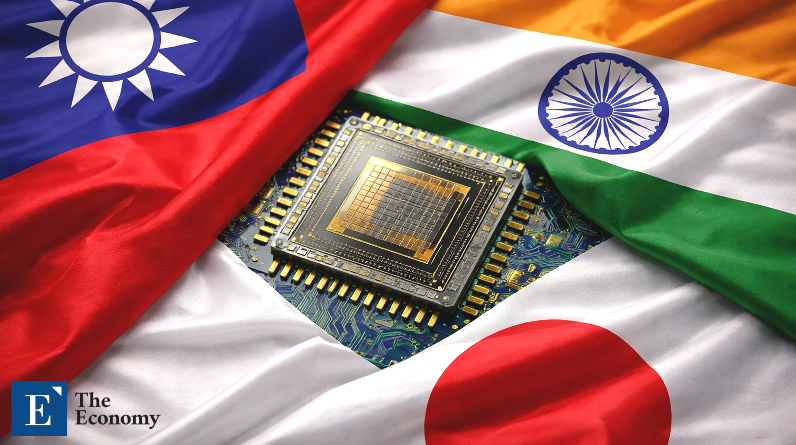
Taiwan, Japan, and India are intensifying strategic cooperation in the semiconductor sector. A “division of roles” framework is taking shape in which Taiwan and Japan provide technological expertise and capital, while India assumes a pilot role during the initial stages of technology development. Market observers assess that this collaborative front reflects the three nations’ resolute commitment to fostering their domestic semiconductor industries.
Semiconductor Cooperation Framework Among Taiwan, Japan, and India
According to Taiwan-based IT outlet DigiTimes on the 26th, Mitsubishi UFJ Financial Group, Japan’s largest financial institution, and National Yang Ming Chiao Tung University (NYCU), a leading Taiwanese semiconductor talent incubator, recently signed a memorandum of understanding (MOU) in Hsinchu, Taiwan, to advance semiconductor industry cooperation. Professor Cheng YC, an international semiconductor talent development expert at NYCU, explained, “India will transplant the successful model of Taiwan’s Industrial Technology Research Institute (ITRI) to disperse risks in early-stage technology development, while Japan, leveraging its advanced financial capabilities, will supply long-term capital for advanced packaging processes and educational infrastructure.”
The three countries have recently been concretizing their cooperative front across multiple fronts in the market. Foxconn, the world’s largest electronics manufacturing services (EMS) provider based in Taiwan, held a groundbreaking ceremony on the 21st for a semiconductor packaging and testing (OSAT) facility in the Yamuna Expressway Industrial Development Authority (YEIDA) zone in Uttar Pradesh, northern India. The ceremony was overseen by “India Chip,” a joint investment venture between India’s IT conglomerate HCL Group and Foxconn. According to Foxconn, India Chip plans to invest $7.59 billion over the coming years in display driver chip (DDI) production facilities, with expectations of establishing a local supply chain and generating more than 3,500 direct and indirect jobs.
Taiwan Semiconductor Manufacturing Company (TSMC), the world’s largest foundry, has decided to mass-produce 3-nanometer (nm) semiconductors at its second Kumamoto plant in Japan. Initially, TSMC had planned to invest $12.2 billion in the facility to establish production lines for 6–12nm chips, but it has revised its strategy to establish Japan’s first 3nm production base. As a result, total equipment investment for the Kumamoto No. 2 plant is projected to expand to $17 billion. The Japanese government, which had previously committed up to $4.46 billion in subsidies for the plant, is now reviewing additional support measures.
Semiconductor Industries Absorbing Massive Capital Flows
Behind the three nations’ aggressive cooperative strategy lies their firm determination to cultivate their semiconductor sectors. Taiwan, widely regarded as a pivotal axis of the global semiconductor market, has designated semiconductors as a national strategic industry and is implementing assertive support measures. A representative example is the so-called “Taiwan Chips Act,” which offers tax credits of up to 25% of research and development (R&D) expenditures and approximately 5% of advanced equipment investment costs. TSMC, the backbone of Taiwan’s semiconductor market, has also announced plans to undertake capital expenditures of up to $56 billion in fiscal year 2026.
The Indian government has likewise approved 10 semiconductor-related projects, intensifying support for the industry. Its ultimate objective is to establish a value chain encompassing two semiconductor fabrication plants (fabs) and eight packaging facilities, with total investment reaching $32 billion. In addition, in March 2024, India launched the “India AI Mission” with a budget of $1.26 billion, supplying graphics processing units (GPUs) to researchers, small and medium-sized enterprises, and academic institutions through subsidy mechanisms.
Private-sector growth ambitions are equally pronounced. Surat-based Indian chemical company Aculis Chemicals recently acquired a 75% stake in South Korean semiconductor chemical materials firm Indicam, marking a full-scale entry into Korea’s semiconductor materials market. The total investment amounts to $2.54 billion. Indicam, a semiconductor materials company established as a joint venture between India’s fine chemical enterprise Aculis Chemical and Korea’s JN Materials, is currently proceeding with the construction of a manufacturing plant and equipment investments in Korea. The facility is slated to commence operations by the end of this year and will produce semiconductor chemical products in alignment with the global expansion cycle in semiconductor capacity.

Japan Accelerates Semiconductor Renaissance Drive
Japan is advancing its “semiconductor revival” strategy with Rapidus at the forefront. Established in 2022 under government leadership to restore Japan’s semiconductor industry, Rapidus is a foundry enterprise that has strengthened its competitiveness on the back of state support. Japan’s Ministry of Economy, Trade and Industry plans to inject an additional $6.09 billion into Rapidus during fiscal years 2026–2027. Including this allocation, total government funding will reach $17.66 billion. Furthermore, 30 leading Japanese corporations will collectively invest $1.46 billion in Rapidus.
The aggressive public-private investment campaign is widely interpreted as an all-out effort to redeem the failure of Elpida. Once hailed as Japan’s hope in memory semiconductors, Elpida was established in 1999 through the integration of the DRAM businesses of Toshiba, Hitachi, and NEC. In its early years, Elpida maintained meaningful competitiveness in server and graphics DRAM and advanced process technologies, posting annual profits and sustaining growth. In 2003, it expanded further by acquiring Mitsubishi’s DRAM operations, and the following year it listed on the Tokyo Stock Exchange.
However, conditions shifted dramatically with the onset of the semiconductor downcycle in 2007. After recording its first quarterly loss in the second quarter of 2007, Elpida incurred a massive deficit of $1.62 billion in 2008 amid the fallout from the Lehman Brothers collapse. In response, the Japanese government extended $273 million in public funds in 2009, while creditor banks provided an additional $910 million. Although Elpida posted brief profits during 2009–2010, it was once again cornered in 2011 as DRAM prices plummeted, ultimately filing for bankruptcy protection in February 2012 under a debt burden of $4.08 billion.
The market identifies policy missteps as one of the principal factors behind Elpida’s downfall. In the late 2000s, Elpida pursued transitions to 50nm and 40nm process technologies, financing most of its investments through borrowing. Following the global financial crisis of 2007–2008, however, Japanese banks sharply curtailed exposure to risk assets, driving up Elpida’s financing costs. A surging yen compounded the strain, further eroding profitability. Government assistance at the time largely took the form of short-term operating funds and guarantees, an insufficient cushion to withstand the downturn.
After effectively losing its semiconductor competitiveness in the wake of Elpida’s collapse, Japan has only recently mounted a comprehensive campaign to restore capabilities and rebuild domestic supply chains. According to U.S. IT media outlet Wccftech, the Japanese administration has repeatedly proposed that Korean firms such as SK hynix and Samsung Electronics construct fabrication plants in Japan, offering astronomical subsidies, complimentary land provision, and total cost of ownership (TCO) reduction incentives. Given that building a cutting-edge semiconductor fab typically requires around $14.5 billion, the structure effectively amounts to Japan providing multibillion-dollar cash support. However, Samsung Electronics and SK hynix are reported to have declined these proposals, prioritizing the protection of Korea’s domestic semiconductor ecosystem.
As one of the youngest members of the team, Tyler Hansbrough is a rising star in financial journalism. His fresh perspective and analytical approach bring a modern edge to business reporting. Whether he’s covering stock market trends or dissecting corporate earnings, his sharp insights resonate with the new generation of investors.
Similar Post