China Achieves Proof of Thorium Reactor Fuelization, Bringing World’s First Commercial Deployment Into View

Siobhán Delaney is a Dublin-based writer for The Economy, focusing on culture, education, and international affairs. With a background in media and communication from University College Dublin, she contributes to cross-regional coverage and translation-based commentary. Her work emphasizes clarity and balance, especially in contexts shaped by cultural difference and policy translation.
Authored On
Modified
Experimental thorium molten salt reactor converts material into nuclear fuel
Construction costs stand at one-quarter of Western levels, reshaping the market through the “manufacturing industrialization” of nuclear power plants
Inner Mongolia reserves alone secure the potential to supply electricity for 60,000 years
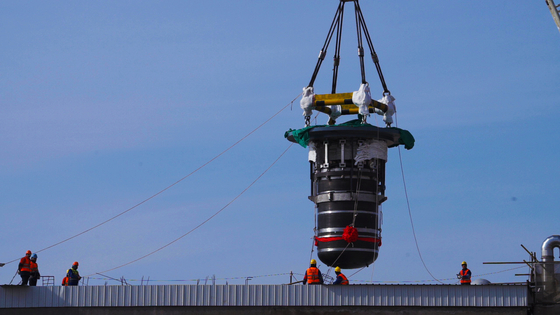
China has succeeded in verifying thorium molten salt reactor (TMSR, Thorium Molten Salt Reactor) technology, widely regarded as a game changer for next-generation nuclear power generation, thereby upending the landscape of energy security. The reactor tested by China is a nuclear power system that injects thorium into a reactor together with molten salt, a high-temperature liquid salt, to induce nuclear fission and generate electricity. Because the molten salt serves as the coolant, the reactor does not need to be built beside the sea to secure cooling water. China has thus succeeded in developing an advanced reactor system that the West abandoned after running into technological limits.
Operation in Desert Conditions Without Cooling Water, Eliminating Risk and Waste at the Source
According to Polish energy outlet Globenergia on April 8 local time, the Shanghai Institute of Applied Physics under the Chinese Academy of Sciences recently succeeded in converting thorium into fissile uranium-233 and operating it in practice at the experimental reactor TMSR-LF1 in Wuwei, Gansu Province. Thorium does not undergo fission on its own, but when neutrons collide with its atomic nucleus, it is converted into uranium-233, and that process functions as the core mechanism of thorium molten salt reactor technology. This approach lowers site constraints by enabling reactor construction in inland regions and is expected to deliver higher energy-generation efficiency than conventional uranium-based reactors. Radioactive waste is also smaller in volume, while safety is higher. For that reason, it is classified as a fourth-generation advanced nuclear system.
The experiment China has now completed is “fuelization proof,” the core step in the thorium fuel cycle. That means China has secured a system capable of producing thorium technology cheaply and repeatedly at scale. Thorium-based nuclear power is not an entirely new technology. Physicists at Oak Ridge National Laboratory in the United States studied ways to use thorium as reactor fuel in the 1960s. A molten salt experimental reactor was later operated at Oak Ridge National Laboratory in Tennessee, but the research was effectively halted after two years. It is known that the work was ultimately abandoned because no viable technological solution could be found at the time.
Germany also operated a TMSR in Hamm in the 1980s. Unlike current proposed designs, however, it used helium rather than molten salt as the coolant. But it was shut down after about a year of operation. The operator decided to close it because it could not bear the cost required to circulate molten salt through the cooling system and maintain sodium in liquid form ahead of nuclear fuel loading. As a result, TMSR in the West was pushed out of the mainstream and categorized as “safe and efficient, but of low practical value.”
Regulation and public sentiment later became the principal barriers. After the Japanese nuclear accident, tighter safety standards sharply increased the time and cost required to commercialize new reactor types, and in the meantime the market had already solidified around standardized light-water reactor systems. To be sure, TMSR still faces high hurdles before commercialization because fuel-cycle technology, materials technology, and operational experience remain insufficient. But the mood is shifting as the spread of artificial intelligence drives explosive growth in demand for power and heat. TMSR is now being reassessed not simply as a power plant, but as an on-site energy hub that can be directly attached to data centers and industrial complexes.
A Technology Capable of Surpassing the Limits of Uranium-Based Nuclear Power
Against that backdrop, China has cleared the technological threshold and become the only country in the world to have actually operated thorium fuel. Beijing has long invested in TMSR as a matter of national strategy. Since 2011, the Chinese Academy of Sciences has designated TMSR as a “next-generation strategic reactor” and pushed ahead with basic physics, materials science, the fuel cycle, the regulatory framework, and workforce development as a single integrated package. While Western countries remained confined to conceptual research amid public opposition and regulatory constraints, China built a roadmap stretching from experimental reactors to expanded output and ultimately commercial reactors.
The Chinese government plans to build a 100-megawatt pilot power plant by 2035 and begin commercial operations around 2040. Dai Zhimin, head of the Shanghai Institute of Applied Physics at the Chinese Academy of Sciences, expressed confidence, saying, “China’s thorium reserves are far greater than its uranium reserves, and if used efficiently, they can guarantee national energy security for more than 1,000 years,” adding that “core equipment has been 100% localized.” Chinese researchers estimate that thorium reserves in Inner Mongolia alone hold power-generation potential equivalent to 60,000 years at current consumption levels. For a country highly dependent on uranium imports, thorium amounts to a strategic stronghold.
The reason thorium-based nuclear power is drawing attention as a next-generation energy source lies not in output volume, but in qualitative superiority. First, monazite, the raw material source of thorium, is abundant in sand. Thorium is three to four times more plentiful than uranium on Earth, and global reserves total 6 million tons, enough to meet humanity’s energy demand for thousands of years. Its energy efficiency is also overwhelming. One ton of thorium is equivalent to 200 tons of uranium and can generate the same amount of heat as 3.5 million tons of coal. Moreover, while current light-water reactors use only 0.7% of uranium and discard the rest, thorium molten salt reactors convert thorium-232 into uranium-233 and utilize more than 99% of the fuel.
Safety is even more exceptional. Existing light-water reactors use water as a coolant and therefore operate under high pressure, meaning that if the cooling system is damaged, there is always a risk of steam explosions or coolant leakage. By contrast, molten salt reactors operate with nuclear fuel dissolved in liquid salt under conditions close to atmospheric pressure. If the temperature exceeds the critical threshold, the molten salt containing the fuel automatically moves into an emergency storage tank, halting the reaction. This is a passive safety system that allows the reactor to secure its own safety even in the event of a total power loss, effectively eliminating the risk of a core meltdown.
Thorium Reactors Also Being Pursued for Application in Nuclear-Powered Icebreakers
More threatening than technological progress and safety is China’s overwhelming price competitiveness. According to the Chinese Academy of Sciences, China’s nuclear plant construction cost averages $2,500 per kilowatt. That is only about 30% of the global average of $8,500. In Western nuclear projects in particular, 30% to 50% of total costs arise from financing costs and delay risk, whereas China has minimized those burdens through state-led low-interest financing and standardized processes. For that reason, China’s TMSR success is being viewed as the opening shot in a shake-up of the existing uranium-centered supply chain. China is currently making its intention clear: to leverage its overwhelming cost advantage in construction and dominate the global nuclear export market as well.
China’s TMSR ambition is also tied to its Arctic push. In a 2018 white paper, China defined itself as a “near-Arctic state” and declared its intention to build a “Polar Silk Road” linking Europe via the Arctic Ocean. Beijing’s strategic concern is clear. Existing maritime routes such as the Strait of Malacca, Suez, and the Panama Canal are exposed to Western control in times of crisis. For China, which depends on sea lanes for more than 70% of its energy imports, securing an alternative route that bypasses these geopolitical chokepoints is a national-security imperative, and the Arctic route is assessed as virtually the only option capable of meeting that need.
China envisions applying TMSR technology to nuclear-powered icebreakers in order to open the Arctic route. That plan is also closely linked to its AI strategy. China has sharply increased AI processor production and built data centers numbering in the hundreds for major domestically produced chips. Its AI computing capacity has risen to second in the world behind the United States, but massive power demand has become a new bottleneck. China currently operates dozens of commercial nuclear reactors, yet nuclear power still accounts for only 4% of total electricity generation. Under these conditions, securing an indigenous technology with a closed fuel cycle such as TMSR would reduce dependence on imported uranium and protect strategic infrastructure such as data centers from sanctions and supply shocks. Even if chip technology trails the United States by one generation, China’s strategy is to defend its AI capabilities by combining large numbers of chips with cheap and stable electricity, effectively overwhelming quality through sheer scale.
Siobhán Delaney is a Dublin-based writer for The Economy, focusing on culture, education, and international affairs. With a background in media and communication from University College Dublin, she contributes to cross-regional coverage and translation-based commentary. Her work emphasizes clarity and balance, especially in contexts shaped by cultural difference and policy translation.
Similar Post