China’s Corruption Trap and the Case for Rule-Based Anti-Corruption

Working across research, policy, and data-driven analysis, the Editorial Board ensures that published pieces reflect a consistent institutional perspective grounded in quantitative reasoning and long-term structural assessment.
Authored On
Modified
Purges shake elites but do not replace relationships with rules
China’s problem is structural: guanxi still outweighs formal rules
Real reform means rules—not people—decide outcomes

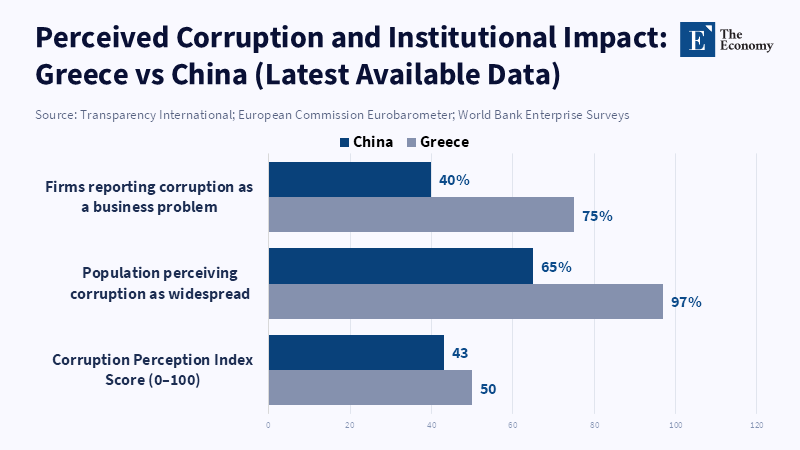
According to Transparency International's most recent index, even Denmark, which scored as the "cleanest," only reaches 90 points out of 100. This fact is important because it debunks a common myth: corruption is not just an issue that afflicts weak, faraway countries; no public system is incorrupt. This is a problem of state architecture, not solely state morals. The fundamental issue is not whether a state is corrupt or pure, but rather whether the rules are generally honored above relationships or if relationships still bend rules. China falls into the latter category and received a score of 43 on the index. Greece, despite being a member of the EU and a nation with a history of talk about reform, scored 50. The commonality between these two cases is evident: corruption will only begin to decrease when individuals believe that the issuance of permits, promotions, contracts, admissions and penalties is decided by transparent, non-discriminatory, rule-based mechanisms rather than by personalized relationships or favors.
China doesn't need another purge. It needs rules-based anti-corruption
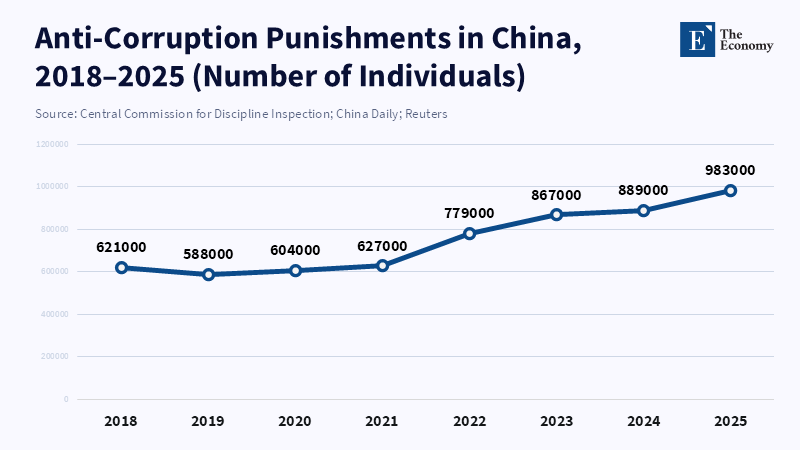
Xi Jinping's anti-corruption campaign has been extensive and relentless in its rhetoric and execution. 889,000 people were investigated for graft during 2024, and a record 983,000 individuals during 2025, including 115 officials at the provincial/ministerial level and above. Despite this sustained effort, the crackdown is still reaching high levels within the party structure. March and April 2026 saw its expansion into the securities regulator, the military, and even the Politburo itself. An anti-corruption campaign that needs to continually demonstrate its seriousness after more than a decade isn't evidence of success; it's evidence of a profound structural problem: the system continues to generate the corrupt behavior it purports to curb. This is the most significant warning sign.
This explains why the typical praise for Xi's harsh methods fails to address the root of the problem. Arresting a vice-chairman of a securities regulatory body, a high-ranking general, or a Politburo member does send a shiver through the bureaucracy and may be enough to cow officials, disrupt personal networks, or offer public assurance that no one is above the law. However, fear doesn't fix broken institutions. When corruption persists even in strategic areas highlighted by Xi, it's difficult to blame the campaign's failure on weakness. The problem runs deeper; too much power remains concentrated in the hands of individuals rather than clear, transparent processes that can be checked and questioned. Today, rules have become less important than personal connections.
Research on guanxi clarifies this problem. Guanxi represents more than simply friendship or a non-Western mode of culture; it's the use of personal connections to influence the flow of resources, trust and obligation. It becomes particularly important in contexts where formal rules are weak or unclear. Jing Vivian Zhan argues that when formal economic and political institutions are deficient, people rely on guanxi for informational flow and an advantage. According to another study of over 70,000 corruption-related court decisions in 266 cities across China, a strong regional guanxi culture correlates with higher conviction rates for corruption, along with forms of patronage that undermine anti-corruption efforts. Essentially, when individuals can't trust rules to determine outcomes, personal relationships become a parallel mechanism.
Why is rule-based anti-corruption a tougher task than arresting another tiger?
This dynamic also helps to explain why Xi's campaign, though outwardly powerful, may be internally trapped. One of the core issues in anti-corruption research is that systemic corruption isn't a result of isolated actions but rather of shared norms. When people believe that others are operating on the basis of connections, favors, and influence, they feel compelled to do the same in order to avoid losing out. This is why large campaigns often prove disappointing: while they instill fear, they don't necessarily change underlying expectations. If citizens, companies, and officials still believe that success is based on one's closeness to power, then only the superficial façade of anti-corruption will be achieved, rather than a genuine rule-based system. Fear can quickly alter pronouncements, but it doesn't fundamentally change structures.
China's own track record under Xi falls into this pattern. Peter Lorentzen and Xi Lu's research shows that while the crackdown targeted areas with lax merit-based systems, individuals with connections to Xi Jinping still benefited from protection. Additionally, a 2025 survey on public perceptions in China reveals that although the campaign succeeded in improving perceptions of corruption in local government over the mid-2010s, persistent revelations of wrongdoing simultaneously eroded trust in officials. This outcome should not be surprising; campaigns can create the impression of control while also highlighting the extent to which control was lacking in the first place, thus strengthening obedience but not necessarily confidence, a fragile and narrow victory.
What authentic rule-based anti-corruption truly looks like is less theatrical, but significantly more effective. It involves published criteria for recruitment and promotions, ongoing, systematic asset declarations, auditable procurement records, clearly defined conflict-of-interest rules, protected whistleblowers, and the right to appeal without fear of retribution. It also means minimizing subjective decision-making, preventing officials from claiming either yes or no to a request without a clear justification. These institutional mechanisms don't have the dramatic flair of a purge, but they demonstrably decrease the value of personal connections and patronage networks in public life. When rule-based systems are in place, individuals spend less time pursuing patrons and seeking favors, as decision-making is more predictable. Furthermore, a system with auditable records makes it harder to conceal corrupt behavior.
More recently, it appears that Xi's anti-corruption campaign is evolving toward broader political discipline, as evidenced by Minxin Pei's observation that between 2024 and later, the proportion of middle and lower-level officials in corruption cases declined, indicating a shift towards enforcing rules on ordinary party members rather than officials. Pei also suggests that new party rules focus on conduct linked to faction, loyalty, personal connections, and information control, which blurs the line between anti-corruption and political management. Rule-based anti-corruption aims to reduce discretion and increase the clarity and predictability of standards, thereby lowering the perceived benefit of personal connections. When enforcement measures also serve to manage loyalty, informal power continues to persist in new forms and disguises.
Rule-based anti-corruption: a universal test that Greece also confronts
This is not solely a Chinese issue, nor a "Western values" story; it's a universal challenge that Greece also faces. Greece has elections, an independent judiciary, EU oversight, and long-standing anti-corruption reform plans, yet the everyday reality remains that progress hinges on connections. The latest European Commission rule-of-law assessment found that 97% of Greek respondents perceive corruption as widespread, 66% report personally experiencing corruption in daily life, and 75% of businesses see corruption as an obstacle in business operations. This data suggests a state with well-drafted laws on paper, but one in which personal networks still largely dictate outcomes.
The recent scandal involving farm subsidies illustrates the magnitude of the problem. EU prosecutors are seeking to lift the parliamentary immunity of 11 lawmakers implicated in a probe into farm aid fraud, while Greece itself has been fined 392 million euros for mishandling subsidy payments from 2016 to 2023 by an agency managing over 2 billion euros in annual EU farm aid. As reported by Reuters in 2025, public sector corruption may cost Greece up to 14 billion euros annually, with the shadow economy estimated to be around 20% of the GDP. While the precise figures can be debated, the message is clear: public funds are being siphoned through personal networks, which further erodes tax morale and complicates reform efforts, turning every new promise of improvement into hollow rhetoric.
Comparing China and Greece in this context is significant because it dispels a common misconception: the problem isn't whether corruption exists in authoritarian or democratic systems (it exists in both), but rather whether institutions can consistently make corrupt behavior risky, unappealing, and uncommon. Greece possesses more external checks, greater opportunities for public debate, and more legal channels for recourse. China, on the other hand, can quickly impose sweeping discipline. Yet both systems falter when rule enforcement relies solely on the will of the top leadership, transforming anti-corruption into an episodic, selectively applied, and purely symbolic endeavor. Only when a system can function even when the spotlight shifts does it truly achieve rule-based anti-corruption.
Education: the cradle of rule-based anti-corruption
This is why the issue is also relevant to an education journal; corruption is not only a fiscal or legal problem, but also a civics lesson that is taught daily. Students observe how others receive internships, permits, appointments, and exemptions and internalize whether effort is rewarded over connections, or whether examinations truly measure competence. This lesson is powerful because it doesn't require a textbook; in more corrupt contexts, education may actually weaken institutional trust, as found in a large cross-national study that showed higher levels of public sector corruption in 21 European democracies correlate with a decrease, rather than increase, in educational attainment, which enables better-educated citizens to perceive the disconnect between the system's rules and its reality.
This finding is also a warning to China and Greece alike. Anti-corruption education must go beyond patriotic speeches and one-off ethics lectures and be integrated into institutional designs. As the OECD highlights in its work on education for public integrity, integrity learning should be a component of the system, rather than a mere ceremony. For policymakers, this means shifting focus from punishment to process. Recruitment must be more transparent, promotion criteria must be published and verifiable, conflict-of-interest rules must be enforced, and the purchasing, school funding, university hiring and public examination processes must generate auditable records without regard for personal relationships. This is how trust is made visible.
For China, this signifies that the toughest part still lies ahead. While Xi's crackdown on "tigers" and "flies" may serve to deter some illegal acts and instill the notion that no one is entirely above the law, truly eradicating corruption would necessitate a more profound transformation than another purge; it requires diminishing the utility of guanxi in public life by establishing predictable, standardized rules that are more important than personal ties. This is a monumental shift that one leader cannot engineer through sheer coercion, even over a series of years or terms. The same is true for Greece, and indeed, for most countries. No nation is entirely free of public corruption. The true test lies in whether their institutions, their schools, and their offices educate the next generation that rules determine what happens next. Otherwise, corruption will simply change its form, while the system underneath remains largely the same. The players may change, but the rules of the game will not.
The views expressed in this article are those of the author(s) and do not necessarily reflect the official position of The Economy or its affiliates.
References
Al Jazeera (2026) ‘Xi Jinping’s anticorruption drive sweeps up senior Chinese military chiefs’, Al Jazeera, 18 March.
BBC News (2026) ‘Xi Jinping: Why is the Chinese leader’s anti-corruption drive still going on?’, BBC News, 13 March.
Cao, Y. (2026) ‘China’s anti-graft efforts deepen in 2025, with 115 senior officials probed’, China Daily, 17 January.
European Commission (2022) 2022 Rule of Law Report. Brussels: European Commission.
European Commission (2025) 2025 Rule of Law Report: Country Chapter on the Rule of Law Situation in Greece. Brussels: European Commission.
Fu, Z., Tian, Q., Wang, S. and Zhou, H. (2025) ‘Guanxi Culture, Corruption and Patronage: A Longitudinal Prefecture-Level Analysis in Contemporary China’, Sociology, 59(4), pp. 681–700.
Hakhverdian, A. and Mayne, Q. (2012) ‘Institutional Trust, Education, and Corruption: A Micro-Macro Interactive Approach’, The Journal of Politics, 74(3), pp. 739–750.
Lorentzen, P.L. and Lu, X. (2018) ‘Personal Ties, Meritocracy, and China’s Anti-Corruption Campaign’, SSRN Electronic Journal. doi:10.2139/ssrn.2835841.
OECD (2018) Education for Public Integrity. Paris: OECD Publishing.
Reuters (2026) ‘Chinese securities regulators targeted for graft as China woos global capital’, Reuters, 31 March.
Souliotis, Y. and Maltezou, R. (2025) ‘Bribery scandals in Greece’s public sector show persistence of corruption’, Reuters, 27 March.
Wedeman, A. (2026) ‘Xi Jinping’s forever war on corruption’, East Asia Forum, 4 April.
Wang, J. (2026) ‘In Depth: Former Hubei Securities Regulator Caught in Expanding Dangdai Fallout’, Caixin Global, 18 March.
Zhai, Y. (2025) ‘Anti-Corruption and Political Legitimacy in China: Shifting Public Perceptions over Time’, Political Studies Review. doi:10.1177/14789299251341213.
Working across research, policy, and data-driven analysis, the Editorial Board ensures that published pieces reflect a consistent institutional perspective grounded in quantitative reasoning and long-term structural assessment.