Gig Jobs and Immigrant Integration: Europe Needs a First-Rung Labor Strategy

Working across research, policy, and data-driven analysis, the Editorial Board ensures that published pieces reflect a consistent institutional perspective grounded in quantitative reasoning and long-term structural assessment.
Authored On
Modified
Gig jobs can pull excluded immigrants into legal work
When regular jobs are blocked, platform work can support stability
Europe should use gig work as a bridge, not a destination

Europe is facing a shortage of workers and a crisis of trust simultaneously. In 2024, the unemployment rate for non-EU citizens in the EU was 12.3%, while the rate for EU citizens was 5.1%. By 2022, 28.3 million workers in the EU were already involved in digital platform work, with that number expected to grow to 43 million by 2025. That contrast has implications: It signifies that Europe currently possesses a substantial and expanding supply of low-barrier work at precisely the moment when many new immigrants still face blocked entry to traditional employment. The crucial policy decision isn't whether gig work is an ideal option. It's not. The actual dilemma is whether having a first step is better than having no step at all. It is increasingly apparent that the answer is yes. When legal work is easily accessible, quick to start, and transparent to local institutions, gig jobs can reduce unemployment, boost legal earnings, and anchor people to rules, routines, and local systems. Therefore, gig work and immigrant integration are substantial policy issues, not secondary concerns.
Why gig jobs and immigrant integration now belong in the same conversation
The debate on migration in Europe is often presented in moralistic slogans. Proponents of the need for immigration state the shortage of workers, while opponents of the issue cite disorders as evidence of the failure of integration. The two camps share a common blind spot. The core policy issue is not simply the volume of arrivals but how quickly new immigrants can be incorporated into legal, structured, and monitored work. As of January 2025, 46.7 million non-EU-born individuals lived in the EU, accounting for 10.4% of the population. An additional 4.2 million people migrated to the EU from non-EU countries in 2024. This presents a significant integration challenge, one that cannot be addressed solely through welfare services, nor can it be resolved by a labor market that demands perfect language, complete documentation, and recognized qualifications before permitting a first job.
The evidence on labor-market barriers is now conclusive. According to the European Commission, an effective migrant integration policy is considered essential for successful and well-managed migration and asylum outcomes across the EU. This is where gig work and immigrant integration converge. While app-based delivery, ride work, and other platform jobs do not entirely solve the problem, they can address the initial issue: ensuring that people enter legal employment rapidly enough to avoid being permanently alienated from the system.
The evidence for gig jobs and immigrant integration is stronger than critics acknowledge
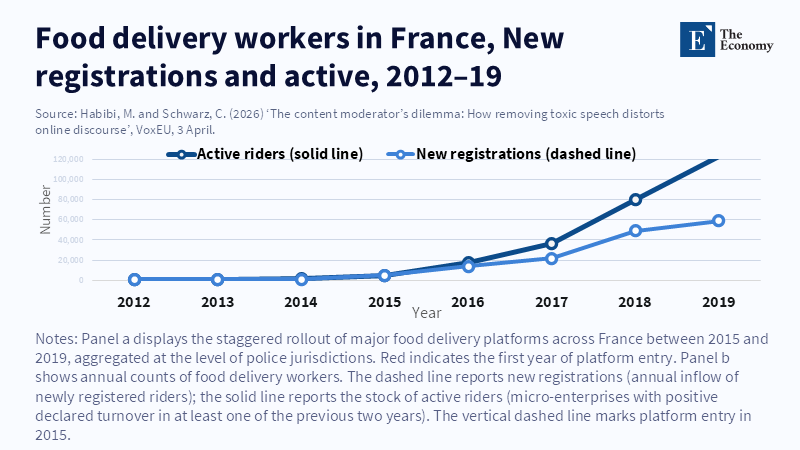
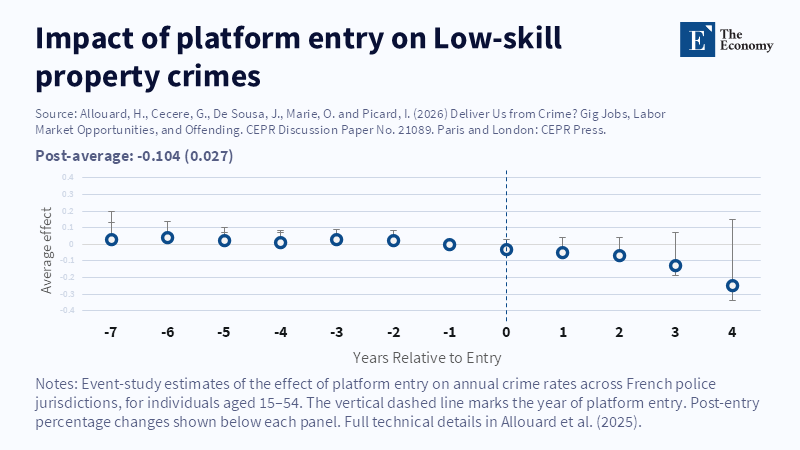
The most compelling recent evidence comes from France. By capitalizing on the phased rollout of food delivery platforms, a 2026 CEPR study found that their introduction increased rider registrations and employment among male immigrants. Furthermore, the study found significant reductions in offenses such as violent crime, petty theft, vandalism, and drug-related crimes, with the decrease primarily concentrated among individuals of legal working age. The policy implication is straightforward. For populations with limited access to conventional employment, even demanding and low-paying legal work can increase the cost of illegal activity, provide income and routine, and instill a sense of involvement. This does not make gig work an ideal solution, but it does indicate that early access to legal employment can reduce risks for groups disproportionately marginalized.
The migration and crime literature, however, is a complex and context-specific field. A 2024 German study found no crime-related effects immediately following refugee arrivals, but a slight lagged increase one year later. In contrast, a 2023 study on the Greek islands reported elevated crime levels, with a large influx of refugees straining local resources. These findings do not support generalizations about the entire immigrant population but rather highlight the importance of access to the labor market, speed of administrative processes, local infrastructure, and integration strategies. Therefore, gig jobs and immigrant integration should be viewed as a matter of risk management. By keeping newcomers out of both mainstream employment and swift access to legal work, the state effectively chooses to delay.
Labor-market evidence refutes two common myths. Firstly, that gig work is inconsequential as it is not a career path. A Swedish correspondence study found that, while it was less beneficial than standard work for most applicants, gig experience was more valuable than unemployment. Secondly, that gig work alone does not resolve marginalization. The same study demonstrated that no form of work experience improved callback rates for minority applicants. Collectively, these findings suggest that while gig jobs may serve as a more effective initial step than idleness, they do not eradicate discrimination. Thus, the task for policymakers is not to endorse the app, but to establish a pathway from the app to mainstream employment.
Education systems can transform gig jobs and immigrant integration into opportunities for mobility
From an educational perspective, this is a critical juncture. Schools, colleges, vocational institutes, and municipal training centers in Europe continue to treat many adult immigrants as if they will enter the labor market and learn subsequently. The perceived order is language acquisition, followed by credential acquisition, and then employment. In reality, however, the sequence is often reversed, as individuals work first to meet immediate financial obligations. Quebec's experience offers an illustrative example. A 2024 study of young immigrants found that delivery work was commonly used as a temporary solution due to its ease of entry, flexibility, and compatibility with family life. Yet, many remained trapped due to the non-recognition of foreign credentials, the underestimation of foreign work experience, and persistent language barriers. The lesson is clear: gig jobs and immigrant integration are most successful when educational systems address individuals where they currently are, not where policy documents suggest they should be.
This necessitates redesigning adult education programs to accommodate irregular work schedules. Language courses should be offered in the evenings, on weekends, and in short, modular formats. Recognition of prior learning must transition from a protracted, bureaucratic process to an expedited labor-market service. Colleges should introduce micro-credentials aligned with sectors experiencing labor shortages and where migrants are already concentrated, such as logistics, care, transport, food services, and basic digital services. Administrators should perceive platform workers as temporary learners rather than dropouts from the formal economy. If platform work represents the initial point of contact with the labor market, then educational programs should be designed to supplement it with transferable credentials, language instruction, and expedited pathways to more stable jobs. This is how gig jobs and immigrant integration shift from a period of stagnation to a trajectory of advancement.
Beyond the economic benefits, there is also a societal gain that schools and local institutions frequently overlook. Platform work inherently involves interactions with specific locations, navigation systems, payment methods, client expectations, tax regulations, rating systems, and time management. While none of these substitutes for social integration, they facilitate repeated exposure to the everyday systems of the host country. This is far more significant than abstract debates suggest, as integration encompasses not only values but also the routine use of daily systems. Individuals become recognizable to employers, municipalities, and service providers through their active participation in legal routines. The state should leverage this. Cities can coordinate licensing, onboarding procedures, language support, and employment services. Colleges can integrate short courses at local platform hubs. Employers can interpret consistent platform work experience as a sign of reliability rather than a mark of failure. This would make gig jobs and immigrant integration genuine pathways for public betterment rather than individual coping mechanisms.
Europe should view gig jobs and immigrant integration as a bridge, not a destination
The most common objection is undeniable. Gig jobs are inherently insecure, low-paid, and lack benefits. This criticism is valid and supported by evidence. Studies of immigrant gig workers in the United States have shown that they receive fewer fringe benefits and experience a dual disadvantage compared with non-gig immigrant workers and native-born gig workers. Europe should not base its integration strategy on perpetual precarity. However, this is not the only available choice. The real decision is whether to have a regulated initial step or a complete void. Many companies remain reluctant to hire migrants who lack local language skills, foreign qualifications, or clear work histories. If traditional employers restrict access, the state should at least facilitate side access, expand it, and connect it to upward mobility.
This requires three policy adjustments. First, rapid access to legal employment is crucial. Delays, work restrictions, and slow documentation processes increase the likelihood that marginalization will become permanent. Second, platform work must offer a basic level of protection, including accident coverage, transparent wages, fair dispute resolution, and legitimate tax status. Europe's platform work reforms are significant in their potential to reduce misclassification without eliminating access. Third, platform work should be linked to progression. Following a predetermined period of work (six to twelve months), migrants should be directed towards language support, skills assessments, job matching with employers, and accelerated vocational training. The objective is not to distinguish good immigrants from bad immigrants based on their willingness to cycle deliver regardless of the conditions, but rather to make legal work more attractive than dependency, informality, or illicit activities.
The economic case is just as strong as the civic one. According to OECD and EU data, labor migration is one of the primary solutions to widespread labor shortages and demographic decline in sectors such as transport, care, agriculture, and information technology. However, Europe is losing labor by forcing many newcomers to endure prolonged periods of waiting, downgrading, or informal work. This is detrimental to both the economy and the integration of immigrants. A strategy that focuses on providing an initial step would not resolve all social conflicts associated with migration, but would replace a passive approach with an active one. Instead of waiting until newcomers are fully integrated before they enter the workforce, governments should consider whether early legal employment can foster the habits, records, and local knowledge necessary for successful integration. In a continent that needs workers and desires stability, this represents a more realistic bargain.
Critics might argue that this policy would legitimize a secondary labor market. It would, if it were the sole endpoint. However, it need not, if it is combined with a clear next step. Europe already endorses transitional systems in other contexts. According to a report from the European Commission, internships are often considered stepping stones, apprenticeships serve as pathways, and temporary protection provides a short-term solution for entering the labor market. The report notes that gig work could potentially play a similar role for migrants and refugees, provided that access is straightforward, rules are clearly defined during employment, and there are guarantees of progression to more stable work. This is a more stable and transparent settlement model than the current approach, which theoretically condemns gig work while practically relying on it. To create safer streets, improve labor market efficiency, and enhance social cohesion, Europe must move beyond denying the significance of the first step. The coming decade of gig work and immigrant integration will be defined by either deliberate planning or chaotic drift; Europe should prioritize planning.
The views expressed in this article are those of the author(s) and do not necessarily reflect the official position of The Economy or its affiliates.
References
Adermon, A. and Hensvik, L. (2022) ‘Gig-jobs: Stepping stones or dead ends?’, Labour Economics, 76, 102171.
Allouard, H., Cecere, G., De Sousa, J., Marie, O. and Picard, I. (2026) Deliver Us from Crime? Gig Jobs, Labor Market Opportunities, and Offending. CEPR Discussion Paper No. DP21089. Paris and London: CEPR Press.
Allouard, H., Cecere, G., De Sousa, J., Marie, O. and Picard, I. (2026) ‘Gig jobs and crime: Evidence from food delivery platforms in France’, VoxEU, 8 April.
Brannon, I. and Wolf, S. (2021) ‘An empirical snapshot of the gig economy’, Regulation, Fall 2021.
Council of the European Union (2024) Spotlight on digital platform workers in the EU. Infographic. Brussels: Council of the European Union.
European Commission, Eurostat (2025a) Crime statistics. Statistics Explained. Luxembourg: Publications Office of the European Union.
European Commission, Eurostat (2025b) Migrant integration statistics – labour market indicators. Statistics Explained. Luxembourg: Publications Office of the European Union.
European Commission, Eurostat (2026a) EU population diversity by citizenship and country of birth. Statistics Explained. Luxembourg: Publications Office of the European Union.
European Commission, Eurostat (2026b) Migration to and from the EU. Statistics Explained. Luxembourg: Publications Office of the European Union.
European Migration Network (2025) ‘Meeting labour market needs through migration pathways’, in European Migration Network Asylum and Migration Overview 2024. Brussels: European Commission.
Fasani, F. (2024) New Approaches to Labour Market Integration of Migrants and Refugees. Study requested by the Committee on Employment and Social Affairs. Luxembourg: European Parliament, Policy Department for Economic, Scientific and Quality of Life Policies.
Kiss, Á., Maldonado, J.E., Turrini, A. and Van Herck, K. (2026) Migration, Mobility and the EU Labour Market: Recent Developments. European Economy Discussion Paper 241. Brussels: European Commission, Directorate-General for Economic and Financial Affairs.
Lange, M. and Sommerfeld, K. (2024) ‘Do refugees impact crime? Causal evidence from large-scale refugee immigration to Germany’, Labour Economics, 86, 102466.
Liu, C.Y. and Renzy, R. (2026) ‘Good Jobs or Bad Jobs? Immigrant Workers in the Gig Economy’, International Migration Review, 60(1).
Megalokonomou, R. and Vasilakis, C. (2023) ‘The effects of exposure to refugees on crime: Evidence from the Greek islands’, European Economic Review, 160, 104605.
OECD (2024) International Migration Outlook 2024. Paris: OECD Publishing.
Orav, A. (2022) Labour Market Integration of Asylum-Seekers and Refugees. European Parliamentary Research Service briefing. Brussels: European Parliament.
Pape, M. (2025) Improving the Working Conditions of Platform Workers. European Parliamentary Research Service briefing. Brussels: European Parliament.
Ryan, M. (2023) ‘Labour and skills shortages in the agro-food sector’, OECD Food, Agriculture and Fisheries Papers, No. 189. Paris: OECD Publishing.
Tremblay, D.-G. and Yao, M.-H. (2024) ‘On-Demand Work in the Gig Economy: The Experience of Young Immigrants in Quebec’, Open Journal of Social Sciences, 12, pp. 364–379.
Working across research, policy, and data-driven analysis, the Editorial Board ensures that published pieces reflect a consistent institutional perspective grounded in quantitative reasoning and long-term structural assessment.