[U.S.-China Summit] “Conciliation vs. Strategic Patience” Diverging U.S.-China Calculus Ahead of Leaders’ Meeting, With Strategic Rivalry Expanding Beyond Trade to the ‘North Korea Variable’

Matthew Reuter is a senior economic correspondent at The Economy, where he covers global financial markets, emerging technologies, and cross-border trade dynamics. With over a decade of experience reporting from major financial hubs—including London, New York, and Hong Kong—Matthew has developed a reputation for breaking complex economic stories into sharp, accessible narratives. Before joining The Economy, he worked at a leading European financial daily, where his investigative reporting on post-crisis banking reforms earned him recognition from the European Press Association. A graduate of the London School of Economics, Matthew holds dual degrees in economics and international relations. He is particularly interested in how data science and AI are reshaping market analysis and policymaking, often blending quantitative insights into his articles. Outside journalism, Matthew frequently moderates panels at global finance summits and guest lectures on financial journalism at top universities.
Authored On
Modified
Washington sends conciliatory signals to Beijing ahead of the May summit
Beijing stays in wait-and-see mode, focusing less on trade frictions than on Northeast Asian security centered on North Korea
North Korea emerges as a U.S. card for containing China under the banner of “expanded influence in Northeast Asia”
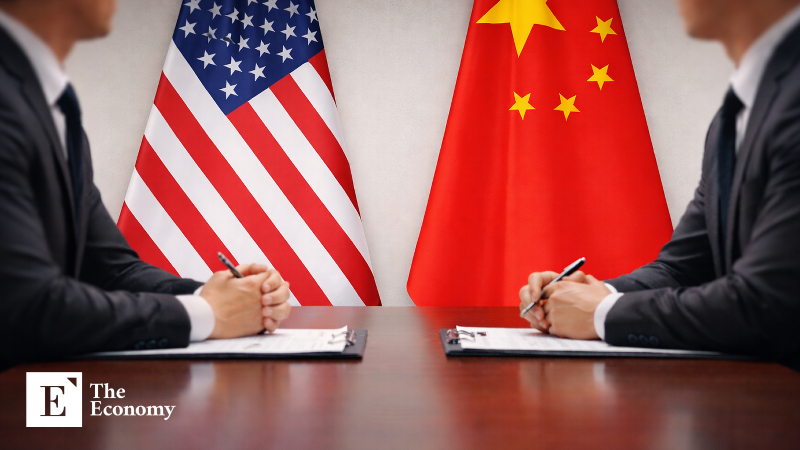
The United States has moved to manage risk ahead of the U.S.-China summit scheduled for May. By issuing conciliatory remarks, Washington has signaled its intention to minimize friction with Beijing. China, by contrast, having remained relatively insulated from the risks stemming from the Iran war and having also secured partial relief from tariff pressures, is maintaining a wait-and-see posture rather than reciprocating Washington’s overtures. As the two sides pursue divergent calculations, diplomatic circles are advancing the view that issues tied to the situation in Northeast Asia, including North Korea, will emerge as the central agenda at the upcoming summit, eclipsing trade, which had previously stood at the core of bilateral tensions.
A Turning Point in U.S.-China Relations
According to the Associated Press on April 8 local time, U.S. Trade Representative Jamieson Greer said at an event held the previous day at the Hudson Institute in Washington, D.C., “We want to maintain a stable relationship” with China and “do not seek a large-scale confrontation.” He added that “the United States established a stable relationship with China by imposing high tariffs on Chinese products, particularly advanced goods and manufactured products,” stressing that “this is not an attempt to fight China again.” The remarks are being read as a management-oriented message aimed at preventing the spread of economic and diplomatic instability amid an increasingly volatile international environment. If U.S.-China relations were to slip into deadlock while the Iran war drags on, the resulting disruption to the global economy could become unmanageable.
While the United States is accelerating efforts to secure strategic stability, China is maintaining a cautious stance. Experts assess that Chinese President Xi Jinping has gained a more favorable position in any talks with U.S. President Donald Trump since the outbreak of the Iran war. John Chin, a researcher at the Brookings Institution, also told ABC News that the Iran war had delivered an important long-term advantage to China. “What China truly wants is time and strategic space to focus on strengthening its national power,” Chin said. “The current situation, with the United States preoccupied in the Middle East, is giving China that opportunity.” In practice, since the outbreak of the war, U.S. military assets have been redeployed in large numbers from the Indo-Pacific to the Middle East.
Chin also interpreted Xi’s silence on the Iran war as reflecting the absence of any compelling reason for Beijing to comment on it. Earlier, after Iran effectively blockaded the Strait of Hormuz, Trump mentioned China and others, arguing that “countries affected by the closure of the strait should escort the ships passing through it.” China, however, sources most of the energy it consumes from domestic coal, while part of its energy imports arrive via Russian pipelines. That means even a closure of the Strait of Hormuz would inflict only limited real damage on China.
Chinese Foreign Minister to Visit North Korea This Month
Analysts are also projecting that the two sides will struggle to produce meaningful trade-related outcomes at the summit. Andrew Tilton, Goldman Sachs’ chief Asia-Pacific economist, said in an interview with the South China Morning Post in Hong Kong on April 6 that “now that many U.S. tariffs have been invalidated, it is not clear what the United States can offer China on the tariff issue,” adding that “perhaps it can do little more than promise not to raise tariffs again.” In fact, after the recent U.S. Supreme Court ruling invalidating tariffs imposed under the International Emergency Economic Powers Act, the Trump administration introduced new temporary tariffs, sharply lowering the effective tariff rate applied to China. The tariff dispute, which stood at the center of U.S.-China tensions last year, has thus lost much of its force.
Instead of trade, security issues in Northeast Asia are increasingly expected to emerge as the principal topic. That expectation has been reinforced by the disclosure of Chinese Foreign Minister Wang Yi’s visit to North Korea. On April 8, North Korea’s state-run Korean Central News Agency reported that Wang would visit the country on April 9-10 at the invitation of the Foreign Ministry. Wang had originally sought to travel to Pyongyang in early March, shortly after North Korea’s 9th Party Congress and before China’s annual “Two Sessions,” the country’s biggest yearly political event, but those plans collapsed in the immediate aftermath of the outbreak of the Iran war. Following the visit, Wang is expected to hold talks in Pyongyang with Foreign Minister Choe Son Hui.
Some observers argue that the visit is unlikely to be merely a gesture of goodwill. One diplomatic specialist said, “If North Korea maintains close ties with Russia and Iran, it strengthens the rationale for U.S. military involvement on the Korean Peninsula, and that burden ultimately returns to China.” The specialist added, “China may have concluded that rather than shielding North Korea unconditionally, it needs to place limits on actions that damage its own strategic environment.” The contact, in that reading, may represent a management-level move aimed at urging restraint and a calibrated pace from Pyongyang.
Washington’s Shift in Its North Korea Response
Diplomatic circles are also paying close attention to the timing of Wang’s visit, given that it is taking place with little time remaining before the U.S.-China summit. The view is that North Korea and China could engage in preliminary coordination on Korean Peninsula issues ahead of the summit. There is also speculation that during Trump’s trip to China in May, Beijing could arrange a meeting with North Korean leader Kim Jong Un. Previously, during Trump’s visit to South Korea in late October last year, he repeatedly sent signals of dialogue to Kim, but Kim remained consistently unresponsive.
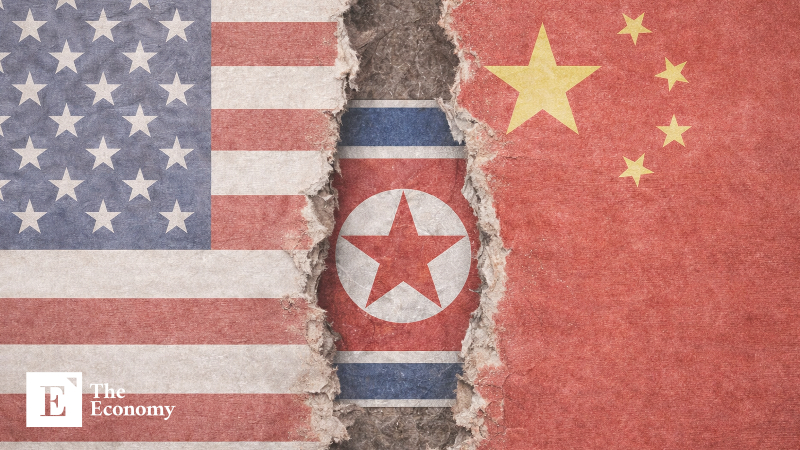
North Korea’s emergence as one axis of U.S.-China relations is rooted in a shift in Washington’s strategy toward Pyongyang. In the past, the United States regarded North Korea primarily as a target for resolving the nuclear issue. The 1994 Geneva Agreed Framework was a negotiation that promised support for light-water reactors and normalization of relations in exchange for a freeze on North Korea’s nuclear development, while the six-party talks in the 2000s were also conducted with the dismantlement of North Korea’s nuclear program as the central agenda. The Barack Obama administration’s policy of “strategic patience” and the U.S.-North Korea summits during Trump’s first term likewise placed denuclearization at the top of the agenda.
More recently, however, the U.S. approach has begun to change. References to denuclearization and North Korea have declined in strategic documents and other policy materials, while the framework of U.S.-China competition has become more prominent. That shift suggests Washington is beginning to regard North Korea not simply as a denuclearization target, but as a strategic variable in containing China. Going forward, the United States may seek to use the North Korea variable to reinforce its own military posture and alliance coordination on the Korean Peninsula and across Northeast Asia. In effect, that would give Washington both the rationale and the means to intensify pressure on China.
Matthew Reuter is a senior economic correspondent at The Economy, where he covers global financial markets, emerging technologies, and cross-border trade dynamics. With over a decade of experience reporting from major financial hubs—including London, New York, and Hong Kong—Matthew has developed a reputation for breaking complex economic stories into sharp, accessible narratives. Before joining The Economy, he worked at a leading European financial daily, where his investigative reporting on post-crisis banking reforms earned him recognition from the European Press Association. A graduate of the London School of Economics, Matthew holds dual degrees in economics and international relations. He is particularly interested in how data science and AI are reshaping market analysis and policymaking, often blending quantitative insights into his articles. Outside journalism, Matthew frequently moderates panels at global finance summits and guest lectures on financial journalism at top universities.
- Previous "From the 2-Nanometer Process to SSDs and GPUs," Samsung Electronics Bets on Semiconductor Competitiveness, With the Core Imperative Being "Organic Growth"
- Next "From Energy to Food" Iran War Fuels Global Inflationary Pressures, Leaving Major Economies in Turmoil While China Alone Finds Room to Breathe
Similar Post