Teaching Renewable Energy Security

Working across research, policy, and data-driven analysis, the Editorial Board ensures that published pieces reflect a consistent institutional perspective grounded in quantitative reasoning and long-term structural assessment.
Authored On
Modified
China’s energy rise is now a story of renewable energy security, not only emissions
Its real advantage is not just hardware, but the education and training system behind it
Countries that teach energy skills well will be less exposed to future oil and power shocks
At 86 percent in 2024, the fraction of new power capacity installed in China that is renewable demands a shift in focus. The world spent years looking at China primarily as a story of dirty growth. Coal powerhouse, a global emissions factory, and a harbinger of doom, China’s history is both real and significant. Even as it still faces massive emissions and coal consumption, a forward-looking analysis requires a different perspective. Rather than focusing on past pollution during industrial catch-up, we need to analyze which countries are currently building the infrastructure of future energy security when oil shocks are a reality, electrification of grids continues, and low-cost power becomes essential for industrial prosperity. From this perspective, China's image shifts. It's not just a builder of renewable energy, but also of renewable energy security, which is increasingly becoming an educational endeavor.
Renewable Energy Security: A Matter of Education
The conventional narrative on China's energy growth oversimplifies the reality by focusing on hardware like solar panels, batteries, wind turbines, and nuclear reactors. Renewable energy security is far more complex, encompassing the ability to design, finance, install, maintain, regulate, and improve a new power system at a significant scale. China's 2024 figures illustrate this point: the renewable sector added 373 GW of new capacity that year, with 278 GW of solar and nearly 80 GW of wind. By year-end, renewables represented 56 percent of the country's installed power capacity, generating roughly 35 percent of its electricity. It is important to note the distinction between installed capacity and total generation or energy consumption; nevertheless, the trend is clear: China is shifting towards an electricity system powered by domestically sourced renewables. In contrast, the United States generated approximately 64 percent of its utility-scale electricity from fossil fuels in 2024, with only 23 percent coming from renewables.
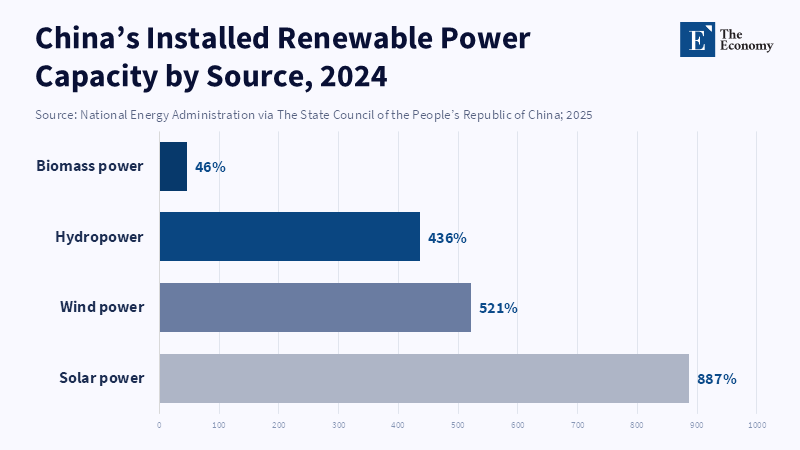
This discrepancy is significant for education journals, as energy transformations are intrinsically linked to education. China's advantage lies in its integrated, system-wide approach to learning about renewable energy security. With an estimated addition of over 3,200 GW of new renewable electricity capacity between 2024 and 2030, China is projected to account for nearly 60 percent of global annual additions by the end of the decade. This transformation extends to China's transportation sector, where electric vehicles made up an estimated 48 percent of new car sales in 2024, with over 11 million units sold. This is crucial because dependence on oil is not limited to the power sector; it also affects cars, trucks, and freight systems. Electrifying both power and transportation is not just an environmental measure, but also a way to reduce vulnerability to future oil shocks. Consequently, renewable energy security is as much about a resilient demand system as it is about a clean supply.
China's Renewable Energy Security is Rooted in a Learning System
The deeper insight is that China's energy leadership is not solely based on equipment production, but also on institutions that foster skills at the same pace as they develop technology. In 2023, China was responsible for 58 percent of clean energy investment in emerging and developing economies. According to the International Renewable Energy Agency, in 2023 China was home to 41 percent of the global renewable energy workforce, employing 7.4 million people, and it led the world in solar PV installations by adding 86 gigawatts, which made up 45 percent of the global total. These figures reflect the interconnectedness of industry, workforce training, engineering education, and deployment. Durable renewable energy security is achieved when each new project contributes to a growing pool of skilled workers capable of executing future projects. This aspect is often overlooked in Western discussions, which tend to focus on dependence on Chinese technology rather than on China's expertise, process discipline, and training depth. The critical asset is not merely the physical panel or battery, but the underlying learning curve.
This is a critical area for educators and administrators. OECD research on the green transition emphasizes the importance of vocational education due to its direct relevance to construction, transport, energy, and manufacturing sectors. According to the OECD, nearly one-quarter of young vocational education and training (VET) graduates are employed in green-driven jobs, a higher proportion than among graduates with tertiary education. In essence, teaching capacity is already a constraint on the green transition. Without the rapid production of skilled electricians, welders, controls technicians, power-electronics specialists, battery engineers, and grid planners, financial investments alone cannot guarantee renewable energy security. China's advantage is not simply its production capacity, but its ability to train sufficient personnel to translate those products into functioning systems, a less visible yet more enduring asset.
Why the United States Lags in Renewable Energy Security
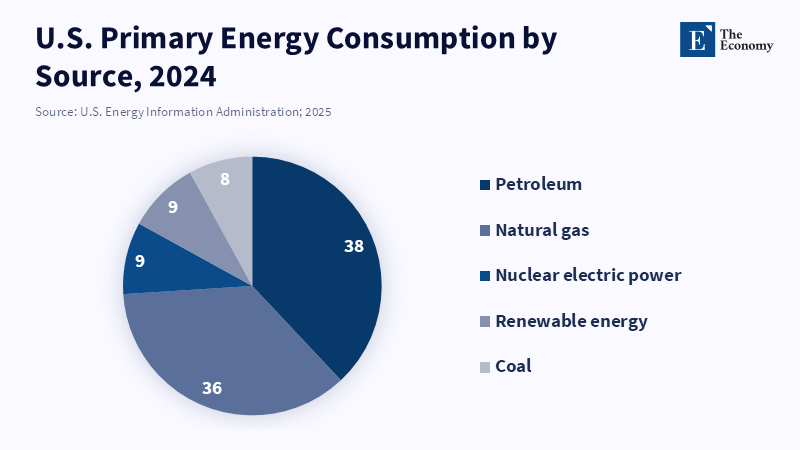
The United States is not lacking in research universities, private capital, or technical expertise; however, these strengths remain within a fossil fuel-dependent system and an outdated training model. In 2024, fossil fuels still accounted for 82 percent of the total U.S. Primary energy consumption, with petroleum making up 38 percent, natural gas 36 percent, and coal 8 percent. According to Statista, in 2023, fossil fuels still accounted for a significant share of China's total electricity generation, highlighting that despite visible progress and innovation headlines, the country remains largely dependent on traditional energy sources. A country can lead in venture capital, artificial intelligence, and frontier science while still relying heavily on fossil fuels. Sustainable renewable energy security requires coordination between community colleges, technical institutes, utilities, universities, and local businesses to align efforts with a shared vision for future labor demand. While the United States has many areas of excellence, it has not yet developed this comprehensive vision at the necessary pace, often continuing to train for the previous energy economy.
An immediate objection is that China's deep reliance on coal makes triumphant claims about its transition inappropriate. This critique has some validity. EIA data indicates that coal still constituted 62 percent of China's energy consumption, and fossil fuels were the source of 63 percent of its electricity in 2024. New coal plant construction also remains high. Similarly, the discussion of thorium should be approached with caution. While China's molten salt reactor program achieved first criticality in October 2023 and its first thorium loading into an operating molten salt reactor in October 2024, followed by the first thorium-uranium fuel conversion in November 2025, experts remain skeptical of near-term commercial viability. Nevertheless, caution should not lead to inaction. The POWER report in 2026 highlights China's increased investment in a range of advanced nuclear platforms. While thorium is not expected to be commercially available next year, China is investing in future options while others debate its viability. The critical point is that China is not necessarily completing its transition, but expanding its future options, which are fundamentally shaped by its education and training infrastructure.
Building Renewable Energy Security Ahead of the Next Oil Shock
For lower- and middle-income countries unable to replicate the entire Chinese model, the key takeaway is that they should prioritize human capital over prestige hardware. With 81 percent of new global renewable capacity producing electricity cheaper than fossil-fuel alternatives in 2023, and over 90 percent of global power-capacity expansion coming from renewables in 2024, the primary obstacles for countries with abundant solar, wind, or hydro resources are not scientific, but financial and educational. The IEA projects that clean energy investment in emerging and developing economies, excluding China, must rise from approximately $270 billion to $870 billion by the early 2030s to meet national commitments. Research indicates that reduced financing costs in developing countries would lead to increased renewable generation, lower power prices, and greater equity; however, these benefits cannot be realized without a workforce ready to implement projects. Renewable energy security is cultivated in classrooms long before it is realized on the grid and should be viewed as a core economic necessity, not merely an aspect of climate policy.
Education policy needs to be reframed to see energy as a fundamental economic infrastructure, rather than a niche environmental issue. Secondary schools require enhanced technical education programs in applied mathematics, electronics, and energy systems. Vocational institutions need to adopt more flexible curricula and modular credentials to foster closer ties with employers. Universities should increase capacity and offer more applied programs in power engineering, materials science, grid software, storage technology, and thermal systems. Administrators require granular local data on labor demand rather than generalized calls for more STEM education. Policymakers must invest in teacher training, laboratory equipment, apprenticeships, and grid-connected demonstration projects. This often unglamorous work is crucial, as countries that emerge as leaders in the next energy era will be those capable of training solar installers, substation technicians, inverter engineers, and battery chemists at scale and at decreasing costs, transforming renewable energy security from a concept into a functioning reality.
The initial statistic-86 percent-serves as more than just a measure of build-out; it signifies a fundamental redefinition of national strength. For China, the shift to renewables for the majority of new power capacity is not about a moral awakening, but a strategic reorganization of its industry, transportation sector, research institutions, and educational system around a future centered on renewable energy security as a tangible asset. This reality necessitates dismantling artificial barriers among energy, industrial, and education policy. Educational institutions are not passive bystanders in this transition but an integral component of the emerging grid. Delaying curriculum reform until the next oil shock will render it too late. The urgent task is to educate for renewable energy security before market realities impose this lesson under more challenging circumstances. The coming decade will favor nations that can educate, train, test, and deploy at speed, not those that merely espouse strategic autonomy.
The views expressed in this article are those of the author(s) and do not necessarily reflect the official position of The Economy or its affiliates.
References
Calcaterra, M., Aleluia Reis, L., Fragkos, P., Briera, T., de Boer, H.S., Egli, F., Emmerling, J., Iyer, G., Mittal, S., Polzin, F.H.J., Sanders, M.W.J.L., Schmidt, T.S., Serebriakova, A., Steffen, B., van de Ven, D.J., van Vuuren, D.P., Waidelich, P. and Tavoni, M. (2024) ‘Reducing the cost of capital to finance the energy transition in developing countries’, Nature Energy, 9(10), pp. 1241–1251. doi:10.1038/s41560-024-01606-7.
International Energy Agency (2023) Scaling Up Private Finance for Clean Energy in Emerging and Developing Economies. Paris: International Energy Agency.
International Energy Agency (2024a) Renewables 2024. Paris: International Energy Agency.
International Energy Agency (2024b) World Energy Employment 2024. Paris: International Energy Agency.
International Energy Agency (2025a) China’s Official Energy Finance in Emerging and Developing Economies: Evolving Institutions, Instruments and Implications for Clean Energy Transitions. Paris: International Energy Agency.
International Energy Agency (2025b) Global Energy Review 2025. Paris: International Energy Agency.
International Energy Agency (2025c) Global EV Outlook 2025: Expanding Sales in Diverse Markets. Paris: International Energy Agency.
International Renewable Energy Agency (2024a) Renewable Capacity Statistics 2024. Abu Dhabi: International Renewable Energy Agency.
International Renewable Energy Agency (2024b) Renewable Energy and Jobs: Annual Review 2024. Abu Dhabi: International Renewable Energy Agency.
International Renewable Energy Agency (2024c) Renewable Power Generation Costs in 2023. Abu Dhabi: International Renewable Energy Agency.
International Renewable Energy Agency (2025) Renewable Capacity Statistics 2025. Abu Dhabi: International Renewable Energy Agency.
Kuczera, M. (2025) ‘Vocational education and training (VET) and the green transition: Insights from labour market data’, OECD Social, Employment and Migration Working Papers, No. 327. Paris: OECD Publishing. doi:10.1787/02b7fcb1-en.
Moritsugu, K. and Soo, Z. (2025) ‘China’s electric car sales grew in 2024 as sales of gasoline cars plunged’, Associated Press, 13 January.
OECD (2025) How the Green Transition Reshapes Vocational Education and Training: Understanding the Impact. OECD Policy Briefs, No. 33. Paris: OECD Publishing. doi:10.1787/4819bf34-en.
Patel, S.C. (2026) ‘China’s advanced nuclear efforts are pushing frontiers’, POWER, 2 March.
Shaw, V. (2023) ‘China’s renewable energy capacity tops 1.4 TW’, pv magazine International, 4 December.
U.S. Energy Information Administration (2025a) China Country Analysis Brief. Washington, DC: U.S. Energy Information Administration.
U.S. Energy Information Administration (2025b) ‘Electricity in the United States’, Energy Explained, 2 April. Washington, DC: U.S. Energy Information Administration.
U.S. Energy Information Administration (2025c) ‘U.S. primary energy production, consumption, and exports increased in 2024’, Today in Energy, 20 June. Washington, DC: U.S. Energy Information Administration.
Waltz, E. and Chiu, Y.-T. (2024) ‘Why China is building a thorium molten-salt reactor’, IEEE Spectrum, 30 December.
World Nuclear News (2025) ‘Chinese molten salt reactor achieves conversion of thorium-uranium fuel’, World Nuclear News, 4 November.
Xinhua (2025) ‘Renewable energy accounts for 56 pct of China’s total installed capacity’, The State Council of the People’s Republic of China, 28 January.
Xue, P. (2026) ‘China’s renewable capacity is a security asset, not a liability’, East Asia Forum, 6 April.
Working across research, policy, and data-driven analysis, the Editorial Board ensures that published pieces reflect a consistent institutional perspective grounded in quantitative reasoning and long-term structural assessment.