“The Iran War Is Erasing 1 Percentage Point of Global Growth” The War-Redrawn Economic Map and the Encroaching Fear of Stagflation

Anne-Marie Nicholson is a fearless reporter covering international markets and global economic shifts. With a background in international relations, she provides a nuanced perspective on trade policies, foreign investments, and macroeconomic developments. Quick-witted and always on the move, she delivers hard-hitting stories that connect the dots in an ever-changing global economy.
Authored On
Modified
IMF and WB Signal Downgrades to This Year’s Growth Outlook
Surging Oil Prices and Fading Growth Momentum
War-Driven Global Economic Uncertainty Deepens
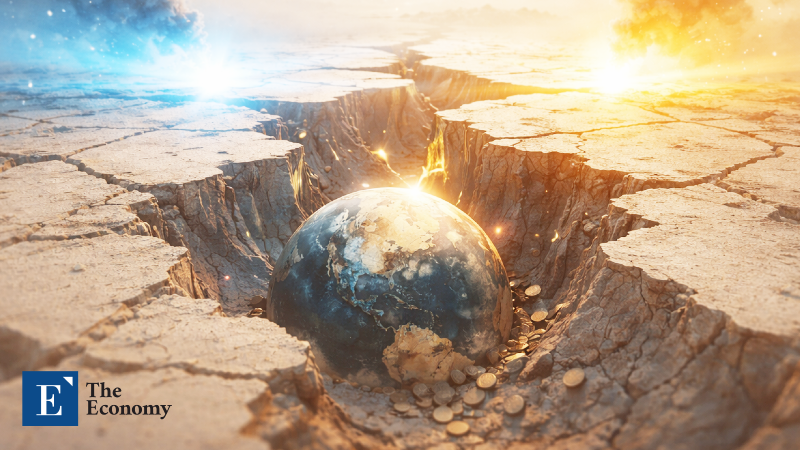
The Iran war is sending significant shock waves through the global economy. The U.S.-Israel-Iran war, which entered a two-week ceasefire after 39 days of fighting, has delivered an economic and political shock comparable to that of the 1973 Fourth Middle East War, or Yom Kippur War, which triggered an oil shock. As the surge in international oil prices combines with the resulting rise in inflation, economic pressure is intensifying, while fears of stagflation — a combination of economic stagnation and inflation — are also beginning to mount.
Iran War and Hormuz Risk Cast a Shadow Over Global Growth
According to Bloomberg on April 12 local time, International Monetary Fund Managing Director Kristalina Georgieva said ahead of the IMF-World Bank Spring Meetings, set to open on April 13, that “we will revise down the global economic outlook, taking into account the impact of the war.” The IMF is scheduled to release its revised World Economic Outlook and Global Financial Stability Report on April 14, the second day of the meetings.
The IMF is understood to believe that elevated inflation and slower growth stemming from the war’s fallout are unavoidable, and is therefore preparing to lower its growth forecast. Georgieva said, “All roads now lead to higher prices and slower growth,” adding, “That means that after recovering from this shock, we must prepare for the next one as well.”
World Bank President Ajay Banga also projected that the war would have a cascading impact on the global economy. In an interview with Reuters on April 10, he said that “even if the ceasefire holds, the damage will continue to deepen,” diagnosing that under a baseline scenario of an early end to the war, global growth could decline by 0.3 to 0.4 percentage point, while in the event of a prolonged conflict, the drop could reach as much as 1 percentage point. He added that if the war persists, the inflationary impact would be far greater, with inflation potentially rising by as much as 0.9 percentage point.
Red Sea Route Reopens, but Higher Energy Costs Remain Inevitable
As recently as January, the IMF had projected global economic growth of 3.3% for this year. Its forecasts stood at 2.1% for the United States, 1.4% for the euro area, and 5.4% for emerging Asia. But the situation changed after U.S. and Israeli strikes on Iran began on February 28. The attacks disrupted energy supply, while the effective closure of the Strait of Hormuz, a critical maritime shipping route, amplified the global shock.
The consequences were immediate. Dubai crude, the benchmark for Middle Eastern oil, climbed above $100 a barrel, while natural gas prices nearly doubled. Bloomberg Economics estimates that, in a worst-case scenario, average Dubai crude prices in the second quarter could surge as high as $170 a barrel. The IMF estimates that global oil supply has fallen by 13% since the outbreak of the war, and this supply crunch is not expected to ease quickly even if the conflict ends in the near term.
Saudi Arabia did in fact carry out emergency repairs to pipelines bypassing the Red Sea route and restored crude shipments through Yanbu Port to 7 million barrels per day, but this amounts to little more than a temporary stopgap. The geopolitical risk surrounding the Strait of Hormuz and the Red Sea is fundamentally undermining navigational security, directly driving an immediate spike in maritime freight rates and insurance premiums and entrenching a high-cost structure for crude supply. In addition, wartime damage to energy infrastructure, including the strike on Ras Laffan LNG facilities in northern Qatar, will not be easily reversed. In other words, even if the Hormuz blockade is lifted, energy supply disruptions are likely to persist for some time.

Worst-Ever Energy Supply Disruption Puts the Global Economy on Full Alert
As a result, countries around the world are reeling as they scramble to cope with the real-economy fallout of higher oil prices — including fuel shortages, food insecurity and protests — as well as financial stress involving consumer prices and interest rates. On April 10, ACI Europe warned of a worst-case scenario in which aviation fuel inventories across Europe could be depleted within the next three weeks due to the impact of the Strait of Hormuz closure. Thousands of flights now face the risk of cancellation, a development that is sharply driving up global logistics costs.
Social unrest triggered by soaring energy prices has also reached an extreme level. Protests that began in Ireland last month over the spike in fuel prices have rapidly spread across Northern Europe, including Norway. Demonstrators are occupying key terminals and highways while forcefully demanding immediate fuel tax cuts and the introduction of caps on fuel prices.
As energy security began to threaten national survival itself, the European Union recently went so far as to define its earlier anti-nuclear stance as a strategic mistake and officially formalized a policy reversal aimed at expanding the share of nuclear power once again. In Indonesia, the government adopted the painful expedient of freezing fuel subsidies despite the immense fiscal burden in an effort to stabilize prices, while Vietnam, facing a more than 14% year-on-year surge in power demand and difficulties securing fuel for generation, has entered emergency mode to prevent power shortages, including shutdowns at manufacturing facilities.
Globally, an emerging humanitarian crisis is also becoming visible as disruptions in natural gas supply cut off the feedstocks essential for fertilizer production, sending grain prices soaring and sharply increasing the number of people facing hunger. The global auto industry has also taken a direct hit from the logistics disruption. A pessimistic outlook suggests that worldwide automobile production could decline by roughly 800,000 units over the course of 2026. In emerging economies, inflation and slower growth are appearing simultaneously. Argentina continues to suffer from annual inflation exceeding 30%, while Brazil is seeing economic activity lose momentum under the burden of high interest rates.
South Korea Faces the Biggest Loss Among Non-Belligerents, Confronting Upward Pressure on Prices and Downward Pressure on Growth
Warning lights are also flashing for the South Korean economy, which remains heavily dependent on energy imports. In a recent report, the Center for Strategic and International Studies said that “no non-belligerent country has been hit harder than South Korea since the Iran conflict began.” South Korea depends on the Middle East for roughly 70% of its crude oil imports, while around 35% of its naphtha — a key feedstock for plastics, synthetic fibers and petrochemical products — also arrives via the Strait of Hormuz.
In addition, 64.7% of the helium essential to semiconductor manufacturing processes is imported from Qatar. With production at Qatar’s Ras Laffan industrial complex now halted, helium prices are reported to have surged by more than 40%. That, in turn, is producing a chain reaction that is raising production costs across industry. Even as recently as February, before the conflict, 33 South Korean-flagged vessels passed through the Strait of Hormuz, but 26 are now stranded in the Persian Gulf. Of those, 17 are carriers transporting crude oil and petroleum products.
Against that backdrop, the Organisation for Economic Co-operation and Development cut its 2026 growth forecast for South Korea from 2.1% to 1.7%, a downgrade of 0.4 percentage point. That marks the steepest downward revision among major economies. CSIS projected that “South Korea’s dependence on Hormuz for crude oil and other critical resources remains high,” and that over the next two to six months the fallout could spread across all industries, including transportation, logistics, petrochemicals, agriculture, and food and beverage.
The problem is that this crisis does not end with geopolitical instability. What the market fears is not simply an increase in oil prices. It is the fear of stagflation, in which growth momentum weakens even as inflation comes under upward pressure. Whenever the word stagflation surfaces, the 1970s oil shocks are inevitably invoked. The two oil shocks triggered by the Arab oil embargo of 1973 and the Iranian Revolution of 1979 left the global economy battered for nearly a decade. In the United States alone, inflation approached 14% at the time, while unemployment also hovered in double digits.
The central lesson from the 1970s is that once inflation expectations breach a certain threshold, the behavior of economic actors begins to shift in a chain reaction. Labor groups intensify wage demands, while companies accelerate price revisions and entrench the pass-through of higher costs. Once this vicious cycle begins, inflation acquires self-sustaining momentum. Stagflation is regarded as such a dangerous variable not because no remedy exists, but because an unavoidable policy trade-off takes hold: measures to suppress inflation trigger economic contraction, while stimulus measures, in turn, reignite price pressures.
Anne-Marie Nicholson is a fearless reporter covering international markets and global economic shifts. With a background in international relations, she provides a nuanced perspective on trade policies, foreign investments, and macroeconomic developments. Quick-witted and always on the move, she delivers hard-hitting stories that connect the dots in an ever-changing global economy.
Similar Post