“Amazon Joins the Fray in Earnest” The Intensifying Low-Earth-Orbit Satellite Race, With Advantages Coming Into Sharper Relief and Cost Burdens Receding

As one of the youngest members of the team, Tyler Hansbrough is a rising star in financial journalism. His fresh perspective and analytical approach bring a modern edge to business reporting. Whether he’s covering stock market trends or dissecting corporate earnings, his sharp insights resonate with the new generation of investors.
Authored On
Modified
Amazon to acquire U.S. satellite communications company Globalstar
Low-earth-orbit satellite communications show clear growth potential by overcoming the limits of legacy networks
Launch costs also falling through reusable rocket technology and economies of scale

Amazon, the world’s largest e-commerce company, is set to acquire Globalstar. The move is widely seen as an effort to absorb Globalstar’s competitiveness in low-Earth-orbit (LEO) satellites and reinforce Kuiper, Amazon’s in-house satellite internet project. As the strategic value of LEO satellite communications comes into clearer focus and launch-cost efficiency continues to improve, the market is expanding at a rapid clip, with the industry watching closely to see whether Amazon can upend the competitive landscape and unseat Elon Musk’s SpaceX.
Amazon’s Low-Earth-Orbit Satellite Business
According to Reuters on April 14, Amazon recently agreed to acquire U.S. satellite communications company Globalstar for $11.57 billion. Globalstar currently operates more than 20 satellites in low Earth orbit and is regarded highly for reliability and security, given its possession of core technologies underpinning Apple iPhone features such as Emergency SOS and Find My.
Under the agreement, Amazon will acquire Globalstar’s satellite business, infrastructure, assets and part of its global spectrum licenses. Globalstar’s new and existing satellites are to be integrated into Amazon’s network. For Amazon, which needs to bolster Project Kuiper, the deal effectively secures a powerful reinforcement. Through the project, Amazon plans to place 3,200 satellites into orbit by 2029 and has already launched more than 240 satellites. It is also seeking an extension from the Federal Communications Commission (FCC) on its deployment deadline. The FCC had previously ordered Amazon to place half of its planned launches into orbit by July this year.
The market is focusing on the fact that Amazon has now begun competing in earnest with services such as Starlink, led by SpaceX Chief Executive Officer Elon Musk. Starlink, backed by an overwhelming satellite count, remains the leading force in the global satellite internet market, with more than 9 million paid users worldwide. Going forward, Amazon is expected to combine Globalstar’s spectrum assets with Apple’s ecosystem and challenge Starlink’s dominance through direct-to-smartphone satellite connectivity. Starlink currently uses a structure in which signals are transmitted from satellites to dedicated antennas, or terminals, and then relayed to devices such as smartphones.
Clear Demand Emerging in Underserved Regions
The fierce rivalry between the two companies reflects the latent potential embedded in LEO satellites. Such satellites are increasingly seen as capable of transcending the limitations of legacy satellite networks and fiber-optic communications. Conventional satellite networks generally rely on satellites in geostationary orbit (GEO) at an altitude of roughly 36,000 kilometers. Because of that distance, signal transmission takes longer, making communication delays inevitable. Fiber-optic communications are extremely fast, yet their physical constraints are severe. In remote areas, war zones and other places lacking robust infrastructure, they are effectively unusable.
By contrast, LEO satellites orbit the Earth at altitudes of 300 to 1,500 kilometers, far closer to the surface than geostationary satellites, which sharply reduces latency. Starlink’s latency, for instance, stands at 20 to 40 m/s, a level comparable to terrestrial fiber networks. To make that network usable across the globe, Starlink has built megaconstellations in space, vast satellite groupings composed of hundreds to tens of thousands of low-Earth-orbit satellites with global coverage. By launching thousands of small satellites, it has enabled internet connectivity from virtually anywhere. Demand for such services may be limited in countries such as South Korea, where mobile telecommunications networks are dense and highly developed, yet they are likely to emerge as highly versatile alternatives in underserved regions around the world. According to the World Economic Forum (WEF), roughly 30% of the global population still lacks internet access.
Industrial applications are also expected to be extensive. LEO satellites can provide uninterrupted internet service to aircraft and ships. In the United States, there have already been cases in which airline passengers used free in-flight internet through Starlink antennas without logging in or making additional payments. Beyond that, next-generation Urban Air Mobility (UAM) is also viewed as a field in which LEO satellites could play a prominent role. UAM is a futuristic transportation system designed to move people and cargo rapidly within cities and nearby areas using drones, electric vertical takeoff and landing aircraft (eVTOLs), and small aircraft. To ensure smooth traffic flows in UAM, real-time control systems are essential, and those systems must be supported by ultra-fast, ultra-low-latency 6G communications. In that market, LEO satellite communications are likely to enjoy a stronger strategic position than geostationary communications or fiber-optic networks.
Successful Cost Rationalization in Launches
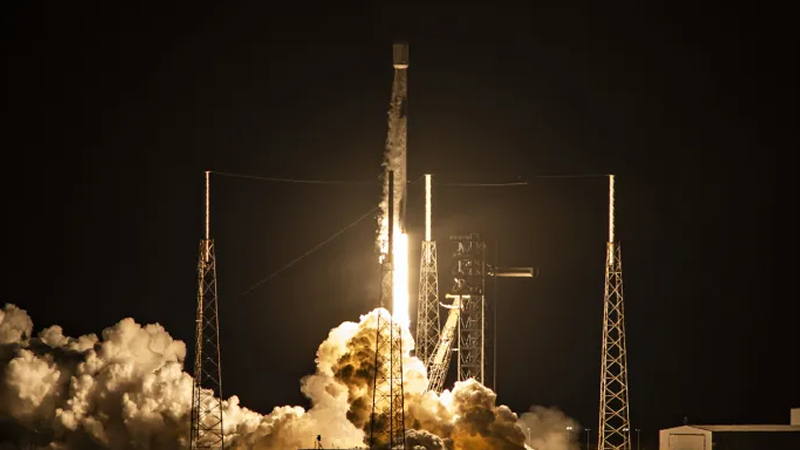
The launch-cost problem, long cited as an inherent limitation of LEO satellites, is also being addressed gradually. The emergence of reusable rocket technology has accelerated cost rationalization. A representative example is SpaceX’s Falcon 9. SpaceX has applied technology to its Falcon 9 launch vehicle that enables recovery and reuse of the first-stage booster after launch. The booster lands through retro-propulsion and attitude control, then undergoes inspection and maintenance before being deployed again. One Falcon 9 booster, B1067, set a record for its 33rd reuse when it was launched from Cape Canaveral Space Force Station in Florida in February. SpaceX is now pursuing its Starship project with the goal of fully reusing both first- and second-stage launch vehicles. Should that plan materialize, it would theoretically all but eliminate manufacturing costs, which account for the bulk of rocket-launch expenses.
The shift in launch infrastructure and satellite manufacturing toward mass production is also cited as a major factor driving costs lower. As launch frequency has increased sharply, economies of scale have begun to materialize in satellite manufacturing and operations, while the procedures for producing, assembling and launching rockets and satellites have started to become standardized. At the same time, the share of lower-cost small-satellite launches has risen, and the advent of heavy-lift launch vehicles capable of carrying more satellites at once has delivered further efficiency gains. Goldman Sachs estimates that the cost of launching LEO satellites, currently around $12,000 per kilogram, could eventually fall to $100 to $200.
Against that backdrop, market competition has intensified. Nvidia has unveiled a new platform aimed at extending artificial intelligence computing into orbit, while Blue Origin, the U.S. private space company founded by Jeff Bezos, is also reviewing a plan to launch more than 5,000 satellites by 2027. In Europe, France’s Eutelsat OneWeb LEO network already operates more than 600 satellites. The French government is also stepping up support for the sector, including the provision of $1.59 billion to Eutelsat. China, meanwhile, has put forward a plan to place more than 200,000 satellites into orbit through 14 satellite constellations.
As one of the youngest members of the team, Tyler Hansbrough is a rising star in financial journalism. His fresh perspective and analytical approach bring a modern edge to business reporting. Whether he’s covering stock market trends or dissecting corporate earnings, his sharp insights resonate with the new generation of investors.
Similar Post