China Moves to Rebuild Entire Education Ecosystem as an ‘AI System,’ Reducing Teachers to ‘Execution Roles’

Anne-Marie Nicholson is a fearless reporter covering international markets and global economic shifts. With a background in international relations, she provides a nuanced perspective on trade policies, foreign investments, and macroeconomic developments. Quick-witted and always on the move, she delivers hard-hitting stories that connect the dots in an ever-changing global economy.
Authored On
Modified
AI integration expands into classroom instruction, teacher certification now requires AI literacy
Comprehensive integration from personalized tutoring to population forecasting
Automation accelerates power shift, intensifying pressure to reduce teachers’ roles

The Chinese government has unveiled a national strategy to embed artificial intelligence (AI) deeply across the entire public education system by 2030, positioning AI as a core pillar of national competitiveness. The plan aims to transform the entire education ecosystem into an intelligent system, spanning teacher certification, resource allocation, and demographic forecasting. However, as AI increasingly penetrates core decision-making domains in education, the restructuring of teachers’ roles and functions is also expected to accelerate.
Nationwide ‘AI + Education’ Rollout
According to state-run Xinhua News Agency on the 20th, China’s Ministry of Education is advancing an “AI + Education Action Plan,” incorporating AI into teacher qualification exams and certification processes. It has also set a goal of embedding AI throughout teaching and instructional workflows. The plan calls for the deployment of smart education systems across the full learning cycle, with AI assisting in assignment management while analyzing classroom activities to reduce teacher workload and enhance educational efficiency.
A parallel initiative seeks to institutionalize AI education across compulsory primary and secondary curricula. The Ministry of Education has mandated the full integration of AI education into regional curriculum systems, requiring local authorities to establish detailed guidelines covering educational objectives, content, and instructional hours. It also encourages AI-integrated education and promotes AI-based learning in after-school programs. This signals a transition toward making AI a foundational component of basic education.
At the classroom level, concrete AI applications designed to support teachers and improve student learning efficiency are being introduced. These include the development of “digital student archives” tailored to individual needs and “smart study companions” providing one-on-one personalized guidance. The ministry also plans to introduce automated test generation, smart proctoring, and AI-based grading systems to reduce administrative burdens while improving instructional quality. In parallel, it aims to build a “National Education Smart Computing Service Platform” that uses AI to dynamically adjust curricula and resource allocation based on demographic shifts and industrial trends.
Guidelines for AI education in universities have also been introduced. The ministry plans to establish AI as a core foundational subject across higher education to cultivate advanced talent for the AI era. It will develop discipline-specific textbooks to ensure all students acquire AI knowledge. In addition, academic structures will be reorganized to align with the intelligent transformation of industry, with new majors created to reflect emerging technologies and sectors. The ultimate goal is to integrate AI into all levels of education—from primary school to university—as well as into broader societal education systems by 2030.
China’s ability to rapidly overhaul its education system is underpinned by its massive data processing capabilities and power infrastructure. Since 2021, the country has significantly expanded its power generation capacity. The National Energy Administration reported that newly added capacity reached 543 gigawatts last year. BloombergNEF forecasts that China will add more than 3.4 terawatts of capacity over the next five years—six times that of the United States. This suggests that China will be able to absorb surging electricity demand from data centers more comfortably than the U.S.
AI Education Expands Across the Classroom
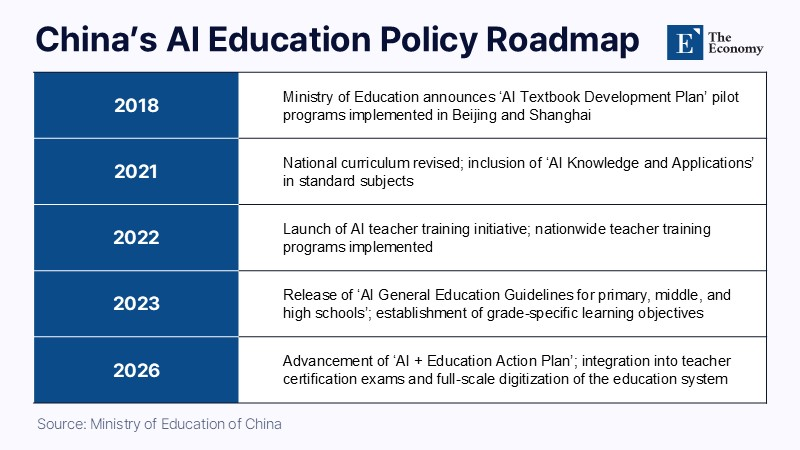
China’s latest move comes amid intensifying competition among major economies—including the United States, Europe, and Singapore—to integrate AI into education strategies. China has been preparing this transition for years through phased policy initiatives. In 2018, the Ministry of Education launched an “AI Textbook Development Plan,” piloting AI curricula in cities such as Beijing and Shanghai. In 2021, it revised compulsory education standards to include “AI knowledge and applications” and introduced AI fundamentals and big data into high school IT courses. In 2022, it launched a nationwide teacher training program under the “AI Teacher Development Plan,” followed last year by guidelines for AI general education across primary and secondary schools, setting age-specific learning objectives.
AI-centered education is already being implemented in practice. Xianghu Future School, a private K–9 institution established in 2021 in Hangzhou, Zhejiang Province, resembles a research laboratory. Its 1,000 students attend classes using “smart pens” equipped with cameras and pressure sensors that transmit handwriting and pressure data to AI systems in real time. The system analyzes where students encounter difficulties and immediately notifies teachers. AI monitoring extends beyond the classroom: in cafeterias, IC chip-enabled trays track nutritional balance, while in physical education classes, wristband sensors measure heart rates to enhance athletic performance.
Nearby Hangzhou Yungu School has also adopted AI early. Established in 2017 with an investment of approximately $20 million by Alibaba founder Jack Ma and others, the private K–12 school now enrolls 1,600 students. It offers courses such as “AI Shapes the Future,” taught by a former Google AI researcher. After spending a decade in Silicon Valley before returning to China in 2021, he now teaches students how to leverage AI to address societal challenges.
At the university level, AI-related departments are rapidly proliferating. Even teacher-training institutions are reducing traditional education majors while expanding AI-focused programs. According to a recent “China–Global Higher Education Trends Report” by Chinese education data firm MyCOS, more than 25% of teacher-training universities in China have added at least three new engineering majors over the past three years, with AI-related fields accounting for the largest share.
AI Encroaches on Teachers’ ‘Professional Judgment’
China’s AI education strategy emphasizes maximum utilization. The country is pursuing a rapid and comprehensive integration of AI across all domains, despite potential risks and uncertainties. Since 2017, China has once again framed AI as a decisive moment for transformation and leapfrogging. By deeply embedding AI, it seeks to identify gaps, risks, and domains where human roles may no longer be necessary, while redefining areas where human involvement remains essential.
However, some analyses suggest that the actual learning effectiveness of AI-based education may be limited. According to the OECD’s “Digital Education Outlook 2026” report released in January, while AI significantly boosts students’ short-term academic performance, problem-solving ability may deteriorate once AI support is removed. The report cites a large-scale empirical study conducted by researchers at the University of Pennsylvania’s Wharton School involving Turkish high school students. The study tracked performance changes among over 1,000 students during the 2023–2024 academic year, randomly assigning them access to GPT-4 as a learning aid.
The results were striking. Students using a chatbot-style interface that provided direct answers scored approximately 48% higher on applied problem-solving tasks compared to a control group without AI. Those using a “tutor-style” GPT-4 system that offered step-by-step hints instead of direct answers achieved performance gains of up to 127%. The reversal came afterward: when AI access was removed and students took similar tests, those who had relied on GPT-4 scored on average 17% lower than those who had studied without AI. The OECD concluded that “AI maximizes short-term performance but risks undermining long-term problem-solving and transfer abilities by partially replacing the learning process,” adding that “while grades may improve, actual human cognitive capability may weaken.”
Similar findings emerged from studies involving Chinese university students. Those who used AI tools to refine English essays received higher scores than those who revised independently or with human assistance. However, subsequent testing showed no improvement in actual knowledge acquisition among AI users.
The report also emphasized that AI should not be seen as a threat to teachers but as a tool to augment them. AI can reduce teachers’ workload in areas such as content generation, formative assessment, and personalized learning support. However, understanding students, making pedagogical judgments, and ethical decision-making remain beyond the scope of technology. The OECD warned that if AI begins to intervene deeply in core professional domains such as curriculum design and evaluation, teachers risk being reduced to mere “executors” of algorithm-driven scenarios. Uncritical acceptance of AI-recommended curricula could shift real control of the classroom from human educators to algorithms, undermining the fundamental role of education in addressing individual student contexts and emotional needs. The report further cautioned that increasing automation raises the risk of dehumanizing education, particularly if automated grading, feedback, and AI-driven instructional recommendations replace teachers’ professional judgment, potentially eroding their core competencies.
Anne-Marie Nicholson is a fearless reporter covering international markets and global economic shifts. With a background in international relations, she provides a nuanced perspective on trade policies, foreign investments, and macroeconomic developments. Quick-witted and always on the move, she delivers hard-hitting stories that connect the dots in an ever-changing global economy.
Similar Post
















