Merit Aid Is Rising Because Colleges Are Competing for Survival

Authored On
Modified
Merit aid is rising because colleges are competing harder for students and tuition revenue
Many scholarships now work less like pure honors and more like strategic price discounts
The real policy issue is not whether merit aid exists, but how openly and fairly colleges use it

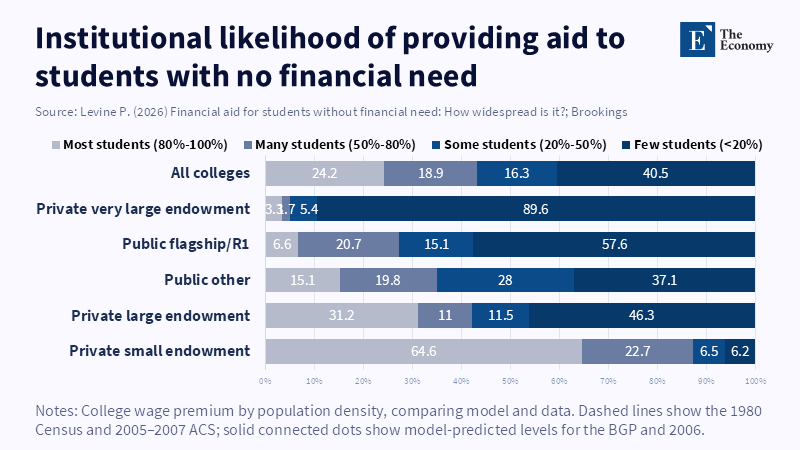
The sticker price is a myth at many American colleges. Recent national data has shown, in fact, that at almost 60 percent of four-year institutions, fewer than a fifth of all full-time first-time students paid anything close to the sticker price. That one stat alone should revolutionize the merit aid debate. For most of the debate, the underlying presumption is that merit aid is a gift based on merit, bestowed on the most deserving, according to a well-established rule. But that is not how the market works. Merit aid has become a pricing strategy, a way of controlling the shape of the entering class, shoring up tuition revenues and countering neighboring publics, elite private institutions and competing states. That doesn't make it noble. It just means it isn't irrational. Colleges are giving increasing merit aid not because they are running a system of merit-based moral principles, but because they are managing demand, revenue and risk.
Merit Aid Is A Pricing System Prior To Becoming An Honor
Merit aid should be recognized for more than what many would like to see it: a trophy for the smartest kid in the room--often, it isn't. While merit-based financial aid has at times been hidden under the cover of need, the federal formulas now include a slew of non-need-based (what reimbursed schools refer to as "scholarships") grant programs. According to new research from the Brookings Institution that examined 722 nonprofit four-year colleges and universities, these discounts influence enrollment choices, rather than accumulate as trophies for past accomplishment. This is consistent with the overall data: the most recent NACUBO tuition discounting survey found large numbers of first-time, degree-seeking undergraduates who enrolled at private, nonprofit colleges were already receiving institutional aid at record levels and the average tuition/fees discount as measured by the schools was higher than it had been in the previous two years. Since all students, on average, are receiving discounted net prices, the scholarship ceases to be a distinction but begins to read as a sale price. Colleges are aware of this. Families are aware of this. Policy, apparently, remains unaware of this.
Therefore, the classic gift of the geek, the fatter, smarter student, or the would-be-star student, cannot be quite so well defined. A college is not just choosing who deserves the most help, but who will actually enroll and who will add to the class and who will increase the school's prestige, yet who will still net the institution enough to help everyone else. In reality, merit aid is just another criterion for selection. One student gets aid because her competing school is desperate for that student, another gets aid because her school wants to boost the reputation of a certain major or research project and the third receives aid because he is the best-fit student who can be had for a discounted figure the school considers acceptable. While perhaps not as romanticized, it is exactly why merit aid is growing: it benefits several institutional factors at the same time.
The competition allows merit Aid to be further expanded
A more competitive, unequal marketplace is fueling the growth of merit aid. A contraction in the traditional college moving population is underway. The latest national projections by WICHE show high school graduate numbers in the United States flattened off at 3.9 million in 2025 and dropped to 3.4 million by 2041, an almost 13 percent decline from the peak. Although some areas and types of schools will be affected more than others, the trend in the national student population is unmistakable. Colleges are already preparing for this change and merit aid is an easy method to defend. It is more adaptable than overhauling the curriculum or hastening the institution's brand; it is less stressful than convincing governments or individual benefactors to cover deficits; and it is less complicated than convincing employees to accept paycheck cuts. A diminishing student body and frozen university costs prompt price discounting, putting even a small tuition charge in the black.
This is true even with the raw application volume growing. While the Common Application claimed 1,498,199 unique first-year applicants for 2024-25, representing a five percent increase over the prior year, overall application volume surpassed 10 million for the first time ever.1 Both first-generation and lower-income applicants increased by a larger percentage than their more affluent and second-generation counterparts. While a very positive trend, this does little to alleviate some of the competition already prevalent in colleges’ absolute value application volume and not proportionate growth in applicants across the entire sector. With students applying at an unprecedented pace to many more institutions and to achieve the best financial aid packages, competition for yield is fierce. The addition of one first-time applicant institution may be less about the absolute figure it received last cycle and more about what it will end up enrolling.
The divide between the public and private sectors has deepened. Fall 2025 total undergraduate enrollment grew by 1.0 percent, consistent with the overall increase of 1.2 percent in postsecondary enrollment, as did total postsecondary enrollment, but the subtleties of the split across the public versus private sectors of four-year institutions provide some troubling news. Public four-year colleges experienced a 1.4 percent increase in enrollment, whereas private nonprofit four-year colleges experienced a 1.6 percent decline in undergraduate enrollment; this is the core of a good part of the matter aid story today: private colleges are losing market share, especially in middle-range areas. Cheaper publics and wealthier privates with ravenous endowments work the ends of the price/quality spectrum, leaving tuition-dependent schools with no "good" options but to stay with the publics and terms and conditions, or be left out. For these schools, it is not about the tactical use of merit aid; merit aid might be used to stay alive.
Students Get Assistance Because Colleges Have to Get the Class and the Money (they need)
So, while the critique of the system that is based on morality is at least partially valid, it is not the whole picture. Schools are going to need revenue, not just revenue at the sticker price. If we look at data for institutional spending in the year 2026, we can see that core educational spending is at least as high as the sticker prices at most public flagship and R1 institutions. Even more so at private colleges that have small endowments. So, in the absence of public support, the college needs students who can afford to pay a huge proportion of the costs and then they give them a tuition discount to get that student to come to their institution. The university is not going to take the full sticker price; they want a feasible net price, which is the engine of the merit aid system.
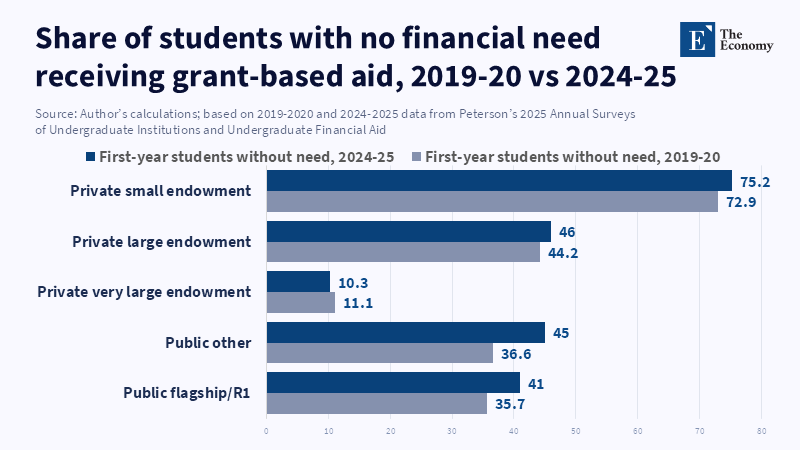
And the scope of this logic is seen in recent figures on access. The report from the Brookings Institution notes that, in 2024-25, 42.7% of colleges in their sample were offering "need-free merit aid to the majority of students, especially those attending public institutions, which are tracking upward far faster than by 35.7% (five years earlier) to 41.0% at R1 or flagship publics and from 36.6% to 45.0% at other public institutions." College Board data further substantiates this trend, showing that average institutional grants (a third of which went to full-time students at public four-year institutions) rose from 1,780 to 4,170 between 2006-7 and 2021-2, while the share of students receiving grants increased from 35 to 62 percent. Discounting has not disappeared at public higher education institutions; it has simply become another instrument.
Merit aid also helps institutions bring in a desired type of students with a profile more refined than test scores alone. Colleges can be strategic in aiming to bring in particular types of students to fill certain disciplines, increase the institution’s geographical scope, increase the honors cohort and increase retention or academic averages in certain majors. Colleges may be trying to bring in students to increase classroom discussions, increase graduation rates, or build their brand with future applicants. Colleges are buying a very specific type of merit aid package that they plan to use. Basing every dollar of aid on the poorest student ignores many institutions’ operating strategies. Colleges do not expect aid to be only a form of charity, but also a tool to build their preferred student cohort while maintaining financial health. While this may be a troubling behavior, pretending to ignore it will paint an inaccurate picture of the current state of financially sustainable universities.
Another piece of evidence that merit aid is not just show but rather part of a strategy is the Brookings study that shows that first-year students who do not display need are more likely to receive aid than upperclassmen, both at public colleges and at private institutions with small endowments. This discrepancy is too large to be explained by increasing the size of the grant and it leans toward the possibility that certain students begin with a more attractive financial aid package than lose it in the long run. This hints that some merit aid functions as a kind of " acquisition discount." Still, it does not establish that individual schools behave in bad faith; rather, it demonstrates how merit aid functions: first as a means of drawing students in; second, as an enduring symbol of academic achievement.
Merit Aid Policy Should Address Opacity, Not Illusion
Nonetheless, the strongest criticism against merit aid is valid: the institutions that spend huge sums on financially needy students will have fewer dollars available for the students who need financial help in order to even enroll. This situation will reproduce itself over and over: the neediest, most underrepresented, non-traditional students will enroll in fewer colleges. But discouraging colleges from competing once you stimulate them with a carrot is a policy goal that will not be realized; they cannot just turn off the tap. Colleges without a strong endowment, financial strength, or reputation for strong demand must not be expected to operate solely as a not-for-profit and philanthropic entity. To expect them to turn the competitive firehose off without adequately replacing their lost revenue is not reform; it is delusion. A serious policy response to the complex of issues related to merit aid must include an acknowledgment of its place in the marketplace and a set of policy guidelines. Public officials should identify additional sources of direct financial assistance for need-based grants, require more detailed reporting on non-need-based institutional aid and instruct colleges to differentiate institutionally-funded, merit-based awards from sticker price discounts in institutional communications.
The reform with the greatest promise is also the simplest: transparency. The model institutions that should be adhered to would require extensive disclosure on the part of schools. There should be an honest sharing of how much institutional aid went to students with need and without; how the first-year grant offers work and what students could be expected to receive from the institution over several years if they stayed in school; and clear disclosures both front and center and in fine print, on the net costs to low and middle-income students over the course of several years. Merit aid will forever be a part of the market, so in the absence of tight regulation, there must be obvious displays of how it is competing among schools. Competition is, after all, nothing new. What is new is the reality that most students in this country receive a discount off the sticker price; the bottom line for most students is the net price. And as institutions are feeling the pressure to deliver aid, they are doing so by offering discounts to lots of students. To stifle the current trend would be to police competition as if schooling were a similarly competitive business, versus a for-profit industry. Instead, we need a system that alleviates this problem while emphasizing those in the most need.
The views expressed in this article are those of the author(s) and do not necessarily reflect the official position of The Economy or its affiliates.
References
Common App (2025) End-of-season report, 2024–2025: First-year application trends. Arlington, VA: Common App.
Levine, P. (2026a) ‘Financial aid for students without financial need: Why do colleges offer it?’, Brookings Institution, 13 April.
Levine, P. (2026b) ‘Financial aid for students without financial need: How widespread is it?’, Brookings Institution, 16 April.
Ma, J., Pender, M. and Oster, M. (2024) Trends in college pricing and student aid 2024. New York: College Board.
National Association of College and University Business Officers (2025) ‘NACUBO study finds private colleges and universities are offering record financial aid to students’, 24 June. Washington, DC: NACUBO.
National Student Clearinghouse Research Center (2026) Final fall enrollment trends: Fall 2025. Herndon, VA: National Student Clearinghouse Research Center.
Peterson’s (2025) Annual surveys of undergraduate institutions and undergraduate financial aid. Princeton, NJ: Peterson’s Data.
Western Interstate Commission for Higher Education (2024) Knocking at the college door: Projections of high school graduates. Boulder, CO: WICHE.