South Korea’s Trilateral Strategy Needs Priorities, Not Balance

Working across research, policy, and data-driven analysis, the Editorial Board ensures that published pieces reflect a consistent institutional perspective grounded in quantitative reasoning and long-term structural assessment.
Authored On
Modified
South Korea still has agency, if it sets priorities
Security should stay anchored with the US and Japan
Strategy now means choosing, not balancing

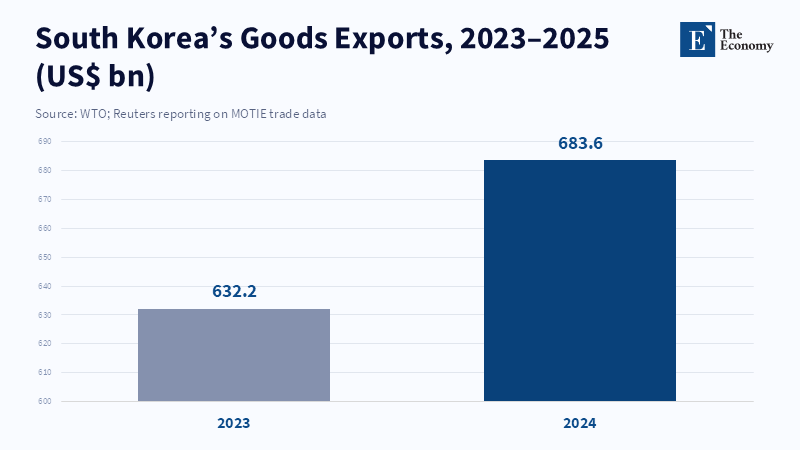
Korea’s Exports in 2025 are over $700bn. That’s a huge, huge achievement. Makes it look as if success is just around the corner. But it's also a clear indicator of vulnerability. When a country’s export figures, you are quite simply vulnerable to an unbelievable range of factors. Whether it's the threat of a nuclear neighbor, a reliance on the alliance with America, the expansive economic ties with China, or the resumption of Japan relations, Korea just can’t be reactive. This is the real reason why the issue of Northeast Asia today is to understand that, at the end of the day, the question isn’t whether Seoul still exercises influence. It does. But whether that influence can be used to set priorities and not for the same old balance of power purposes. For Korea, a radical departure from the American role is out of the question. The best it can do is be manipulated by the other powers around it. What is needed is a hierarchy of priorities, of the earth security within the trilateral US-Japan-Korea framework, of managing economic security in a China-Japan-Korea format and of cracking the China-Russia-N Korea coalition rather than trying to dismantle it with outlandish diplomacy. If Seoul continues to pretend that all options are equally necessary, then the other great powers will use Korea’s strategy against it. Rigidity is not required. What is needed is to leave the mistaken belief of momentum equalling strategy behind. Today, what is needed is direction in addition to dissemination.
Reject False Symmetry in South Korea's Trilateral Strategy
The existing Korean leadership has already shown what it is doing. Within days of the Jungho administration's installation in June 2025, Lee Jae-myung met with Donald Trump and reiterated how close the U.S. Alliance was. Following this, the leaders told Xi Jinping after the inauguration that Seoul wanted increased cooperation with China on the economy, security and culture. This order is not wrong; it just displays the realities of Korea's geopolitics. There is no sense in engaging each channel of diplomacy without having others, but that does not mean all options should be treated equally. The rub is to stave off conflict, embrace economic and political friction and then intensify pressure on the security interests of the Republic of Korea, either through an overt answer, inferred measures, or by providing Seoul with every other resource needed to meet challenges on both the economic/cultural front and the security front. Even well-intentioned analysts of a broader Korean role are increasingly emphasizing preserving alliances rather than emphasizing behavioral gains while exploring strategic independence. This will greatly amp up Seoul's direction-taking, instead of engaging this abstract maniac.
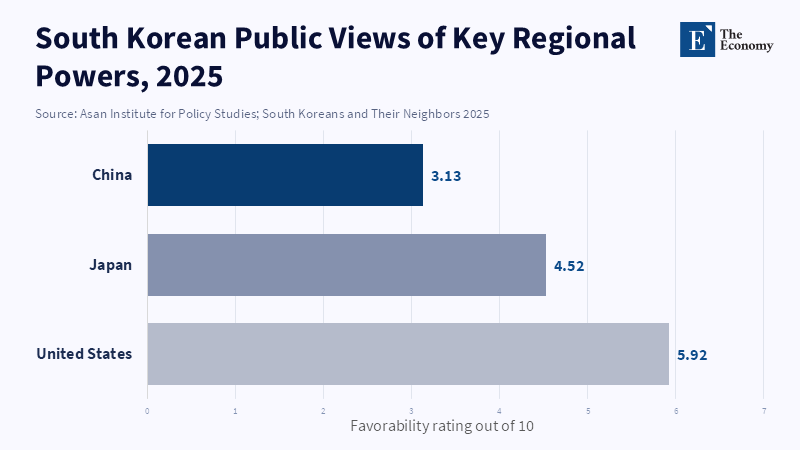
The South Korean public does not always have a pro-pure equidistance stance. A 2025 poll taken by the Asan Institute found that the United States was still the preferred neighbor with an aggregate 5.92 out of 10. Japan, South Korea's most difficult partner for foreign policy, received 4.52 out of 10 in the 2025 poll. China was rated far lower at 3.13. While public opinion itself should not be the sole determinant of grand strategy, it is indicative that the South Korean public will be welcoming of any long-term South Korean trilateral strategy, as it will be easier if done in the context of what is possible, i.e., a certain degree of alignment. Even with an unreceptive South Korean political animal in early 2025, acting authorities proved that the trilateral partnership has persisted, as it remains a key part of the new government. This persistence is heartening because it suggests that the most stable component of South Korea 's foreign policy no longer depends on presidential whim and is gradually becoming state practice. State practice would be significantly more resilient, giving Seoul more operating room for action in other directions. And it would require the public's support.
Hard Security Lock-In is Key to South Korea's Trilateral Strategy
To matter, agency must be directed at where it matters most. The U.S.-Japan-South Korea whatever-that-was constructed at the Camp David summit has the most promise. Here, leaders of all three reaffirmed in the 2023 annual roundtable ministerial, summit and transsommet rapid response; enhanced cooperation on missile defense, supply chains and technology. Unanimously reaffirmed in 2024, other leaders delineated this as a primary way forward. For a symbol to matter, it cannot be just words; exercise Freedom Edge was the strongest demonstration to date of trilateral military cooperation and the true nuance of how far the military dimension has come. Stimson's report rightly notes that U.S.-ROK collaboration is already spreading to regional leadership tasks. South Korea should leverage this force multiplier by deepening institutional strength, avoiding the trap of episodic summit series and making the alliance more resilient to intra-capital shifts. Institutional strength is the foundation for agency.
A widely shared concern in Seoul-that closer security arrangements with Washington and Tokyo would foster tighter cooperation between Beijing and Pyongyang and peel off Seoul from its allies-was simply mistaken. North Korea and Russia are already working together on a security pact. They signed a mutual defense agreement in June 2024. Today, Reuters shows how they are transferring military recruits and armaments in the following months. In 2026, China will again extend its influence on North Korea through trade and border construction, according to the research of Reuters. In brief, the China-Russia-North Korea alliance would be created regardless of Seoul's decision. Strengthening security cooperation with Washington and Tokyo would not reduce this danger; instead, it would bolster deterrence and clear guises. Beijing prefers that Pyongyang recognize that Seoul is diminishing strategic cooperation with the United States; however, it will be happy with neither Korea nor North Korea. So be careful. Swap the military commitment away from the United States, but not bring peace and confidence, but uncertainty. It is what North Korea wishes. Dialogue with Beijing is a possibility, but from a position of empirical force, not a fragile one. False ambiguity is not a cover.
Economic Safeguards are Essential for South Korea's Trilateral Strategy
The convening of the Korea-China-Japan trilateral mechanism in itself is not an argument for expelling South Korea from the China-Japan-South Korea framework. In fact, the framework offers South Korea an added space for agency if, as cross-learning, it is chosen wisely. The Korea-U.S.-China cooperation and consultation summit in Seoul in May 2024 is announced to reinvigorate cooperation to counteract the security controversies, bringing together a broad network of participation with summit and ministerial-level meetings to institutionalize a partnership. Seoul ignores that its peril is an institutionalized space for economic and functional interactions with these powers. It is fine for South Korea to threaten to leave the security triangle and work towards an irreversibility of what is inherently an institutional mechanism, which, if properly used, will buffer shocks without construing enrichment of economics as a form of security deterrence, a false equivalence.
One cannot discard the policy logic of the middle course. Exports rose 3.8% to $709.7 billion in 2025, a new record. But its 2024 trade surplus with the United States - already a target for tariff threats - hit a record $55.6 billion. The KITA numbers show that 46.8% of 2024 U.S. Imports from Korea are Intermediaries (that is, directly-invested links in the supply chain). These facts prove how deeply supply chains are now entrenched across the Pacific. This is the problem. Korea is no longer as dependent on China as in the past, nor is it politically assured in the U.S. market. It faces vulnerabilities in both directions. This is why a bona fide South Korea trilateral policy needs to go well beyond making economic policy subordinate to political strategy. Seoul needs China-Japan-South Korea mechanisms for shock-mitigation and quicker diversification to India, ASEAN, Europe and further afield so that neither Beijing nor Washington can impose a veto in the form of strong-arm punishment, repeatedly. The goal is not neutrality. The goal is to make the other side pay more for the Korean experience. Seoul will not end great-power rivalry, but it can make punishment more costly and benefits more productive.
Korea's trilateral strategy has to survive domestic politics
The hard part will be to keep that hierarchy in the face of elections, scandals and leadership changes. South Korea's foreign policy discourse remains oscillating between overreach and timidity, believing Koreans are moral leaders without enough agency, or expecting limitations that only allow for reactive diplomacy. Both fail to grasp the real agency middle powers have to reorder regions: they do not own the landscape they are on and they produce stability by lowering other people's uncertainty. Seoul can do that; it was the city of the reawakened China-Japan-South Korea trilateral and of the institutionalized Camp David process, it has the industrials (batteries, semiconductors, ships, defense, etc) and it has the ability to sway global supply chains. It has also retained the course that has been able to sustain the alliance with Japan and its relationship with China, despite the deep domestic crisis, amid the recent stabilization with the neighboring counter-actor. And that is not paralysis but statecraft and the natural role of a stabilizer that region punishes for showing inertia and excessiveness equally. Middle powers produce agency by just being good at other arenas without blurring the distinctions of their respective ordering.
South Korea's strategic agency will not be an iconic tactical departure from the United States nor even a rhetorical blessing of China. It will emerge as a clarifying and consistent demonstration that not all trilaterals are for the same purpose. First, the US-Japan-South Korea trilateral must be the defined deterrent core. Second, the China-Japan-South Korea nexus must be maintained as a co-service for moderate economic risk and the interlocking of regional dialogue. Third, the China-Russia-North Korea strategic-political nexus must be publicly recognized as a real security threat, not as an interlude. Here is the order. Because South Korea has exceeded the 700 billion dollar mark for exports in 2025, it is intertwined with China and the region and with the United States and the world, so the interconnectedness should cause Korea to prioritize, lest it fall into the evergreen trap. The age of balancing upon a tightrope as political theater has passed. South Korea's sustainable trilateral choice, order and action must precede the steps others take. It will be a healthy sign of South Korea's independence, not a sign of South Korea decreasing its independence. Purposively prescriptive priority, not disaffected detachment, is a more effective means by which the South Korean state can pronounce its sovereignty in a zone of punishment for drifting.
The views expressed in this article are those of the author(s) and do not necessarily reflect the official position of The Economy or its affiliates.
References
Asan Institute for Policy Studies (2025) South Koreans and Their Neighbors 2025. Seoul: Asan Institute for Policy Studies.
Chu, M.M., Park, J. and Fu, C. (2026) ‘China is rebuilding its grip on North Korea. Is Kim Jong Un ready to oblige?’, Reuters, 11 March.
Hao, N. (2026) ‘Examining South Korea’s agency between three trilaterals’, East Asia Forum, 17 April.
Kim, C. (2026) ‘South Korea Dec exports beat forecasts, wraps 2025 at a record’, Reuters, 1 January.
Kim, J.J. (2026) ‘Redefining the US–ROK Alliance in an Era of Uncertainty’, Stimson Center, 30 January.
Kim, J., Park, J. and Zhang, Y. (2025) ‘South Korean President Lee, Xi pledge closer economic, security cooperation’, Reuters, 10 June.
Lee, J. (2025) ‘South Korea’s trade surplus with U.S. will shrink, exporters say’, Reuters, 29 May.
Lee, J., Jin, H. and Hunnicutt, T. (2025) ‘South Korea’s Lee, Trump agree to work towards swift tariff deal, Lee’s office says’, Reuters, 6 June.
Ministry of Foreign Affairs, Republic of Korea (2023) The Spirit of Camp David: Joint Statement of Japan, the Republic of Korea, and the United States. Seoul: Ministry of Foreign Affairs, Republic of Korea, 18 August.
Ministry of Foreign Affairs, Republic of Korea (2024a) Joint Declaration of the Ninth ROK-Japan-China Trilateral Summit. Seoul: Ministry of Foreign Affairs, Republic of Korea, 27 May.
Ministry of Foreign Affairs, Republic of Korea (2024b) Joint Leaders’ Statement on the Anniversary of the Trilateral Leaders’ Summit at Camp David. Seoul: Ministry of Foreign Affairs, Republic of Korea, 19 August.
Smith, J. and Park, J. (2024) ‘Russia’s Putin and North Korea’s Kim sign mutual defence pact’, Reuters, 19 June.
Working across research, policy, and data-driven analysis, the Editorial Board ensures that published pieces reflect a consistent institutional perspective grounded in quantitative reasoning and long-term structural assessment.