“Now Is the Moment”: Big Tech Moves Ahead With Restructuring Under the Banner of AI Transition, Stocks Rebound Despite Layoffs

Authored On
Modified
Meta to lay off 8,000 employees as it accelerates an AI-driven business overhaul
A relay of job cuts sweeps across big tech as companies pursue management efficiency aligned with the AI era
“AI-led restructuring is bullish for markets” as shares of companies cutting headcount surge

Meta, the operator of social media platforms Facebook and Instagram, is set to carry out large-scale layoffs next month. As advances in artificial intelligence have shifted market perceptions of workforce restructuring in a more favorable direction, management-efficiency strategies framed around AI are spreading rapidly across the broader big tech sector. Some experts argue that technology companies, burdened by bloated organizational structures left behind after the COVID-19 pandemic, are using AI as a convenient rationale for workforce reductions.
Big Tech Workforce Cuts Under the Banner of AI
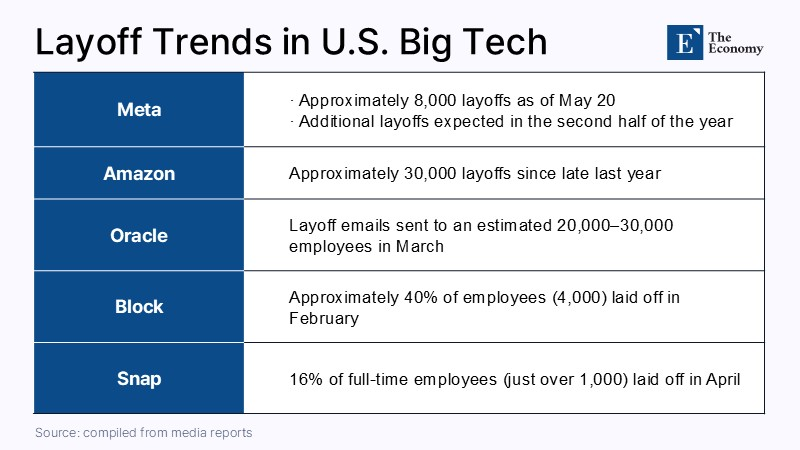
On April 17 local time, Reuters, citing multiple sources, reported that Meta plans to lay off about 8,000 employees on May 20. That amounts to roughly 10% of Meta’s total workforce of about 79,000 as of the end of December last year, and marks the company’s largest reduction since the “year of efficiency” push between late 2022 and early 2023, when 21,000 jobs were eliminated. Sources said Meta is also planning additional restructuring in the second half, although the exact timetable and scale have yet to be finalized. Management is expected to adjust its workforce plans in line with the pace of future AI development.
The move is being viewed as part of an AI transition strategy led by Meta Chief Executive Officer Mark Zuckerberg. Zuckerberg has been pouring massive investment into reshaping the company’s core business structure around AI. Last year, Meta’s AI-related capital expenditure was projected at as much as $65 billion, while the company’s cumulative investment in infrastructure and jobs in the United States had approached $600 billion by year-end. Zuckerberg’s longer-term vision is to maximize organizational efficiency through AI adoption while gradually reducing layers of management.
The same pattern is spreading across the wider U.S. big tech industry. Amazon, the world’s largest e-commerce company, has cut about 30,000 white-collar jobs over the past several months, while software firm Oracle has also launched a sweeping restructuring program that includes laying off about 30,000 employees, or roughly 18% of its global workforce. Layoffs.fyi, a website that tracks job cuts across technology companies, estimates that about 124,000 workers lost their jobs last year, with another roughly 73,000 departing their companies so far this year.
AI and the Market Response Give Companies a Clear Restructuring Rationale
Among experts, a growing view holds that AI has become, for big tech, a strategic instrument. In this reading, AI is being deployed as a justification for restructuring as companies work through the aftereffects of pandemic-era overhiring. One market specialist said, “It is true that AI adoption is changing the way organizations operate and altering labor demand, but it is difficult to interpret the recent wave of large-scale restructuring solely as the result of technological change,” adding, “Big tech’s recent workforce reduction strategies reflect the convergence of a future-oriented AI transition agenda and the practical need to recalibrate payrolls that were aggressively expanded during the COVID-19 pandemic.”
Even on the ground, many believe it will take time before AI directly displaces workers at scale. At present, the AI systems companies have introduced are more accurately described as tools that enhance the efficiency of certain repetitive tasks and augment the productivity of existing employees, rather than substitutes capable of driving enterprise-wide job cuts. Their effective deployment also remains concentrated in relatively limited areas such as customer service, document drafting, coding assistance, and data organization, prompting criticism that it is premature to argue that the broader employment structure is on the verge of a sudden transformation. There is also a counterview that AI adoption simultaneously creates new roles and new demand, making it difficult to draw a straight line from AI implementation to large-scale layoffs.
Even so, the sharp rise in companies invoking AI as a rationale for restructuring reflects a clear shift in market psychology. It has become evident that the market responds more positively when companies frame cuts as “AI-driven efficiency” than when they simply describe them as restructuring based on management judgment. That change has also influenced how investors assess workforce reductions. In the past, mass layoffs were often interpreted as a sign of deteriorating management conditions. More recently, they are increasingly being read as evidence of a willingness to lift earnings by cutting costs. The expectation that lower labor expenses will translate directly into improved profitability is being reflected almost immediately in share prices.
Stock Gains Repeatedly Follow Large-Scale Layoffs
That trend is clearly visible in the stock performance of individual companies. Snap, the operator of Snapchat, is a representative case. Its shares, which had fallen 23% over the previous year, jumped about 8% in a single day after the company announced plans this month to cut 1,000 jobs. Snap CEO Evan Spiegel said in announcing the restructuring that “advances in AI can reduce repetitive work and improve productivity.” The Wall Street Journal also reported that major companies including Amazon, Oracle, and Block experienced stock rebounds after carrying out large-scale layoffs.
Block in particular had seen its stock decline about 16% from the start of the year as of late February, then cut about 4,000 jobs, or roughly 40% of its total workforce. Its shares later erased those losses and moved higher. In an interview, Block Chief Operating Officer and Chief Financial Officer Amrita Ahuja said, “Executives around the world have asked for the ‘playbook’ on how they can replicate this kind of sweeping workforce reduction at their own companies,” adding, “Mass layoffs are an unavoidable trend, and as a CFO, I believe it is better to act even a little early than too late on this issue.”
The WSJ said the current situation reveals a fundamental shift in how big tech companies view white-collar labor. Companies that once offered extraordinary pay packages and benefits to attract top knowledge workers have begun to conclude that oversized organizations themselves undermine operational efficiency. In that regard, Mo Koyfman, founder of venture capital firm Shine Capital, said, “Most companies could probably cut 30% to 50% of their workforce at any time with little difference in performance,” adding that “AI has given companies the rationale to execute the long-needed right-sizing they had been waiting for.”
Similar Post