Japan Elevates Metal and Plastic Recycling to a National Priority, Seeking a Complete Break from Dependence on China Through “Urban Mining”

Authored On
Modified
Resource Recycling Strategy Elevated to the Level of National Resource Security
$6.26 billion to be invested by 2030 as Japan accelerates recycling hubs and technology development
Aimed at strengthening Japan’s leadership in the global resource market
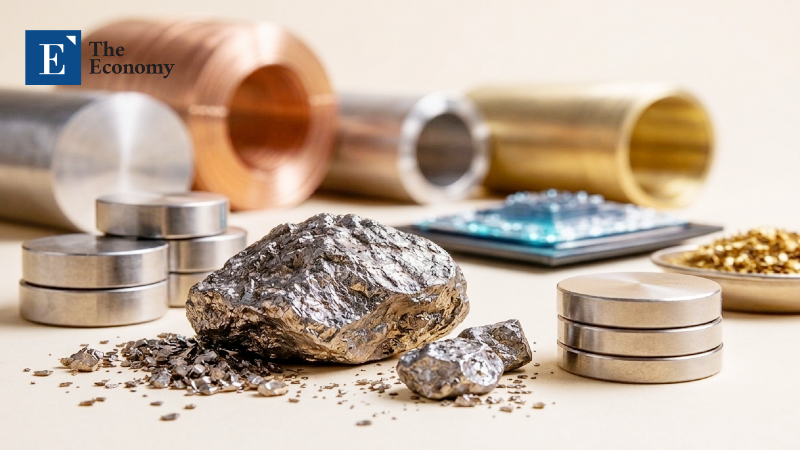
The Japanese government has elevated the recycling of key resources to the level of a national priority in response to intensifying global competition over resource procurement. The strategy is designed to dramatically reduce overseas dependence from the standpoint of economic security. Built on large-scale investment, regulatory overhaul and public-private cooperation, the initiative is centered on industrializing “urban mining” and positioning the resource-circulation system as a core pillar of national infrastructure.
Japan Finalizes Circular Economy Action Plan
According to the Asahi Shimbun on April 23, the Japanese government convened a ministerial meeting on April 21 and finalized a concrete action plan for realizing a circular economy. The plan is focused on easing instability in resource supply chains and securing sustainable growth drivers. Japan has decided to mobilize a total of about $6.26 billion in combined public and private investment by 2030 to build recycling hubs and develop new technologies. Through the initiative, the government plans to maximize the recovery capacity of urban mines that extract metals from discarded home appliances and foster the recycling industry as a new engine of growth for Japan.
Urban mining is a term first coined in Japan in the 1980s. It emerged from the idea of treating large volumes of metal waste from discarded or damaged appliances and automobiles as a single mine and recycling them accordingly. In essence, the concept calls for industrializing the extraction of rare metals and high-value metallic minerals from discarded mobile phones and home appliances. The expansion of urban mining also carries the added benefit of curbing resource waste and reducing carbon dioxide emissions. While some global companies such as Apple have pursued metal-recycling strategies, there has been no precedent for such an initiative being advanced at the national level.
The action plan also sets out concrete recycled-material usage targets for individual metal resources. By 2030, the Japanese government aims to source about 40% of domestically produced aluminum used in automobile manufacturing and other industries from recycled materials, while setting the target for copper at 30%. It also plans to secure about 30% of the raw materials used in rare-earth permanent magnets, a core component in advanced industries, through recycling. In the steel scrap sector, Japan intends to add annual domestic processing capacity of 2 million tons to improve the efficiency of resource circulation. The government plans to actively reflect the action plan in this summer’s growth strategy and in the Basic Policy on Economic and Fiscal Management and Reform. The message is unequivocal: resource reuse is being positioned as a central pillar for safeguarding both the national economy and national security, rather than remaining confined to environmental policy.
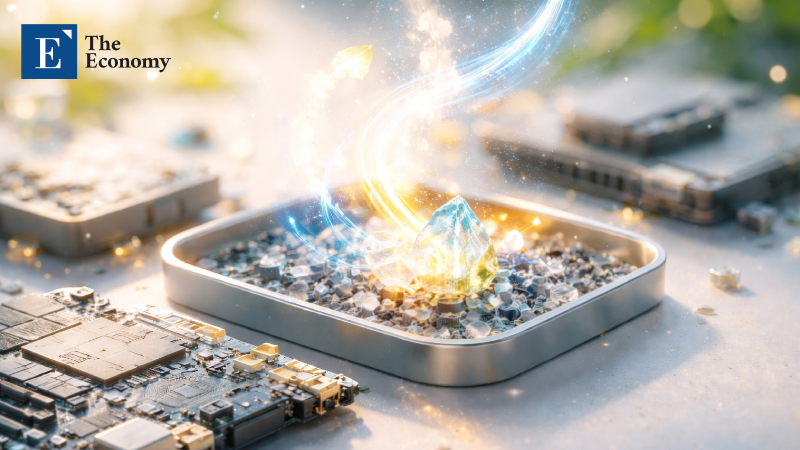
Supply-Chain Stabilization and Resource Recirculation at the Core
In 2023, Japan initially allocated ¥330 million for its rare-metal stockpiling program, but later expanded that figure to ¥11 billion through a supplementary budget in the same year. It also injected an additional ¥1.2 billion into the Resource Autonomous Economic System Development Promotion Project, a program aimed at developing technologies capable of recycling metals and plastics contained in discarded products.
Beyond that, Japan allocated ¥25.3 billion in 2022 to its program for strengthening the supply chain of critical materials in response to changes in the economic environment, which supports the development of rare-earth raw material recirculation technologies to diversify and reinforce supply chains for permanent magnets, an essential material in advanced industries. In the same year, it committed ¥125 billion to its Economic Security Important Technology Development Program, which supports projects including next-generation magnet development.
With the transition toward a circular economy drawing greater attention, the Japanese government also established regulations and rules in March 2023 under its Growth-Oriented Resource Autonomous Circular Economy Strategy. Through these measures, Tokyo is expanding policy support for the demonstration and deployment of research and development related to resource circulation while reinforcing collaboration among industry, academia and government. It has also 마련ed investment-promotion measures to realize Green Transformation, or GX, and plans to mobilize a total of roughly $12.53 billion in public and private investment in the resource-circulation sector over the next decade.
In the early stages of implementation, urban mining projects were limited to securing precious metals such as gold and silver from electronic circuit boards. Melting one ton of iron ore mined from a conventional mine yields about 20 grams of gold and 150 grams of silver, while one ton of electronic circuit boards can produce 300 grams of gold and 1,600 grams of silver. In the 2020s, however, technologies capable of extracting rare metals such as cobalt—said to be more expensive than gold—began to emerge. Japan has now reached a level at which nearly all metals used in circuit boards, including lithium and nickel, which are key battery materials, as well as copper and zinc, can be recycled.
Acceleration of a Non-China Supply Chain
This year, several of Japan’s leading corporations have joined the effort, pushing the initiative into a full-fledged commercialization phase. Daikin Industries, Shin-Etsu Chemical, Hitachi and Tokyo Eco Recycle announced on April 14 that they had launched a joint project to dismantle rare-earth magnets from commercial air-conditioner compressors and return them to magnet raw materials. The companies have automated the entire process of disassembling magnets containing rare earths from air-conditioner compressors and extracting the raw materials through artificial intelligence-based image recognition and robotics. It marks Japan’s first circular system built around commercial air conditioners, with commercial operations targeted for 2027. The industry views the project as the first step in extending the urban mining concept into the realm of industrial equipment. Hitachi had already launched a circular network in December last year to extract and recycle rare earths from magnet motors used in aging elevators.
Japan has also shifted overseas procurement networks, once left to private-sector discretion, into the realm of national projects. JOGMEC, the government-affiliated Japan Organization for Metals and Energy Security, established a joint venture called JARE with trading house Sojitz and on March 10 fully restructured its existing supply contract with Australia’s Lynas. Under the agreement, Japan will secure 5,000 tons of neodymium-praseodymium oxide annually from Lynas as committed volumes through 2038, 12 years from now, and will also receive 75% of Lynas’ heavy rare-earth production for Japanese industrial use.
The contract also stipulates that if the rare earths purchased by Japan rise above $150 per kilogram, Lynas will return 30% of the excess portion to JARE, with an annual rebate cap of $10 million. The arrangement is widely interpreted as a national-security measure designed to sustain non-Chinese producers with state backing rather than leave Japan dependent on China’s rare-earth supply chain. Amanda Lacaze, Lynas’ chief executive officer, said the agreement would ensure a stable supply of rare-earth products strategically important to Japanese industry while applying fair market prices and reducing price volatility.
Japan has gone beyond supporting private Australian producers, directly deploying government funds into refining facilities in allied countries such as France. On April 1, Japanese Prime Minister Sanae Takaichi reached an agreement with French President Emmanuel Macron on a roadmap for rare-earth supply-chain cooperation during Macron’s visit to Japan. Under the agreement reached by the two leaders, the Caremag rare-earth refining plant in Lacq, southern France, is set to begin operations at the end of this year, eight months from now. JOGMEC is participating in the project on behalf of the Japanese government, while gas company Iwatani and the French government have joined as co-investors. Japan plans to source around 20% of its future demand for dysprosium and terbium from the plant. Roland Lescure, France’s minister delegate for industry and energy, said in an interview with NHK that rare earths cannot be left dependent on a single country, particularly China.
Similar Post