"From LA to New York State," Smartphone Restrictions Spread Across U.S. Schools, With Similar Measures Following in Australia and South Korea

Oliver Griffin is a policy and tech reporter at The Economy, focusing on the intersection of artificial intelligence, government regulation, and macroeconomic strategy. Based in Dublin, Oliver has reported extensively on European Union policy shifts and their ripple effects across global markets. Prior to joining The Economy, he covered technology policy for an international think tank, producing research cited by major institutions, including the OECD and IMF. Oliver studied political economy at Trinity College Dublin and later completed a master’s in data journalism at Columbia University. His reporting blends field interviews with rigorous statistical analysis, offering readers a nuanced understanding of how policy decisions shape industries and everyday lives. Beyond his newsroom work, Oliver contributes op-eds on ethics in AI and has been a guest commentator on BBC World and CNBC Europe.
Authored On
Modified
LA moves to regulate screen time after banning smart-device use on campus
New York State also mandates smartphone restrictions across all K-12 schools
A broader global trend is emerging, with Australia and South Korea also tightening measures targeting minors
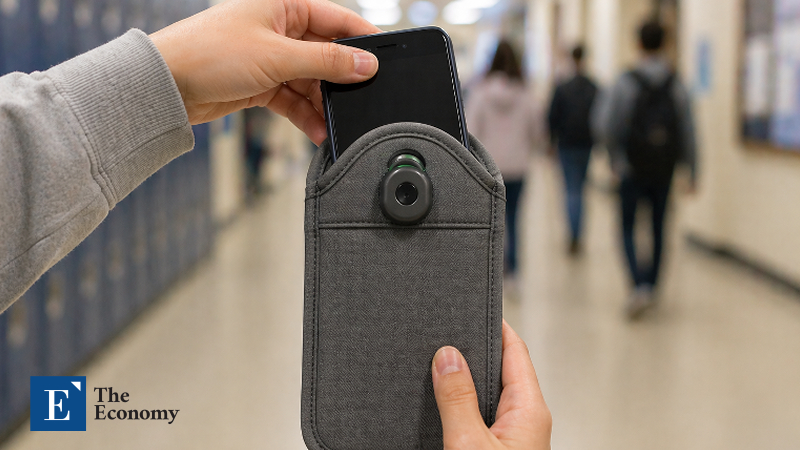
Los Angeles, California, is moving forward with a policy to limit screen time on school campuses. The measure marks a renewed push to tighten digital restrictions on minors, following last year’s blanket ban on the use of smart devices at school. New York State has likewise prepared a statewide framework mandating restrictions on smartphone use in schools, while similar discussions are gaining momentum in other countries, including South Korea and Australia.
LA’s Push for In-School Digital Restrictions
On April 21 local time, NBC News reported that the Los Angeles Board of Education had passed a resolution centered on limiting smartphone use and encouraging homework completed with paper and pen. Under the measure, the Los Angeles Unified School District, which operates public schools across the LA area, will establish screen-time policies by grade level and subject. Smartphone use will be prohibited for students in first grade and below, and procedures will also be created allowing parents to opt out of their children’s use of technology at school. The policy is set to take full effect beginning in the next academic year.
The Los Angeles Board of Education had previously introduced a phased ban on the use of smart devices on campus. That policy gained traction through the passage of a resolution in June 2024 and, after a preparation period, took effect in February last year. The board imposed a comprehensive ban on the use of mobile phones, smartwatches, and earbuds on school grounds, covering not only class hours but also lunch and recess. Individual schools were allowed to choose how to enforce the policy, with common methods including storing devices in bags, collecting them in classroom bins, or locking them in magnetic pouches. Certain exceptions were recognized, however, including cases involving disabilities or the need for smart devices for translation or health-related purposes.
The early impact was clear. According to LAist, a field review conducted about four months after the policy took effect found that teachers, students, and administrators broadly agreed that visible cellphone use on campus had declined and student-to-student interaction had increased. Teachers in particular said classroom distractions had diminished and that they could immediately feel students making greater efforts to focus on learning instead of their phones. At the same time, however, the review also exposed limits to the policy’s behavioral impact, including students finding ways to circumvent the restrictions or increasing smartphone use outside school.
New York State Crafts a Statewide Regulatory Framework
New York State has taken similar action. Beginning in 2024, the state had already pilot-tested cellphone restrictions in certain school districts. Large districts, including the New York City Department of Education, in particular had assessed the effects of policies such as banning use during class or requiring device storage, and in the process teachers accumulated positive assessments pointing to improved student concentration and restored classroom order. At the same time, concerns among parents over cyberbullying and social media addiction gained traction, helping push broader policy expansion into the public debate.
In step with that trend, New York State established a legal basis last May through the state legislature to mandate restrictions on smartphone use in schools. During the policy rollout, Governor Kathy Hochul described smartphones as a “major distraction” in classrooms, citing their impact on learning concentration, while also underscoring the link between worsening adolescent mental health and rising social media use. Shelley Mayer, chair of the New York State Senate Education Committee, likewise said in a media interview that schools should be a “distraction-free environment” in which students can learn without interference, presenting the spread of cyberbullying and online conflict into classrooms as justification for regulation.
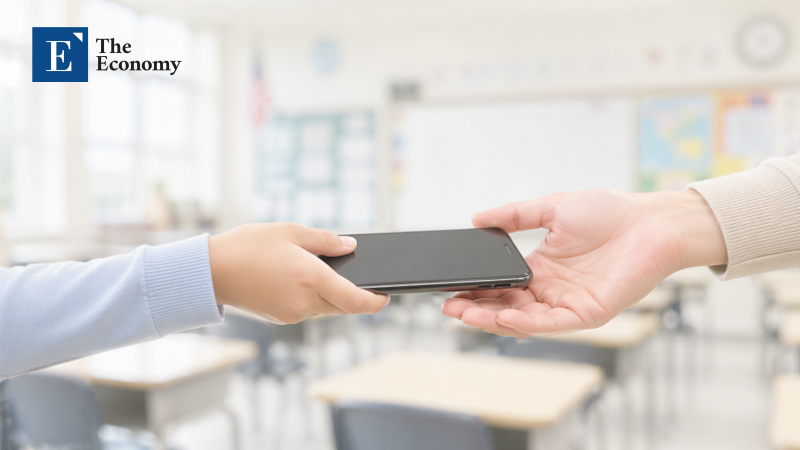
Implemented from the fall semester last year, the policy is not a mere recommendation but a statewide standard applying to all K-12 schools, including public schools and charter schools. Its basic principle mirrors LA’s so-called “bell-to-bell” ban, which restricts students’ use of personal smartphones throughout the full school day, from arrival to dismissal. Schools are permitted to choose their own methods for physically separating students from their devices or otherwise controlling usage.
Countries Move to Protect Minors
Such measures are now being adopted well beyond the United States. Australia, for example, last December became the first major country to enforce legislation blocking social media accounts for users under the age of 16. The law is centered on imposing fines of up to about $35.6 million on social media platforms that fail to take reasonable steps to prevent users under 16 from holding accounts. According to Australia’s online safety regulator eSafety, the 10 social media platforms covered by the measure deleted or blocked roughly 4.7 million accounts belonging to users under 16 within just one month of implementation. That figure far exceeded initial projections and amounted to nearly two accounts per person among Australia’s population in that age bracket.
South Korea is also revising related systems one after another. A representative example is the amendment to the Elementary and Secondary Education Act that took effect last month. The core of the amendment is to prohibit students, in principle, from using smartphones during class, while leaving decisions on exceptions for educational purposes, emergencies, or the use of assistive devices in special education to the discretion of school principals and teachers. It also established a legal basis allowing principals and teachers, where deemed necessary to protect students’ right to learn and to safeguard educational activities, to restrict by school rules the use or even possession of smart devices on campus itself.
Discussions are also under way over imposing stricter limits on smartphone use among lower-grade elementary school students. On the 13th, Education Minister Choi Kyo-jin, responding during a National Assembly interpellation to a proposal from National Assembly Education Committee Chair Kim Young-ho to introduce smartphones equipped only with learning functions for lower-grade elementary students, said that “if an alternative smartphone that can truly be used only for learning can be developed, it would be a very meaningful idea.” The concept is to leave only calling and educational functions intact while blocking access to games, social media, and video platforms, thereby minimizing the risks of addiction and exposure to harmful environments.
Even so, parts of the education sector argue that while they agree with the broader direction of reducing indiscriminate smartphone use among younger students, device restrictions alone cannot serve as a complete solution. In their view, it remains uncertain whether developing a separate device would generate effects beyond those already achievable through existing control tools. The amended Elementary and Secondary Education Act is already in force, and it has also become increasingly common for parents to use features that control app installation and screen time on their children’s smartphones. On top of that, costs related to device development and distribution, as well as the feasibility of managing such devices in school settings, are also cited as factors that must be weighed in the policy design process.
Oliver Griffin is a policy and tech reporter at The Economy, focusing on the intersection of artificial intelligence, government regulation, and macroeconomic strategy. Based in Dublin, Oliver has reported extensively on European Union policy shifts and their ripple effects across global markets. Prior to joining The Economy, he covered technology policy for an international think tank, producing research cited by major institutions, including the OECD and IMF. Oliver studied political economy at Trinity College Dublin and later completed a master’s in data journalism at Columbia University. His reporting blends field interviews with rigorous statistical analysis, offering readers a nuanced understanding of how policy decisions shape industries and everyday lives. Beyond his newsroom work, Oliver contributes op-eds on ethics in AI and has been a guest commentator on BBC World and CNBC Europe.
- Previous “Six-Minute Near-Full Charge” — China’s CATL Unleashes a Technological Offensive Beyond the Limits of LFP, Leaving South Korea’s Three Battery Makers Searching for a Route Through Solid-State Batteries
- Next EU to Mandate User-Replaceable Smartphone Batteries from Next Year, Industry May Circumvent Regulation with High-Performance Cells Instead of Removable Designs
Similar Post