South China Sea Governance Is Becoming China’s Quietest Expansion Strategy

Working across research, policy, and data-driven analysis, the Editorial Board ensures that published pieces reflect a consistent institutional perspective grounded in quantitative reasoning and long-term structural assessment.
Authored On
Modified
China is using South China Sea governance to normalize strategic control
Scientific cooperation and treaty leadership can quietly support territorial ambitions
The SCS and Taiwan are becoming one connected gray-zone battleground

Strategies don't require a naval battle to redraw the map. The year 2025 will record the highest number of Chinese maritime militia vessels recorded per day on average across the South China Sea, 241 vessels per day. Simultaneously, the China Coast Guard was detected on 352 days of the year in patrol in the vicinity of Scarborough Shoal. That's not a one-off show of force; it's a system of routinized presence. It's not just designed to intimidate rivals. It is designed to normalize Chinese activity, to render it regular, routine and difficult to undo. That is why the real contest in the South China Sea today is not just over reefs, runways, or patrol routes. It is over language, institutions and expertise. Chinese attempts at South China Sea governance leadership are framed as legal, scientific, even altruistic, but the more inconvenient reality is that the governance push is an effort by Beijing to translate contested space into administered space. Once that translation is solid, the strategic linkage of the South China Sea and Taiwan will become even more difficult to manage.
South China Sea governance is not neutral
A key reason why China's more recent ocean diplomacy is so readily misleading is that it is phrased in the language of order. Beijing has signed the BBNJ treaty, it has expressed support for faster talks on a South China Sea Code of Conduct by 2026 and it has made a deliberate effort to promote blue partnerships through scientific research and capacity building. The stated accomplishment of the Chinese government is that China has signed 50 maritime cooperation agreements with various countries and organizations, it has built over ten joint research platforms, announced 100 cooperation projects and offered 5,000 training opportunities. This is corroborated by analyses of China's maritime policy, indicating a focus on ocean governance and institution-building. On their face, these facts present an image of a country investing in multilateral problem-solving. Viewed in context, they present something different: they reveal an effort by Beijing to use ocean governance as a way to smooth the road for its ongoing territorial ambitions.
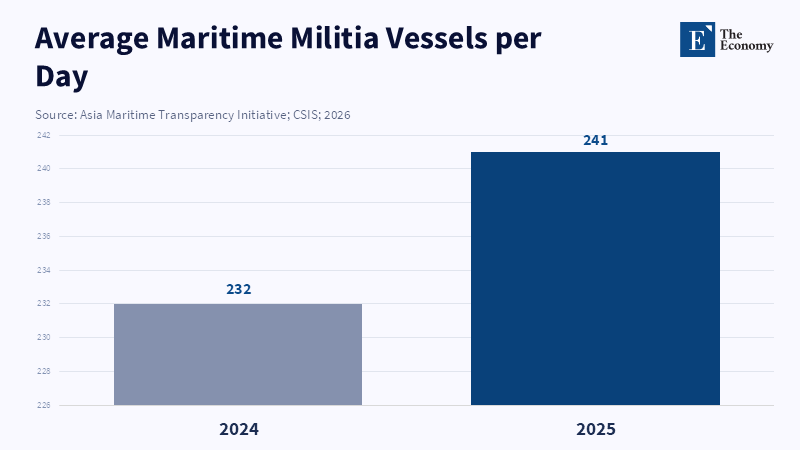
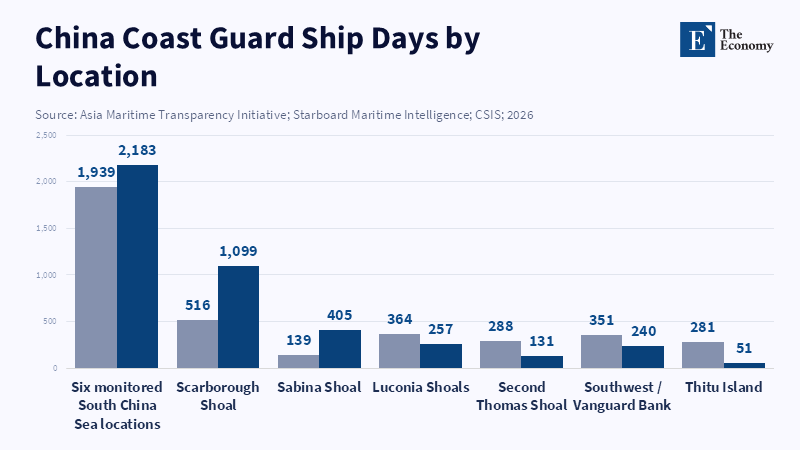
It is critical to observe context because the on-the-ground reality directly contradicts China's public pronouncements. Commercial satellite data from the Asia Maritime Transparency Initiative in 2025 has recorded the highest numbers of militia activity since data has been tracked, 241 vessels per day, up from 232 in 2024. Of these boats, nearly half were observed clustered around the reefs of Mischief and Whitsun. AIS data reported to the Asia Maritime Transparency Initiative also documented a rise in Chinese Coast Guard presence in six strategic areas to 2,183 ship days in 2025, compared with 1,939 in 2024. In particular, ship days associated with the Coast Guard in the Scarborough Shoal region leaped from 516 to 1,099. These figures underscore a state not freezing territorial competition for governance-building; instead, China is intensifying its day-to-day control while simultaneously cultivating the appearance of a diligent guardian of maritime order. This dual strategy is the essence of Beijing's approach.
The legal dimensions only sharpen this contrast. In 2016, the Permanent Court of Arbitration rejected China's claim to historic rights within the nine-dash line as lacking any legal basis under UNCLOS. The ruling also found that the features within the Spratly Islands were insufficient to grant exclusive economic zone or continental shelf rights, including Mischief Reef, which the Court classified as a low-tide feature within the Philippines' EEZ and continental shelf. Beijing formally denies the ruling's legitimacy and maintains it is illegal and void. Therefore, the question of South China Sea governance is inseparable from issues of sovereignty. China's attempt is not to substitute law for power, but to imbue a territorial agenda with legal, scientific and administrative dimensions that were never abandoned in the first place.
South China Sea governance as science and presence
The fight over the location of the BBNJ secretariat provides a case study for this dynamic. China's bid for the secretariat in Xiamen was presented largely in technical terms, with its authorities describing the city as a center for marine science and technology and a significant regional research hub. Those familiar with diplomacy were quick to see why such a bid matters: by hosting the secretariat, China stands to gain an increased pool of institutional expertise, a larger voice in the day-to-day operation of a new global regime, a stronger hand in agenda setting, greater influence within its staff, more scientific prominence and influence and a bureaucratic edge. While not intrinsically wrong or unusual in the context of state competition, in the South China Sea this dynamic acquires specific strategic significance. The contest for South China Sea governance is also about the struggle for authority through administration.
This is also why philanthropy emerges as a useful tool for Beijing. The discourse today frames China as a provider of public goods in the oceans: joint research, forecasting, weather warnings, capacity-building programs, scientific exchanges and other environmental cooperation. China highlights, for instance, its early warning system serving over 130 countries and its growing network of maritime research partnerships. There is no question that these are tangible and valuable activities, but within disputed waters, scientific undertakings are never neutral. Marine spatial planning may create precedents for jurisdiction, scientific monitoring can establish access for data collection, joint research can create routine presence and capacity-building initiatives may influence partners' conception of what is permissible within a given legal and scientific framework. When paired with a territorial dispute, this becomes a soft-power tactic not just to grab a reef without notice, but to legitimize Chinese leadership in South China Sea governance as necessary, beneficial and nearly impossible to reject on its merits.
More compelling evidence lies in China's own formal position as articulated during its accession to the BBNJ agreement. When it ratified the treaty in January 2026 (it entered into force that month and has 88 parties to date), Beijing filed a declaration stating that the agreement "must be without prejudice to any state's sovereign rights or jurisdiction." It further maintained that the agreement's tools for area-based management should "not include any area involving claims of a state to sovereignty, sovereign rights, or jurisdiction." These stipulations are no mere footnote. They signal Beijing's intention to engage in global ocean governance while simultaneously insulating its contested maritime claims from any reinterpretation that might compromise them. That is to say, China's engagement with multilateralism is highly jurisdiction-sensitive and not designed to limit controversial activities under external scrutiny, but rather to reshape the operational environment around those activities to reduce friction over time.
South China Sea governance is linked to Taiwan
It would be a mistake, therefore, to view the contests for South China Sea governance and for Taiwan as distinct and separate strategic questions. They may differ in their immediate objectives and operational strategies, but they are increasingly interlinked. An April 2025 analysis from the Atlantic Council differentiated Beijing's approach in the South China Sea and Taiwan, arguing the former uses "incremental, incremental pressure. To change facts, while the latter employs "a broader range of pressure to wear down defensive capacity and public resolve." The differences in tactics notwithstanding, the underlying logic is the same: to incrementally achieve goals that do not rise to the level of sparking a coalition response. Thus, the ongoing efforts in South China Sea governance are deeply tied to China's strategic ambitions regarding Taiwan, helping solidify the gains from its gray-zone maneuvers in the South China Sea.
Events of the past week underscored that linkage. An official from Taiwan’s Ocean Affairs Council held the first ministerial visit to Taiping Island in the Spratlys in seven years this week to observe coast guard drills. Simultaneously, the Philippines, the US and allies launched their biggest-ever Balikatan exercises to date, with over 17,000 troops conducting training near Luzon, across the water from the Taiwan Strait. Those actions do not imply that a single crisis is inevitable. They do imply that regional actors increasingly view the waters between northern Philippines and the Spratlys to Taiwan as a single strategic arc and if Middle East-driven diplomacy takes up less of the stage, then this arc will come under growing pressure. The battle lines are already drawn beneath the declaration of war.
China’s rhetoric itself links them. Beijing Vice Foreign Minister Sun Weidong, for example, discussed the South China Sea, a Code of Conduct, arbitration and Taiwan in the same terms in a December 2025 speech on global ocean governance. That’s important because it gives us insight into how Beijing frames maritime order itself. Taiwan is not a distinct file; it is interwoven with the broader argument for Chinese territorial claims to the postwar order and maritime rights. Once that is recognized, then Beijing’s drive for leadership of South China Sea governance becomes less about prestige and more about defining the legal and political context within which further Chinese maneuvers near Pratas, Scarborough, the Spratlys, or maritime lanes off Taiwan will be judged. It is for this reason that forums for science diplomacy, hosted treaty arrangements and maritime training cannot be dismissed as an innocuous background.
A more nuanced take on South China Sea Governance
But every power tries to shape institutions and China should not be excluded from ocean governance; no serious policy is founded on an imaginary scenario in which diplomacy only proceeds when Beijing abstains from the process. This is not a problem of China's participation; it is a problem of pattern. A state that pushes for prestige through maritime law and conservation, while simultaneously sustaining an all-time high level of gray-zone pressure in disputed waters, wants its partners to view these two initiatives as separate while they remain integrated in its strategy. To do so is to be ensnared. To look at China's leadership role in South China Sea governance on its own terms helps solidify an approach that most of its partners already condemn. There is a solution – not a boycott, but controlled engagement on tighter terms, with greater transparency in all ventures, more rigorous management of conflict of interest in dual-use research and greater public awareness of maritime coercion tactics.
To policymakers, the first step will be to stop bifurcating their discussions of coercion and governance into separate policy briefs. The pressure tactics used by coast guards, militia grazing at sea, partnerships for maritime research and conservation, intergovernmental efforts toward an agreed-upon convention on maritime law and the verbose language of the environment-all come together; their response should do the same. Claims states of the region, together with their partners, must publish encounters more promptly, share intelligence and make links between their own bilateral maritime cooperation and China's adherence to transparency and reciprocal obligations. States supporting the 2016 ruling should proclaim their support of it more often and with greater clarity; university administrations and scientific institutions should scrutinize ocean partnership deals involving research on seabed mapping, surveillance technology, dual-use sensing technology and maritime law courses and training more closely; and educators, including university departments and publications, must end their pretense that South China Sea governance is an issue of neutral technical management and instead, characterize it correctly, as a struggle on a new frontier where rules, knowledge and physical presence are merged into power.
This first statistic reveals the underlying paradigm shift: an average of 241 militia vessels each day signifies more than merely a measure of security; it provides a warning of method. Beijing is attempting not only to seize control of the waters but also to legitimize its claim through administered acceptance-that is the subtext for China's ambition of leadership in the region. It's not the disguise that is threatening; it's the reality that the diplomatic tool of governance can be used to reduce resistance to its territorial ambitions. When this becomes normalized, backtracking will be a much harder endeavor than merely lodging another complaint. The call to action is thus elementary: Stop talking about governance and its security counterpart as separate and disparate concepts; in the South China Sea, they are integrated. Failure to comprehend this paradigm will lead to a response that is inevitably delayed by years.
The views expressed in this article are those of the author(s) and do not necessarily reflect the official position of The Economy or its affiliates.
References
Asia Maritime Transparency Initiative (2026a) ‘All Together Now: China’s Militia in 2025’, Asia Maritime Transparency Initiative, Center for Strategic and International Studies, 23 February.
Asia Maritime Transparency Initiative (2026b) ‘Eyes on the Prize: CCG Patrols Prioritize Scarborough in 2025’, Asia Maritime Transparency Initiative, Center for Strategic and International Studies, 29 January.
Blanchard, B. (2026) ‘Taiwan minister makes rare visit to South China Sea island for drills’, Reuters, 23 April.
Chan, E.S.Y. (2026) ‘China seeks greater leadership in ocean governance’, East Asia Forum, 20 April.
Chou, C.-Y. (2025) What Taiwan Can Learn from China’s Gray-Zone Actions Against the Philippines. Washington, DC: Atlantic Council.
Corrales, N. (2026) ‘Philippines, US and allies start military exercises testing “real-world” readiness’, Reuters, 20 April.
Ding, D. (2025) ‘China’s Global Governance Initiative offers guide for regulation of oceans’, National Institute for South China Sea Studies, 8 September.
Li, L. and Ge, X. (2026) ‘Why China Wants to Host the New BBNJ Secretariat’, The Diplomat, April.
Permanent Court of Arbitration (2016) The South China Sea Arbitration: Award of 12 July 2016. The Hague: Permanent Court of Arbitration.
Sun, W. (2025) ‘Advancing Global Ocean Governance and Building Blue Partnerships’, keynote speech at the Sixth Symposium on Global Maritime Cooperation and Ocean Governance, Sanya, 10 December. Beijing: Ministry of Foreign Affairs of the People’s Republic of China.
United Nations (2026) Agreement under the United Nations Convention on the Law of the Sea on the Conservation and Sustainable Use of Marine Biological Diversity of Areas beyond National Jurisdiction: Status of Treaties. New York: United Nations Treaty Collection.
United Nations (2026) Offer of the People’s Republic of China to Host the Secretariat of the BBNJ Agreement in Xiamen. New York: United Nations.
Working across research, policy, and data-driven analysis, the Editorial Board ensures that published pieces reflect a consistent institutional perspective grounded in quantitative reasoning and long-term structural assessment.