Japan Energy Security and the Nuclear Buffer That Cannot Arrive in Time

Working across research, policy, and data-driven analysis, the Editorial Board ensures that published pieces reflect a consistent institutional perspective grounded in quantitative reasoning and long-term structural assessment.
Authored On
Modified
Nuclear power cannot rescue Japan fast enough
Summer heat makes power security urgent
Japan needs flexible buffers, not wishful thinking
Under a worst-case weather scenario, the reserves in Tokyo could fall to 0.9 percent in August 2026. This is not a prediction of blackouts; it is far more valuable. It is a warning of how strained the reserve margin will be when heat, outages and fuel pressure collide. Japan's government still holds to the belief that nuclear power should generate 20 percent of electricity in 2040, but the pressures from the Iran crisis, the risks in the Strait of Hormuz and the coming summer do not respect a twenty-year timetable. This is the real fallacy in the current debate: Tokyo seems to be writing off nuclear revival as a long-term strategic reserve, but it simply cannot. Nuclear may have to be a key part of the future generation mix, but it cannot be the principal player demanded of the power system today, where research shows citizens, schools, hospitals, trains and hotels all need steady, affordable power.
Japan energy security is not the same as a nuclear comeback
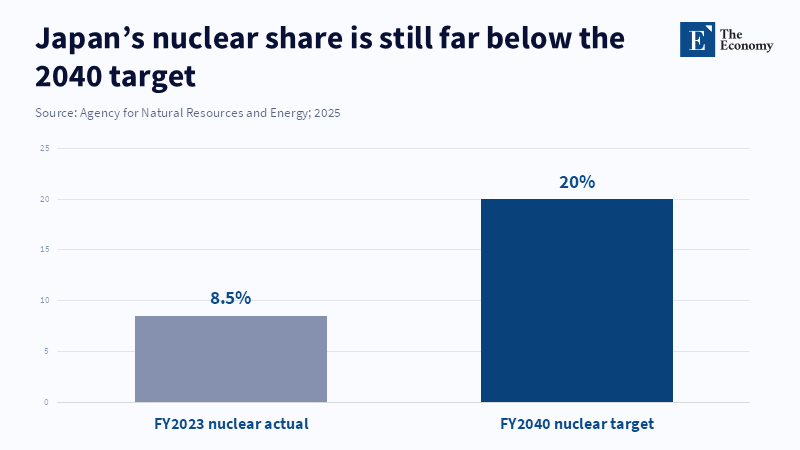
The argument for a nuclear revival can be justified. Japan is a notoriously resource-poor country in terms of fossil fuels and imports more than 90 percent of its crude oil needs from the Middle East. So, growing demand as a result of the expanded data center and chip plant activity, as well as the push towards electrification of transportation, creates a requirement for more baseload, low-carbon energy generation capacity. In theory, nuclear seems to be one of the most attractive options. Once the fuel is added to the core, it is domestic and once operational, it emits very low carbon emissions, allowing for stable generation. This is why the Seventh Strategic Energy Plan sets out a target for nuclear to supply 20 percent of the power generation portfolio by 2040. Unfortunately, apparently attractive are no match for the reality of the grid and in FY2023, nuclear can contribute no more than 8.5 percent of Japan's energy generation. Jan 25, though and only 14 reactors are operational in Japan, 24 are to be decommissioned and 10 have not yet applied for evaluation. The final admission is made by the government itself, highlighting that even coming out of Fukushima over ten years ago, people are not yet fully free of the concerns and resentment that surrounded the accident and nuclear power for many years following. This is not a call from activists but one for understanding why the government's plans are progressing so slowly.
The overriding issue at this point is the perceived feasibility of delivering what is wanted. Even if a reactor has gained regulatory approval, the resumption depends on local consensus, evacuation planning, proven utility reliability and the potential for political or legal delays. Kashiwazaki-Kariwa provides a glaring example, given its strategic significance to the greater Tokyo region. Although the local minds are preoccupied with fears and safety concerns, the resumption process has been brought to a halt on a number of occasions. By late 2025, a survey showed that 60.0 percent of residents of Niigata Prefecture did not believe the plant had fulfilled the safety criteria for a restart and nearly 70.0 percent of respondents expressed concerns about a TEPCO-operated facility. This is the fundamental flaw in Japan's energy policy; no one lacks the desire for nuclear power to provide strategic stability, but the country's current energy infrastructure cannot and should not act as the immediate stabilizer that is ordered to be one. Japan enjoys plenty of oil supplies and a few weeks' supply of LNG, but these supplies cannot stall the inevitable in the absence of another source of sustainable power post-consumption.
Although the country does have fuel dependency issues and is reliant on nuclear power, there are some benefits for Japan that other countries do not have. Japan's oil reserves are better stocked than most and contrary to Europe, which had to reconstruct an entire energy system whilst during 2022 under war-driven fuel price volatility, Japan is not currently in the same position and does not have to rebuild an entirely new system. This advantage is significant as it allows time for Japan to prevent a brewing fuel crisis. Based on this situation, where, as a result of the situation, it does not face many of the problems the other countries do, I believe it is even more important that pragmatism should be the energy policy driver. When a country is some months away from running out of fuel, it should use time wisely and develop alternative energy sources that can be easily brought online at a later time. Reactors are not as adaptable to being restarted because they are a whole system; once they are on, they are off. We need to promote their re-inclusion, but public opinion cannot be mandated. They are focused on the immediate region and there is no incremental benefit to the region nations when a reactor begins operation. Japan's main vulnerability is not simply to a fuel deficit or crisis in the country, but also to becoming complacent. Policymakers who mark the nuclear industry's tale as running faster or slower than it actually is are more likely to neglect to prepare all key technologies for an eventual seamless transition during times of strain.
Japan's Energy Security is now at risk for Summer Cooling, Health and Tourism
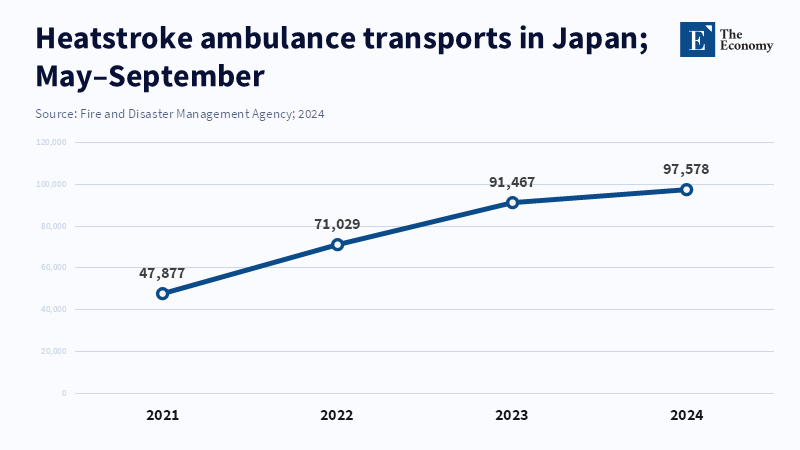
This is where the summer problem becomes even more relevant. Energy shortages are usually seen as the old stand-by comfort issue in policy circles, but they are very real when it comes to the health care system in modern Japan. Ambulance responses to heat stroke victims increase year after year, with 97,578 calls coming in from May to September of 20204, the highest ever. The Japanese Ministry of the Environment has announced both heatstroke alerts and specific heatstroke alerts and the latter was launched on April 22, 20055. This is not a physical action, like turning on a warning light, but it suggests that heat is now a central component of disaster response planning. This is very important information for not just the elderly and the young, but anyone concerned about how hot the classrooms are, or how they are going to cool off the hospital during the rush of a busy summer, especially if you care about the health of the elderly and the young. By the summer of 2040, this will be the only thing that has anyone else worried. Key to the summer problem is not whether or not Japan will hit its 2040 nuclear targets, but whether or not there will be enough cheap, easily accessible electricity to go around. Before we have a formal shortage, both the high cost of fuel, demands for voluntary power saving and worries about blackouts may compel institutions and households to cut the power and drive up the health hazards for the elderly and the young.
There is one more reason that this topic is so important: the political context of power in Japan. Calls to reduce power use in the winter are popular; most people can live with a few days of mild discomfort. However, in the height of summer and particularly in our most population-dense city areas, it is much more difficult to do this. Offices could cut hours, shops could turn down the lights and schools could move classes to the internet for a time. But it is extremely difficult to do this for hospitals, nursing homes, train lines, airports, hotels and homes with elderly or ill citizens. This is why the misconstruing of energy policy can be so dangerous. When those in charge of energy security position our summer power problem as something to be solved by nuclear/solar/wind in the future, they misplace people's thoughts on near-term solutions that could be of use this summer, such as direct cooling subsidies, demand response programs with peak-price adjustments, hospital backup power systems and summer heat action plans that connect power policy to public health. And in the next two to five years, it will not be the imagined solutions included in a 2040 road map that determine Japan's energy security, but those that will guarantee that our power system is reliable, affordable and nimble, beginning today.
The other reason it is true is for a second reason. The need to change power politics through the increasing use of heating. The population will accept energy use limitations in the winter for a few days, but the social marginal utility of demand restraint can only endure for a few summer days. For those mega cities, the limits on asking the people to do more are worse than in winter: schools can provide online or off-peak lectures, offices can turn partial operations or shut down, but public transport, hospitals, nursing homes and older community dwellers will not be able to afford to use less power and for these reasons, the wrong energy future narrative can be dangerously misplaced. If leaders see urban summer resilience only as a future nuclear solution, then the focus on practical alternatives linked to this seasonal-targeted cooling subsidies, more realistic consumer pricing signals for flexible demand, more intelligent, mobile distributed power sources and backup for key users (handle this is the UK electric story) and an urban heat plan tied to public health will disappear. The key moment for energy security in the country will not be the top load on this set of summer days, but the charts of a 2040 power mix.
A similar argument applies to the tourism problem from an economic point of view. With a record 42,683,600 foreign visitors expected in 2025, security of power in the summer months can no longer be seen simply as ensuring the comfort of residences or even the industrial plants. It becomes part of the country's service export infrastructure. Although its users would not be aware of the generation mixes, tourists will expect reliable train service, comfortable hotels, smooth airport and retail operations, as well as urban amenities, safety and comfort. The country can bypass collapse, yet still have a challenging summer season if the hotels, the tourism industry, or the government agencies themselves elevate prices, request voluntary restrictions, limit working hours, or else the local transport infrastructure becomes more heavily loaded or correspondingly more costly, in order to protect their own air conditioning requirements. This is where the focus on nuclear becomes distorting: while a new reactor could seem to imply strategic stability, it could actually take years to be completed and until then, the short-term demand for thermal backup, LNG supply, grid balancing and demand response is only greater. Indeed, Japan's energy security is being decided not in the technical design of the future system, but in the very prosaic realities of the current system and its summer demands.
Energy security requires a tangible strategy after the mirage is gone: a post-mirage energy blueprint
The first step toward a credible plan begins with clarity around numbers. The official OCCTO outlook projects at least 11 percent reserve margins over all regions and months in FY2025 and FY20026-which is reassuring but does not provide an assured safety cushion- Institute of Energy Economics, Japan specialist Kenichi Onishi estimates that in a pathway of worstcase weather, simultaneous grid disruption and equipment failure, the best case in August 2026, Tokyo Electric Power Co's network reserve margin could be 0.9 percent Both scenarios are conceivable given different assumptions about stress on the grid and certain equipment availability. That gap underscores that it is time for a policy conversation that is more complex than simply a nuclear 'yes' or 'no.' Japan should continue to safely restart regulated, locally supported reactors that can operate while maintaining sufficient evacuation capacity, but it should stop portraying nuclear power as the magical solution to looming immediate geostrategic risks. The more urgent policy goals are securing flexible LNG supplies; building up storage; getting batteries out quickly; improving demand response; allowing interregional use of the grid at higher levels; implementing broader, more aggressive building energy efficiency standards; and developing robust heat emergency plans that treat cooling needs as critical infrastructure. Such plans will deliver concrete, actual resources to school systems, hospitals, universities and local communities before 2040.
Detractors can present this argument as undervaluing the importance of having stable, low-carbon electricity. Indeed, nuclear power remains an important component and Japan cannot achieve its climate ambitions without a proportion of its power coming from nuclear; and it is right to reject nuclear/renewables as mutually exclusive. But it is this argument that points in the opposite direction to that discussed above; what Japan is drastically underestimating is the expense of relying on a lingering long-term solution, contingent upon public confidence that is nowhere near complete. Reliable electricity security is not created through any single "hero"technology, but from multiple redundancies – modest and pragmatic nuclear, bold renewable targets, reliable existing thermal plant in the transition period and markedly greater demand-side efficiency, particularly in the summer cooling months. While it may help the population if the government reassures them that nuclear power will be able to guarantee security in the short term, building a comprehensive safety net will prove far more beneficial. "Energy security" will have to be redefined away from a focus on restoring one factor into the ability to safeguard people's everyday existence from stress.
So, the 0.9 figure still matters. It doesn't mark an unavoidable spiral of decline but a visible divergence between intention and reality and operational vulnerability. Japan's leaders are right to fear geopolitical shocks and to seek greater resilience. They are right to see nuclear as one element in a more sustainable energy future. But they threaten to pay a stiff price if they mistake a long-term approach for an urgent one. The response is straightforward: Keep undoing the war damage to the existing nuclear fleet, just keeping safety, local support and emergency evacuation coverage in mind. The job of immediate security remains: ramp up grid stabilization, energy storage, energy-efficient buildings, resilient LNG supply chains, reasonable heat roadmaps, capable state and local service agencies and inspired public institutions that rise to the challenge without panicking. While this approach won't make a heroic story, it stands to make homes cool, buses and trains run, hospitals stay open, schools stay cool, tourists keep coming and the lights stay on when the next earthquake hits.
The views expressed in this article are those of the author(s) and do not necessarily reflect the official position of The Economy or its affiliates.
References
Agency for Natural Resources and Energy (2025a) 10 Questions for Understanding the Current Energy Situation. Tokyo: Ministry of Economy, Trade and Industry.
Agency for Natural Resources and Energy (2025b) The 7th Strategic Energy Plan. Tokyo: Ministry of Economy, Trade and Industry.
EAF editors (2026) ‘The price of Japan’s post-3/11 nuclear mirage’, East Asia Forum, 20 April.
Fire and Disaster Management Agency (2024) Reiwa 6 Nen (5 Gatsu–9 Gatsu) no Netchusho ni Yoru Kyukyu Hanso Jokyo [Heatstroke emergency transportation situation, May–September 2024]. Tokyo: Fire and Disaster Management Agency.
Govella, K. and Nakano, J. (2026) ‘What Are the Implications of the Iran Conflict for Japan?’, CSIS Commentary, 20 March. Washington, DC: Center for Strategic and International Studies.
Japan National Tourism Organization (2026) Homon Gaikyaku Su (2025 Nen 12 Gatsu Suikeichi): 2025 Nen Kei 42,683,600 Nin, Nenkande 42 Million Nin o Toppa shi Kako Saikō [Estimated visitor arrivals to Japan, December 2025 estimate]. Tokyo: Japan National Tourism Organization.
Komiya, K., Obayashi, Y. and Golubkova, K. (2025) ‘Japan prepares to restart world’s biggest nuclear plant, 15 years after Fukushima’, Reuters, 22 December.
Koppenborg, F. (2026) ‘Japan’s nuclear revival is more wishful thinking than reality’, East Asia Forum, 19 April.
Ministry of the Environment, Japan (2026) Heat Illness Prevention Information: Heat Stroke Alert. Tokyo: Ministry of the Environment.
Onishi, K. (2026) Challenges for Japan’s Electricity Policy in 2026: Securing Long-Term Power Supply in the Face of Increasing Electricity Demand (Presentation Materials). Tokyo: The Institute of Energy Economics, Japan.
Organization for Cross-regional Coordination of Transmission Operators, Japan (2025) Aggregation of Electricity Supply Plans for Fiscal Year 2025. Tokyo: OCCTO.
Ranking News Editor (2026a) ‘Beyond the Numbers: Interpreting Rankings in Complex Institutional Environments’, Ranking News, 16 March.
Ranking News Editor (2026b) ‘National Competitiveness Indices and Their Role in Economic Policy Reform’, Ranking News, 16 March.
Ranking News Editor (2026c) ‘Transparency and Accountability in the Rankings Industry’, Ranking News, 16 March.
Ryall, J. (2026) ‘Japan warned of “hellish summer” as energy fears mount’, South China Morning Post, 18 April.
Working across research, policy, and data-driven analysis, the Editorial Board ensures that published pieces reflect a consistent institutional perspective grounded in quantitative reasoning and long-term structural assessment.