To Cut Aviation Emissions, Open the Right Markets and Regulate the Right Costs

Working across research, policy, and data-driven analysis, the Editorial Board ensures that published pieces reflect a consistent institutional perspective grounded in quantitative reasoning and long-term structural assessment.
Authored On
Modified
Aviation emissions are also a route-efficiency problem, not only a fuel problem
Liberalisation can cut emissions per passenger, but it can increase total demand
The best policy combines open routes with strict carbon rules
Almost 50% of all aircraft CO2 emissions made since 1940 have been after 2000, the figure this discussion should be based on. It indicates that aviation emissions are not a byproduct and that time is of the essence. The industry cannot await a perfect fuel, a perfect plane, or a perfect global deal and if these exist, they are not appearing quickly enough. The easiest improvements are to be made to route planning, airspace management and market access. New research shows that airlines burn less per passenger when their networks allow for more direct routing and improved aircraft running time. And importantly, it shows that simply opening markets on its own does not cut emissions; the more ease of access created by markets results in more travel. So the policy choice is not between liberalization and climate change, but between reform and activation. Governments should tear down the framework that keeps inefficiency alive and ensure that those policies that reflect the true costs of carbon are maintained.
Aviation emissions are now a network problem
Even though CO 2 from aviation is small by comparison with that from other sectors worldwide, it is also derived from a sector one of the hardest to find alternatives for 4. Globally, 2023 saw aviation accounting for around 2.5% of worldwide energy-related CO2 emissions and an output of just under 950 million tonnes, almost 90% of pre-COVID levels. It is similarly impressive in Europe, accounting for 3.8%,4% of all greenhouse gases in 2022, or 14% of total transport emissions. These are not dry figures. They constitute a powerful policy dilemma: how can governments obtain emissions savings in a sector that, by its very nature, is expected to grow? And without turning mobility into a luxury?
This is where tech comes in. More efficient engines, cleaner fuels, new aircraft designs– all this counts. But the time factor is crucial. Fuel systems take time to evolve and fleets take time to replace older, equivalent ones. But route structure and market regulation evolve quickly. Hence, the importance of the recent results: a study on 27.5million flights in 2023 showed substantial efficiencies across routes, carriers, airports and aircraft in a 2026 projection. An implementation of what the study describes as current observed optimal route operations would bring 10.7% reduction of total emissions without a reduction of transport capacity. It's significant because it proves that a significant share of aviation CO2 emissions is accounted for by sub-optimal flight routes, aircraft and load factor matches.
This conceptual shift is crucial. This is not merely a fuel dilemma for aviation; it's a network dilemma. Most governments continue to view aviation policy through an existing prism of competition, airline protection and the preservation of bilateral agreements. Climate policy asks a fundamental question: Does this network and its current configuration transport people along the shortest, least wasteful path? Or does it coerce travelers into longer flight routes, multiple intermediate destinations and over dense, integrated fleets? This is a practical, tangible and verifiable challenge and it imposes limitations on the decisions of present-day policy makers. Such a distinction is subtle, but decisive and it is where reform should be directed. While this applies to the race for technological solutions, the first aviation-related mitigations might not necessarily involve new equipment; it might be simply addressing the wasteful inefficiencies intrinsic to today's operations.
Aviation emissions fall per passenger when markets open
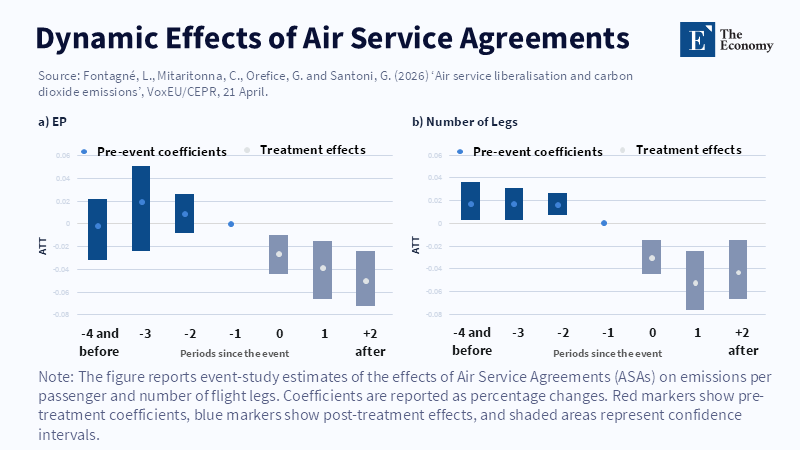
This is the aspect of liberalization that warrants some serious thought. Looking at air service agreements, liberalization appears to result in more optimal airline route structures. In lines between liberalized nations, flows of passengers increased by 12.7%, the average flight path time and length dropped by 1.4% and the number of flight legs by 3.9% between 2012 and 2019, lowering emissions per passenger accordingly. Identifying what caused this was not difficult: direct routes omitted inefficiencies caused by additional landings and takeoffs, by inefficient hub / spoke systems and by employing newer generation aircraft on well-established markets with significant demand. Even more dramatically, total emissions fell by 3% and 3% per passenger.
This is an important result because it suggests that some existing rules of the game reduce cleaner operation. Rules that serve to protect political interests by requiring longer circuits and needless halts are, environmentally, indefensible. Liberalized markets can help provide cleaner operations by promoting efficient routing systems and encouraging demand to switch to more efficient carriers. So, to the extent that existing evidence applies to the market conditions now prevailing, open markets can lead to aviation emission reductions that "just happen" by eliminating waste. The key insight of the new study is valid: as market access improves, cabin emissions must fall and routing patterns will be a real element of climate policy.
But this is just a reflection of the air travel market, not the number of flights overall. When these are considered, the picture appears very different. The increased cheapness and convenience of air travel increase demand. Data on the EU's external aviation policy shows price falls of between 6 and 23% and a 27% rise in demand, of which there was no effect on frequency. Other previous literature finds similar results, where liberalization, related rises in traffic are between 12 and 35% higher than expected. A model run between the US and UK predicted a rise of just under 29% in traffic with increased cheapness and direct routes. There is no doubt that this increases consumer benefits, but this will not necessarily translate into a decline in overall aviation emissions. Data from CEPR clearly and convincingly demonstrate that, with liberalization, there is a 4.0% increase in passengers with only a 1.7% increase in all emissions, a 2.3% reduction in emissions per passenger.
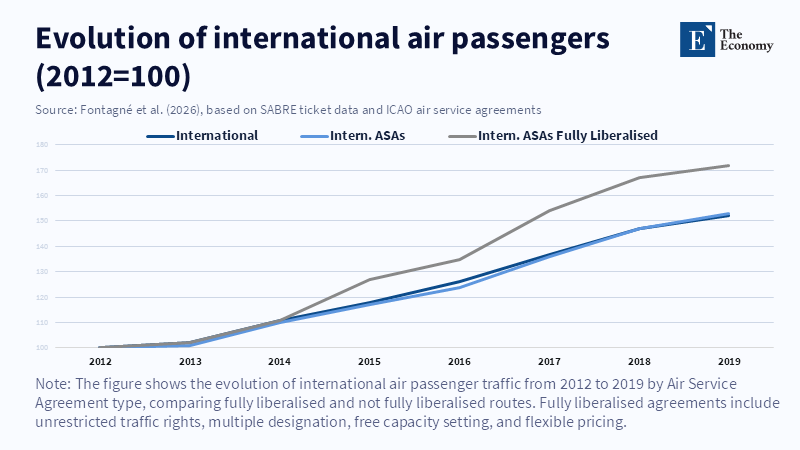
This fact appears to get largely lost in the mix. For every journey that becomes more efficient, the system becomes larger in scale. When these two are viewed together, the policy conclusions are clear. The climate targets are not to merely maintain redundant barriers but to achieve the efficiency benefits of more direct routes while still inhibiting cost reductions and encouraging unabated emissions growth. According to the authors, both sides of the market must be regulated: route structures in addition to a carbon tax.
Aviation emissions stay high when rules keep routes indirect
This leads us to the root of our problem: bad regulation, not regulation. A case study of Europe is revealing. EUROCONTROL found a horizontal en route inefficiency of 3.16% in 2024 as compared to the filed flight plan distance of 4.57%, of which more than half was due to cross-border barriers, not to weather or the planned flight path of aircraft. This is an important difference, as extra miles translate directly into more fuel burn and greater emissions. Moreover, research into airspace restrictions amid the Russia-Ukraine war showed 1% higher global aviation emissions from rerouting. This can be translated into 8.2 million tonnes of CO2 in one year.
So the agenda for a useful reform is not a broad appeal for more open skies. It is a more limited and more demanding one. It is about removing bilateral restrictions that prevent direct flights for political reasons. It is about reforming the slot system that rewards old access rights rather than short-haul efficiency. It is about looking afresh at the acrid landscape of fragmented airspace, not just a technical issue but one with the greatest climate implications. And it is about being honest with taxpayers who will pay for a system that does not work. When governments subsidize inefficient airlines or hang onto small political titbits, the major airlines can largely offset the cost when they can recover a financially inefficient business model. Smaller businesses, students, migrants and tourists pay higher prices and fares. The climate pays in carbon. A policy that universally favors short journeys, fully loaded aircraft and transparent assessment of carbon performance rather than 70 years of seniority is surely the right place to start.
Aviation emissions will fall only if open markets meet hard carbon rules
It is finally time to get to the part of the argument that should now be clear. It is not proper regulation preventing efficiency; it is the absence of proper regulation. The optimum is not a scenario of totally liberalized skies or one where all regulations are outdated. It is one of the free market access in areas where opening to the free market decreases inefficiencies and strict environmental standards, where free markets have no clue how to account for carbon emissions. This is where the European Union seems to be heading. By cutting down the free allocation of aviation allowances from the updated EU ETS by 25% in 2024 and by 50% in 2025 and expanding towards full auctioning in 2026, it will really give more incentives towards reducing emissions. ReFuelEU Aviation will seek a 2% share of sustainable aviation fuels at airports in the European Union by 2025, with a scale-up to 70% in 2050, including distinct goals for synthetic fuels. These reforms will matter as they soon will generate the missing incentive that liberalization cannot create alone; the cost of carbon will again matter for airline decisions.
This is the sort of carbon cost signal that will fill in the missing part of the policy mix. Further market opening should be accompanied by ongoing encouragement to pick the cleanest items available: cleaner fuels, the latest aircraft, higher loaded cabins and shorter routes. Without that stimulus, what cheaper costs offer is simply more activity. Some people will protest that more severe carbon regimes drive up prices and reduce the connectivity of some customers. That is quite possible, but it should not be the justification for keeping carbon costs low and ignoring the eventual bill. If income is recycled wisely, thin routes that are needed can be defended and a chunk of revenue can be diverted into modernizing air traffic management systems, cleaner airport infrastructure and finding cleaner fuels; otherwise, the very opening up that is urgently needed risks driving unnecessary expansion.
Another approach would be legal reform. International aviation has an extensive record of disconnects between rules and enforcement. Jae Woon Lee's recent study of over 600 publicly available air services agreements (ASAs) provides evidence that it need not be so. International Civil Aviation Organization standards are frequently non-binding, but the threat of withdrawal of market access in response to breaches of certain conditions makes bilateral ASAs bite. This plays a critical role in mitigating aviation emissions. Future bilateral ASAs in international aviation should go beyond bearing simple lip service to environmental issues and should explicitly tie operating privileges not only to transparent reporting and non-discriminatory carbon regulations, but also to hard performance promises (assurances to which a government can hold another accountable).
And finally, the last lesson: If markets will not necessarily bring aviation emissions down and state protection will not necessarily bring emissions down, how do we bring down aviation emissions? Three approaches have to be tackled at the same time by states: bring down unnecessary mileage, encourage the efficient carriers and contextualize the cost of carbon. It makes more sense to think about it this way. The goal is not to proudly defend liberalization as a dogma but rather to seek the advantages brought about by liberalization, where it is possible, while making inefficient carriers pay for their inefficiency. For the transportation ministries, airport administrators, competition authorities and environmental authorities, this will have a different meaning, since they are each controlling parts of this waste problem. Good coordination of actions may be able to achieve lower fares, more efficient routes and lower emissions without one happening at the expense of the other.
The views expressed in this article are those of the author(s) and do not necessarily reflect the official position of The Economy or its affiliates.
References
Abate, M. and Christidis, P. (2020) ‘The impact of air transport market liberalization: evidence from EU’s external aviation policy’, Economics of Transportation, 22, 100164.
Dannet, G., Bellouin, N. and Boucher, O. (2025) ‘Airspace restrictions due to conflicts increased global aviation’s carbon dioxide emissions in 2023’, Communications Earth & Environment, 6, 52.
European Commission (2024) Reducing emissions from aviation. Brussels: European Commission.
European Commission (2024) ReFuelEU Aviation. Brussels: European Commission.
European Union Aviation Safety Agency, European Environment Agency and EUROCONTROL (2025) European Aviation Environmental Report 2025. Cologne: European Union Aviation Safety Agency.
EUROCONTROL Performance Review Commission (2025) Performance Review Report 2024. Brussels: EUROCONTROL.
Fontagné, L., Mitaritonna, C., Orefice, G. and Santoni, G. (2026) ‘Air service liberalisation and carbon dioxide emissions’, VoxEU/CEPR, 21 April.
Fontagné, L., Mitaritonna, C., Orefice, G. and Santoni, G. (2026) Air Service Agreements, Connectivity and Emissions. CEPII Working Paper No. 2026-04. Paris: CEPII.
Gössling, S., Klöwer, M., Leitão, J.C., Hirsch, S., Brockhagen, D. and Humpe, A. (2026) ‘Large carbon dioxide emissions avoidance potential in improved commercial air transport efficiency’, Communications Earth & Environment, 7, 13.
International Energy Agency (2025) Aviation. Paris: International Energy Agency.
InterVISTAS-ga² and International Air Transport Association (2006) The Economic Impacts of Air Service Liberalization. Montreal and Geneva: InterVISTAS-ga² and IATA.
Lee, J.W. (2026) ‘Regulating carbon emissions from international aviation through air services agreements: lessons from aviation safety enforcement’, Leiden Journal of International Law, 39(1), pp. 199–223.
Working across research, policy, and data-driven analysis, the Editorial Board ensures that published pieces reflect a consistent institutional perspective grounded in quantitative reasoning and long-term structural assessment.