Global Labour Supply After 2000: Competition, Skills, and the New Work Divide

Working across research, policy, and data-driven analysis, the Editorial Board ensures that published pieces reflect a consistent institutional perspective grounded in quantitative reasoning and long-term structural assessment.
Authored On
Modified
Global labour supply is now a measure of competitive strength
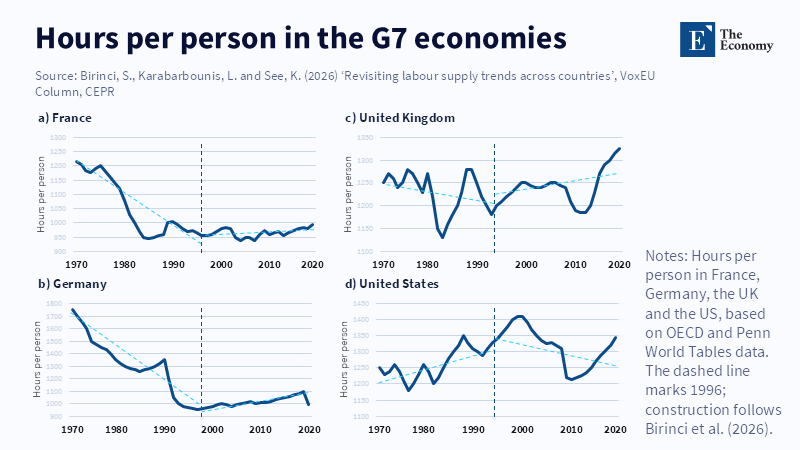
The US and UK rebounded faster than France and Germany after 2010
France and Germany risk falling behind if skills, participation, and effective labour input rise too slowly

By the late 2010s, about half of the hours gap that had emerged between the US and the rest of the advanced economies over the 1990s had been repaired. At face value, this fact alone shifts the focus of our interpretation of the last quarter-century of labor market evolution. The question that we had used to probe the US's divergence with other rich countries was why it was pulling ahead on hours; the question that we must now address is why this collective upward trend in global hours stalled. From 2000 onward, companies confront stiffer price competition, more rapid technological development, closer international benchmark comparisons and more direct exposure to foreign competitors. Then, labor supply was more a matter of existential social choice, more a representation of social values; subsequently, it became a gauge of competitive assertiveness. The economies that preserved the motivation and ability to keep most of their working-age population in the labor force, enhance skill endowments and adapt firms to be more productive, achieved greater success; those that could not slip behind. The true 'divide' of the 2010s was between those economies still able to leverage enough labor and those that exhausted institutional or social limitations in response to an environmental challenge.
Global labor supply became a competitive indicator rather than only a social statement
This new cross-national literature on labor supply offers us one really essential insight: the old U.S. edge is not the good benchmark it used to be. This finding is critical because it has implications for labor supply policy. We formerly regarded stable or declining hours as a byproduct of how rich we had become, of aging, or of individual volition. Those sources definitely still exist. But they cannot, by themselves, fully explain the last twenty years. Post 2000, with intensifying international competition, the period trend in global hours became a signal of exactly what kind of economies could still draw productive labor inputs from their population and which could not. The economies that succeeded in reconstructing or maintaining inputs were not always the hardest working. Quite frequently, the economies that balanced demands for their sophisticated workforces with human capital enhancement and firm organization did best. The upheaval of the global competition environment in the 2000s turned out to be a test of an economy's capacity for labor supply, too.
This revision has important implications for the understanding of labor supply. The 2010s constituted a dynamic and transformative decade, marked by significant structural changes and heightened complexity in global labor markets. It was the era of digital scale, fierce supply, chain rivalry, significant import share increases in tradable industries and intensifying investor oversight. This, in turn, shrank firms' room for hiding excess slack in their organizations. Instead, firms needed to drive up output with the same workforce and, at the same time, subject existing workers to more effective redeployment. For resilient labor markets, this meant bringing more employees into the fold and drawing more out of them – through concerted effort from domestic firms and employees and a robust, adapting labor market. For less responsive markets, this meant stagnation or depressed underemployment among working-age employees, or a shift into less sophisticated jobs. The result, as Birinci, Karabarbounis and See (2026) show, is not a total global surge in hours, but a clean split: among those systems in which supply responded to a difficult environment with increased mobilization and those in which a hesitant response led to sluggishness.
The key to this story was the centrality of adult skills. According to the new OECD study, based on recent PIAAC reporting, a highly significant positive association exists between the status of adult skills and labor productivity and in the hypothetical case of engaging all OECD economies at the level of average skills embodied by the top three performers, the overall OECD average would surge by some 18 percent. To us, this is not a marginal observation: the advantage of richer, in-skilled economies is not only in raw output per hour, but also in their ability to maintain labor supply in the face of external challenges, thanks to higher productivity, more fitting jobs and smoother worker mobility. Thus, the way ahead must change. The 2010s labor supply growth was not a merely reflexive one, an automatic result of tax,benefit,system adjustments, or societal shifts. It was also an earned growth, an outcome of the fact that some economies could sustain world-class competitiveness, gained high skills, built stronger firms and did more to mobilize their labor forces. The world was not simply more productive at the end of the 2010s, but also more ready to deploy that activity in the form of employment.
In this regard, Anglo-American labor supply rebounded
US reemployment rates are revealing in this respect. The UK announced an increase in the 16–64 employment rate from 70.4 percent in 2010 to 76.1 percent in 2019, a performance in which both firms and individual adults eagerly participated. This is by no means insignificant. Britain achieved such an improvement in under nine years, not by adding hours, but by enlarging the share of working-age adults in paid employment, during a period of aggressive corporate effort to enhance its digital reach, pursuit of global scale and efficiency and removal of redundant structures. At the same time, the overall economy's capacity to absorb the additional labor extended the reach of its potential reactants without necessarily extending hours. The same story can be observed in the US, where the employment-to-population ratio was 58.5 percent in March 2010 and 61.1 percent in December 2019, before the disruptions of the pandemic. Though these figures suggest some rebound, they do not signal a rebirth of the prior American dominance of hours worked per capita. Furthermore, the OECD's recent statistical estimate of the labor force participation rate in the US in 15,64 in mid,2023 exceeded the pre-pandemic share by a narrow margin. The US had not achieved anything close to its legendary will,power,driven, steep hours application rate; instead, the post-2000 decline had finally bottomed out. The 2010s may have been a temporary reversal of the trend, but in doing so, it proved that global hours could be heightened when conditions worked in favor of the demand side.
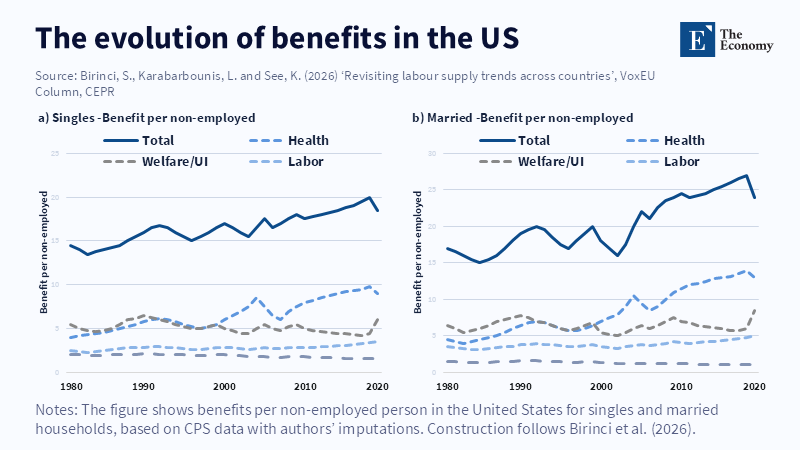
The success of Anglo-American labor supply was not only the magnitude of participation increase, but the eagerness and acumen of individuals and firms to adapt and adapt fast, despite average operating environments that are more responsive and susceptible to more drastic reconfiguration than their European counterparts. Those circumstances can have the dark outcome of higher job insecurity, compromised pay,bargaining leverage, or more frequent hyper-investment burnout, but they are crucial to our understanding of speed. In a hyper-competitive world, this facilitated a superior post-crisis global labor supply rebound in the US and the UK than in other economies in the 2010s. Thus, the lesson is not that other economies should copy the Anglo-American strategy, but that they too can promote higher mobility, labor force participation, rates of success for individuals and sectors, switching odds when they develop systems that are able to respond rapidly to robust demand on the one hand and global competitive pressures on the other.
France and Germany show the limits of global labor supply
France and Germany complicate the Anglo-American story; they do not overturn it. They demonstrate what is likely to happen when economies are productive, institutions are strong and stable, but the dynamics of global competition fail to produce an unambiguously stronger story of effective labor availability. There was a steady rise in employment in France, and the slope of hours per person was, in general, far flatter than in the UK or US, rebounding after 2010. But that does not imply that France failed. Slow adjustment, sluggishness and a steady constriction by social and institutional limits in a less competitive world might have been enough. Slow mobilization of labor, then, would be a strategic structural weakness when firm benchmarking in global competition becomes ever more brutally punishing.
Germany is a tougher case, but it needs to be presented carefully. Its performance was better than France's, so the point is no longer that Germany failed to bring people into work; instead, it is now evident that Germany's approach exported work more broadly, but not to the same extent of intensity. The broad employment, not long enough hours for a year and a quite big part-time workforce established a form of broad but limited working power. This supported social balance but cannot provide firms that faced fiercer global competition with enough effective working power. Germany's problem is not labor,market failure: it is a cap on the usable working power at the exact time aging, industrial pressure, and skills shortage were calling for more.
This difference is important for the point about strategy. The UK and US illustrated how a labor supply restriction can be reversed if demand, flexibility and firm adjustment all rise in unison. France and Germany demonstrated that advanced economies can be highly productive and orderly without responding quickly enough to competitive pressures. In the case of France, the participation challenge is clear. For Germany, it is hours, intensity. The strategic risk for both is that if effective labor supply increases at too slow a pace, productivity will have to shoulder an enlarged load. This is a dangerous proposition at a time when other economies are improving skills, opening up participation and reorganizing work.
The lesson of the 2010s, therefore, goes more to the heart than a call for more work. Global labor supply has emerged as a central channel through which advanced economies demonstrate their competitive postures. The UK and US proved that during strong demand, labor deployment can be revitalized and institutions can adapt swiftly. France and Germany showed that relatively sluggish or slow responses can protect the social model but also make economies vulnerable in the long term. The coming decade will be more unforgiving. Aging will attrit the easy-to-use reserve. Digital rivalry will expand the premium on flexible skills. Firms will judge price, output, and labor manageability across jurisdictional frontiers with even more zest. If France and Germany cannot upgrade their effective supply through better skills, broader inclusion, and more discerning work management, then they will not merely deprive themselves of hours. They will cede space to more aggressive rivals to drive the next wave of productivity. The policy choice is no longer between reasonable work and competitive work. It is whether advanced economies will develop labor systems that can reliably produce both.
The views expressed in this article are those of the author(s) and do not necessarily reflect the official position of The Economy or its affiliates.
References
Acemoglu, D. and Restrepo, P. (2020) ‘Robots and jobs: Evidence from US labor markets’, Journal of Political Economy, 128(6), pp. 2188–2244.
Andrews, D., Égert, B. and de La Maisonneuve, C. (2025) ‘Adult skills and productivity: New evidence from PIAAC 2023’, VoxEU, 15 July.
Autor, D.H., Dorn, D. and Hanson, G.H. (2013) ‘The China syndrome: Local labor market effects of import competition in the United States’, American Economic Review, 103(6), pp. 2121–2168.
Bick, A., Brüggemann, B. and Fuchs-Schündeln, N. (2019) ‘Hours worked in Europe and the United States: New data, new answers’, Scandinavian Journal of Economics, 121(4), pp. 1381–1416.
Birinci, S., Karabarbounis, L. and See, K. (2026) ‘Revisiting labour supply trends across countries’, VoxEU, 20 April.
Birinci, S., Karabarbounis, L. and See, K. (2026) ‘Why do Americans no longer work so much more than non-Americans?’, NBER Working Paper, No. 35020.
Boppart, T. and Krusell, P. (2020) ‘Labor supply in the past, present, and future: A balanced-growth perspective’, Journal of Political Economy, 128(1), pp. 118–157.
Bureau of Labor Statistics (2026) ‘Employment-population ratio’, Current Population Survey. Washington, DC: U.S. Bureau of Labor Statistics.
Eurostat (2025) ‘Part-time and full-time employment — statistics’, Statistics Explained. Luxembourg: Eurostat.
Feenstra, R.C., Inklaar, R. and Timmer, M.P. (2015) ‘The next generation of the Penn World Table’, American Economic Review, 105(10), pp. 3150–3182.
McDaniel, C. (2011) ‘Forces shaping hours worked in the OECD, 1960–2004’, American Economic Journal: Macroeconomics, 3(4), pp. 27–52.
OECD (2024) ‘Adult skills and productivity: New evidence from PIAAC 2023’, OECD Policy Briefs, No. 11. Paris: OECD Publishing.
OECD (2025) OECD Compendium of Productivity Indicators 2025. Paris: OECD Publishing.
Office for National Statistics (2026) ‘Employment rate: Aged 16 to 64, seasonally adjusted’, Labour Market Statistics Time Series. Newport: Office for National Statistics.
Ohanian, L., Raffo, A. and Rogerson, R. (2008) ‘Long-term changes in labor supply and taxes: Evidence from OECD countries, 1956–2004’, Journal of Monetary Economics, 55(8), pp. 1353–1362.
Prescott, E.C. (2004) ‘Why do Americans work so much more than Europeans?’, Federal Reserve Bank of Minneapolis Quarterly Review, 28(1), pp. 2–13.
Ranking News Editor (2026) ‘National competitiveness indices and their role in economic policy reform’, Ranking News, 16 March.
Rogerson, R. (2006) ‘Understanding differences in hours worked’, Review of Economic Dynamics, 9(3), pp. 365–409.
Working across research, policy, and data-driven analysis, the Editorial Board ensures that published pieces reflect a consistent institutional perspective grounded in quantitative reasoning and long-term structural assessment.